
Acne is one of those skin problems that can feel frustratingly unpredictable. You may have a carefully planned skin care routine, wash your face regularly, and avoid picking at blemishes, yet new pimples still seem to appear.
Learn more about Acne: Causes, Types, Treatments & How to Get Clearer Skin
While topical treatments such as benzoyl peroxide, salicylic acid, adapalene, and azelaic acid remain some of the most established acne treatments, nutrition can also play a supporting role. Certain vitamins and minerals are involved in inflammation, immune function, wound healing, oil production, and normal skin cell turnover — all processes that can influence acne.
View more information about Acne >
However, vitamins are not a magic cure for acne.
The American Academy of Dermatology notes that there currently isn’t enough evidence to recommend vitamins or other alternative therapies as standard acne treatments. Dermatologists generally recommend getting nutrients from a balanced diet unless a deficiency or other medical reason makes supplementation appropriate.
That said, research suggests that certain nutrients may be more interesting than others when it comes to acne.
Here are the vitamins and minerals worth knowing about.
Can Vitamins Really Help Acne?
Vitamins may help support healthier skin, particularly when someone is deficient in a particular nutrient.
Nutritional supplements may also influence several factors involved in acne, including:
inflammation
skin barrier function
immune responses
wound healing
oxidative stress
hormone metabolism
skin cell turnover
A 2023 systematic review examining oral nutraceuticals for acne found some evidence of potential benefits from vitamin D, vitamin B5, zinc, omega-3 fatty acids, probiotics, and several botanical ingredients. However, many of the studies were relatively small, so researchers emphasized the need for larger clinical trials.
In other words, think of nutrition as one part of an overall acne management strategy rather than a replacement for proven acne medication.
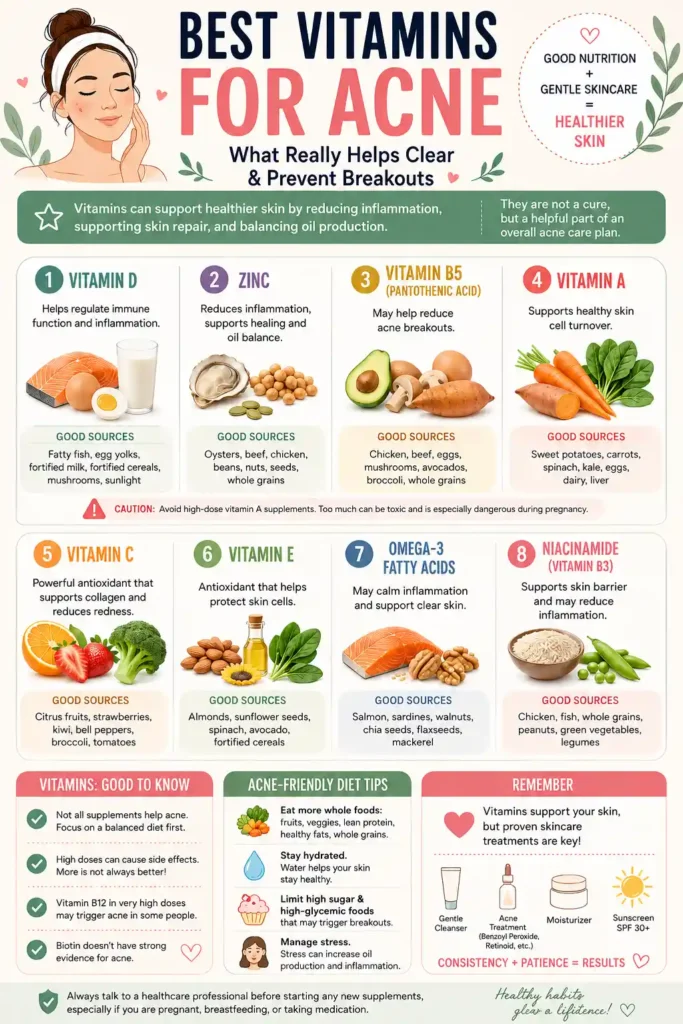
1. Vitamin D
Vitamin D may be one of the more interesting vitamins being studied for acne.
Vitamin D plays an important role in immune function and inflammatory regulation. Since inflammation is a major component of inflammatory acne, researchers have investigated whether vitamin D status may influence breakouts.
Some studies have found lower vitamin D levels among people with acne, although that doesn’t automatically mean low vitamin D causes acne.
Research included in a systematic review of oral acne supplements found that vitamin D supplementation showed potential benefits in some patients.
Food Sources of Vitamin D
Good sources include:
salmon
trout
tuna
egg yolks
fortified milk
fortified plant milks
fortified breakfast cereals
The American Academy of Dermatology recommends meeting nutritional needs through food whenever possible rather than automatically taking supplements.
Should You Take Vitamin D for Acne?
I wouldn’t recommend taking high doses simply because you have acne.
If you suspect you’re deficient, ask your healthcare provider about a blood test. Correcting an actual vitamin D deficiency makes much more sense than blindly adding large doses to your supplement routine.
2. Zinc
Technically zinc is a mineral rather than a vitamin, but it deserves a prominent place on this list.
Zinc contributes to:
immune function
wound healing
inflammatory regulation
normal skin function
It has also been studied extensively as a potential acne treatment.
A systematic review and meta-analysis found that people with acne tended to have lower serum zinc levels than control groups. Zinc treatment was also associated with improvements in inflammatory pimples, particularly papules.
Earlier research has suggested that zinc may have anti-inflammatory and antibacterial effects, although the overall quality of acne evidence has historically been inconsistent.
Foods High in Zinc
You can naturally get zinc from foods including:
oysters
beef
chicken
crab
beans
nuts
seeds
fortified cereals
Is a Zinc Supplement for Acne Worth Trying?
Possibly, particularly if your dietary intake is low or a healthcare professional identifies a deficiency.
However, more isn’t necessarily better.
High-dose zinc supplements can cause stomach problems and, when used excessively over time, may interfere with copper absorption.
The systematic review of nutraceutical acne treatments also noted gastrointestinal side effects among people taking zinc.
For that reason, I wouldn’t treat zinc like an unlimited acne supplement.
3. Vitamin B5
Vitamin B5, also known as pantothenic acid, appears frequently in supplements marketed for acne.
Pantothenic acid contributes to normal energy metabolism and is involved in the synthesis and breakdown of fats.
Several small clinical studies have explored whether supplemental vitamin B5 can reduce acne lesions.
A systematic review published in JAMA Dermatology found some fair- or good-quality evidence suggesting that vitamin B5 could potentially improve acne. However, researchers emphasized that the studies were small and more research is needed.
Natural Vitamin B5 Sources
Pantothenic acid is found in many everyday foods, including:
chicken
beef
eggs
mushrooms
potatoes
broccoli
whole grains
avocados
Because it is widely distributed in food, true vitamin B5 deficiency is uncommon.
What About High-Dose B5 Acne Supplements?
Some acne supplements contain extremely large quantities of pantothenic acid.
I’d be cautious with these.
The evidence isn’t strong enough to say that megadoses are necessary or appropriate for preventing acne, particularly over long periods.
4. Vitamin A
Vitamin A is closely connected with acne treatment — but there is an important distinction to understand.
Some of the most effective acne medications are retinoids, which are derivatives of vitamin A.
Examples include topical adapalene and prescription tretinoin. The powerful prescription acne drug isotretinoin is also related to vitamin A.
That doesn’t mean swallowing large quantities of ordinary vitamin A supplements will produce the same benefits.
It won’t.
Why Vitamin A Matters for Skin
Vitamin A contributes to:
normal skin cell development
immune function
skin maintenance
Foods containing vitamin A or provitamin A carotenoids include:
sweet potatoes
carrots
spinach
kale
eggs
dairy products
liver
Don’t Megadose Vitamin A for Acne
This is particularly important.
Too much preformed vitamin A can cause toxicity. The National Institutes of Health lists the adult upper intake level for preformed vitamin A at 3,000 micrograms RAE per day from food, beverages, and supplements unless vitamin A is being medically prescribed and monitored.
Excessive intake can cause symptoms including headaches, nausea, blurred vision, dizziness, and other serious health problems.
Vitamin A also requires particular caution during pregnancy because excessive amounts of preformed vitamin A can cause birth defects.
Never attempt to replicate prescription retinoid acne therapy with high-dose vitamin A supplements.
5. Vitamin C
Vitamin C may not directly eliminate acne, but it plays an important supporting role in healthy skin.
It is required for collagen production and functions as an antioxidant. It also contributes to normal immune function.
For acne-prone skin, vitamin C may be particularly interesting because acne can leave behind redness, discoloration, and scars.
Good Vitamin C Foods
Try including plenty of:
oranges
grapefruit
strawberries
kiwi
bell peppers
broccoli
tomatoes
The American Academy of Dermatology lists citrus fruits and peppers among useful dietary sources of vitamin C.
Vitamin C supplements aren’t generally considered a primary acne treatment, though.
If your diet already contains plenty of fruits and vegetables, additional vitamin C may not make your pimples disappear.
6. Vitamin E
Vitamin E is another antioxidant nutrient that contributes to normal immune function.
It is commonly marketed as a “skin vitamin,” but evidence supporting oral vitamin E supplements specifically for acne remains limited.
Food sources are generally a better approach.
Foods Rich in Vitamin E
These include:
almonds
sunflower seeds
sunflower oil
safflower oil
avocado
spinach
fortified cereals
The American Academy of Dermatology recommends obtaining nutrients such as vitamin E through a balanced diet whenever possible.
7. Omega-3 Fatty Acids
Omega-3 fatty acids aren’t vitamins, but they deserve mentioning because they may help influence inflammatory processes within the body.
Sources include:
salmon
sardines
mackerel
chia seeds
flaxseeds
walnuts
Research evaluating nutraceutical treatments for acne has identified omega-3 fatty acids as one of the interventions showing potential benefits in clinical studies.
Again, the research isn’t strong enough to say fish oil is an acne cure.
Adding omega-3-rich foods to an otherwise balanced diet, however, is a reasonable nutritional strategy for overall health.
8. Niacinamide — Vitamin B3
Niacinamide is a form of vitamin B3 that you may recognize from skin care products.
Topical niacinamide is commonly found in moisturizers and serums designed for oily, sensitive, or blemish-prone skin.
It may help support the skin barrier and reduce inflammation.
However, oral niacin or niacinamide supplements should not automatically be taken as acne treatments.
Extremely high supplemental doses of certain forms of vitamin B3 can cause side effects, so don’t assume that taking more will produce clearer skin.
For acne, topical niacinamide generally makes more sense than randomly taking high-dose oral vitamin B3.
What About Biotin?
Here’s where things become interesting.
Biotin is frequently promoted in supplements for “hair, skin and nails,” but it isn’t necessarily something I would reach for if acne is your primary concern.
There isn’t convincing evidence that biotin supplements improve acne.
The American Academy of Dermatology also warns that unnecessary supplements may have side effects, and biotin supplements can interfere with certain laboratory blood tests.
If you’re already eating a varied diet containing foods such as eggs, meat, fish, nuts, and seeds, you’re likely getting biotin naturally.
Can Vitamin B12 Make Acne Worse?
Potentially, in some people.
This is one of the most important things to know before buying an enormous “skin health” vitamin blend.
Vitamin B12 is essential for health and should absolutely be used when medically necessary. However, rare cases of acne-like eruptions have been reported following high-dose B12 supplementation.
A 2024 U.S. case report described an acneiform eruption developing following high-dose vitamin B12 treatment.
Previous case reports have documented similar reactions after oral or injected B12 supplementation.
That doesn’t mean vitamin B12 normally causes acne.
It does mean that if you suddenly develop an unusual outbreak after starting a high-dose B12 or B-complex supplement, mention the supplement to your dermatologist.
And if B12 has been prescribed because you are deficient, don’t stop medically necessary treatment without discussing it with your healthcare provider.
Can Vitamins Prevent Acne?
No vitamin can guarantee that you’ll never develop acne.
Acne is influenced by several factors, including:
hormones
genetics
excess oil production
clogged pores
inflammation
skin bacteria
certain medications
cosmetics and hair products
stress and lifestyle factors
Nutrition may influence some of these processes, but it is only one piece of the picture.
For most people, preventing acne requires a combination of gentle skin care and evidence-based acne ingredients.
The Most Effective Acne Prevention Routine
If supplements are only supporting players, what actually helps prevent pimples?
For mild acne, I would build a routine around proven topical ingredients.
Morning
Use:
A gentle facial cleanser.
Salicylic acid or benzoyl peroxide if appropriate.
A lightweight noncomedogenic moisturizer.
Broad-spectrum SPF 30 or higher sunscreen.
Evening
Use:
Gentle cleanser.
Adapalene or another acne treatment.
Noncomedogenic moisturizer.
The American Academy of Dermatology’s updated acne treatment guidelines include strong recommendations for topical benzoyl peroxide and retinoids, with additional recommendations for treatments including salicylic acid and azelaic acid.
These treatments have considerably stronger evidence than most vitamin supplements.
Vitamins vs Proven Acne Treatments
Option |
Evidence for Acne |
Best Use |
|---|---|---|
Zinc |
Moderate/potential benefit |
Supporting inflammatory acne treatment |
Vitamin D |
Emerging evidence |
Correcting deficiency; possible acne support |
Vitamin B5 |
Emerging evidence |
Possible supplemental acne support |
Vitamin A supplements |
Not recommended as DIY acne therapy |
Meet normal nutritional requirements |
Vitamin C |
Limited direct acne evidence |
General skin health |
Vitamin E |
Limited direct acne evidence |
General nutritional support |
Omega-3 |
Emerging evidence |
Dietary inflammatory support |
Biotin |
Little evidence |
Not recommended specifically for acne |
Vitamin B12 |
Not an acne treatment |
Treat diagnosed deficiency; high doses may rarely trigger acne-like eruptions |
Benzoyl peroxide |
Stronger evidence |
Mild-to-moderate acne |
Topical retinoids |
Stronger evidence |
Treating and preventing clogged pores and acne |
Salicylic acid |
Established topical option |
Clearing clogged pores |
Azelaic acid |
Established topical option |
Acne and post-acne discoloration |
Should You Take a Multivitamin for Acne?
Probably not solely because you have pimples.
A standard multivitamin may be useful for people who struggle to meet nutritional requirements, but taking one doesn’t automatically translate into clearer skin.
Check the label carefully too.
Some “beauty” supplements contain extremely high amounts of individual nutrients rather than normal daily values.
The American Academy of Dermatology points out that supplements sold in the United States don’t have to prove that they’re safe and effective before reaching consumers in the same way medications do. If supplementation is needed, it recommends discussing the dose with a healthcare professional and considering products independently verified by organizations such as USP or NSF.
Eat Your Vitamins First
For most healthy adults, my preferred approach would be to concentrate on food rather than an overflowing supplement cabinet.
A skin-friendly eating pattern might regularly include:
Breakfast
Eggs with avocado and whole-grain toast, plus berries.
Lunch
A large salad containing leafy greens, peppers, chicken, pumpkin seeds, and olive oil.
Snack
Greek yogurt with walnuts and berries.
Dinner
Salmon with sweet potato, broccoli, and leafy greens.
That gives you a natural mixture of vitamin A precursors, vitamin C, vitamin D, vitamin E, zinc, protein, antioxidants, and omega-3 fats.
No flashy “clear skin gummy” required.
When Should You Ask a Doctor About Vitamins and Acne?
Consider talking with your healthcare provider or board-certified dermatologist if:
your acne suddenly becomes severe
you’re developing painful cysts or nodules
your acne is leaving scars
over-the-counter treatments aren’t working
you suspect a nutritional deficiency
you’re considering high-dose supplements
you’re taking prescription medications
you develop acne after beginning a new supplement
you’re pregnant, breastfeeding, or trying to conceive
Acne affects up to 50 million Americans each year and can occur well beyond the teenage years. The American Academy of Dermatology notes that adult acne can persist into the 30s and 40s and is particularly common among women.
There is no reason to simply “put up with it” if your acne is persistent or affecting your confidence.
Frequently Asked Questions
1. What is the best vitamin for acne?
There isn’t one universally accepted “best acne vitamin.” Zinc, vitamin D, and vitamin B5 have some of the more interesting research, but none should be considered a substitute for established acne treatments.
2. What vitamin deficiency causes acne?
No single vitamin deficiency has been proven to directly cause ordinary acne. Some studies have found associations between acne and lower levels of nutrients such as zinc or vitamin D, but associations don’t prove that deficiency is the cause.
3. Does vitamin D clear acne?
Possibly in some people, particularly if they are deficient, but vitamin D isn’t currently considered a standard standalone acne treatment.
4. Is zinc good for acne?
Research is reasonably promising. A systematic review and meta-analysis found that zinc treatment reduced inflammatory papules in people with acne.
5. Does vitamin C prevent acne?
Vitamin C contributes to healthy skin, collagen formation, and antioxidant defenses, but there isn’t strong evidence that taking vitamin C supplements prevents acne.
6. Can multivitamins cause acne?
Occasionally, an ingredient within a supplement may trigger an acne-like eruption in susceptible people. High-dose vitamin B12 has been documented as a rare cause of acneiform eruptions.
7. Does biotin help acne?
There isn’t strong evidence that biotin supplements treat acne. Unless you have a reason to supplement biotin, getting it naturally through food is generally sufficient.
8. Should teenagers take vitamins for acne?
Teenagers shouldn’t routinely take high-dose vitamin supplements specifically for acne without discussing them with a pediatrician or dermatologist. Evidence-based topical acne treatments are generally a better starting point.
The Bottom Line
Vitamins can certainly play a role in maintaining healthy skin, but acne is too complicated to be solved by a single supplement.
If I were putting together an acne-friendly nutritional plan, I would focus first on a varied diet containing vegetables, fruit, whole grains, healthy fats, lean protein, fish, nuts, seeds, and other nutrient-rich foods.
Among individual nutrients, zinc, vitamin D, vitamin B5, and omega-3 fatty acids currently have some of the more promising research behind them. Even then, the evidence isn’t strong enough to recommend supplements to everyone with acne.
I’d be much more cautious about megadosing vitamins A, B6, B12, biotin, or any “clear skin” supplement containing huge quantities of nutrients.
For actually treating and preventing acne, proven ingredients such as benzoyl peroxide, topical retinoids, salicylic acid, and azelaic acid remain better-supported options.
The best strategy is usually a combination of sensible nutrition, gentle skin care, appropriate acne treatments, and professional advice if breakouts are persistent, painful, or causing scars.
Resources
American Academy of Dermatology (AAD) – Vitamins and Supplements for Skin Health
Discusses whether skin supplements are necessary, food sources of key vitamins, supplement safety, and why dermatologists generally favor obtaining nutrients through diet.
https://www.aad.org/public/everyday-care/skin-care-secrets/routine/supplements-for-your-skin
PubMed / U.S. National Library of Medicine – Safety and Effectiveness of Oral Nutraceuticals for Treating Acne
A systematic review covering nutrients including vitamin B5, vitamin D, zinc, and omega-3 fatty acids and their potential role in acne treatment.
https://pubmed.ncbi.nlm.nih.gov/37878272/
American Academy of Dermatology – Updated Guidelines for Acne Management
Useful for balancing the vitamin discussion with established acne treatments such as benzoyl peroxide, retinoids, salicylic acid, and azelaic acid. The AAD notes that evidence remains insufficient to formally recommend vitamins as an acne therapy.
https://www.aad.org/news/updated-guidelines-acne-management
Medical disclaimer: This article is for general informational purposes only and is not intended to diagnose, treat, cure, or prevent any medical condition. Vitamins and dietary supplements can cause side effects and interact with medications. Always speak with a physician, registered dietitian, pharmacist, or board-certified dermatologist before starting high-dose supplements, particularly if you are pregnant, breastfeeding, trying to conceive, taking medication, or have an existing health condition.