If my skin suddenly starts feeling drier, looking duller, or breaking out for no obvious reason, skincare is usually the first thing I think about. Do I need a richer moisturizer? A new serum? More exfoliation?
But sometimes what is happening on the outside can also reflect changes happening inside the body.
Hormones influence everything from oil production and inflammation to skin thickness, moisture, and collagen. This becomes particularly noticeable during hormonal transitions such as perimenopause and menopause. Falling estrogen levels, for example, are associated with reduced skin hydration, elasticity, and collagen production.
That doesn’t mean we can eat a bowl of berries and magically “balance” our estrogen or progesterone. Unfortunately, nutrition doesn’t work quite like that.
What we can do is eat in a way that gives our bodies the protein, healthy fats, antioxidants, vitamins, minerals, and fiber needed to support normal hormone function and healthy skin.
View more Healthy Food Ideas >
And happily, many of the foods that make a healthy diet also happen to be fantastic foods for glowing skin.
Here are some of my favorites.
What Do Hormones Have to Do With Our Skin?
Quite a lot.
Hormones communicate with tissues throughout the body, including our skin. Estrogen in particular has an important relationship with collagen production, skin thickness, hydration, elasticity, and wound healing.
As estrogen levels fall around menopause, women commonly experience increasing dryness, thinning skin, wrinkles, and changes in elasticity.
Other hormones can influence our skin too.
Androgens, including testosterone, can stimulate sebaceous glands and affect oil production. Stress hormones may indirectly affect inflammatory skin conditions, while insulin and the hormones involved in blood-sugar regulation can influence numerous metabolic processes.
So while I wouldn’t describe any single ingredient as a magical hormone-balancing food, I do think it makes sense to build meals around nutrient-rich foods that support our overall health.
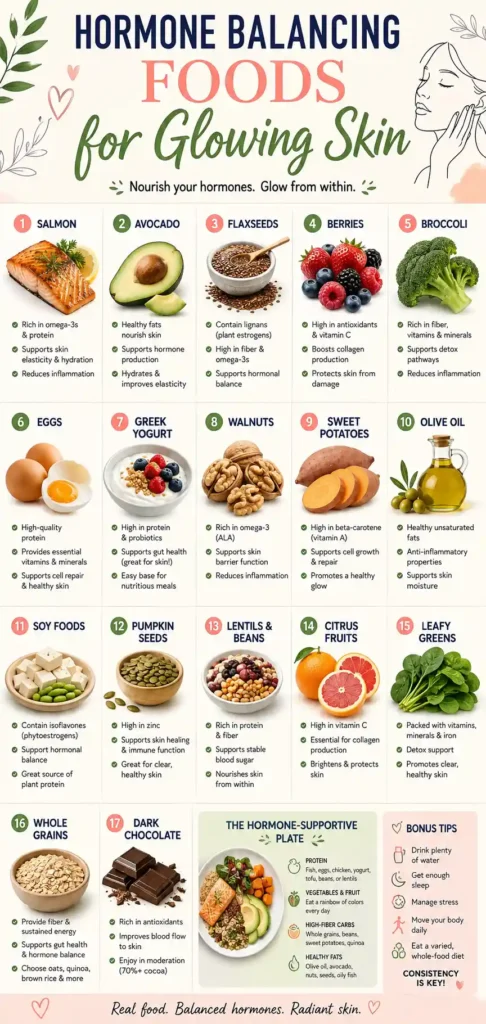
Think of food as creating a better nutritional environment for the body rather than directly controlling one particular hormone.
1. Salmon
Salmon is one of the first foods I think of when talking about both healthy aging and skin.
It’s rich in protein and omega-3 fatty acids.
Omega-3 fats are important components of cell membranes, and oily fish is one of the best dietary sources of the long-chain omega-3s EPA and DHA.
Protein is equally important because our bodies need amino acids to build and repair tissues.
Easy ways I like to eat it:
Add grilled salmon to a big salad.
Serve it with roasted vegetables and brown rice.
Add canned salmon to a whole-grain wrap.
Mix salmon with avocado for an easy lunch.
If salmon isn’t your thing, sardines, trout, mackerel, and herring are other oily fish worth considering.
2. Avocado
It’s hard to talk about glowing-skin foods without mentioning avocado.
Avocados provide mostly unsaturated fats as well as fiber and several micronutrients.
Dietary fat sometimes gets an unfairly bad reputation, particularly when we’re trying to eat healthily. But fat is an essential part of the diet, and including unsaturated fats from foods such as avocado, nuts, seeds, olive oil, and fish makes far more sense than trying to eliminate fat altogether.
I love adding avocado to:
Eggs on whole-grain toast
Salads
Grain bowls
Smoothies
Wraps
The combination of healthy fats, vegetables, protein, and fiber also makes meals much more satisfying.
3. Flaxseeds
Flaxseed is one of the most interesting foods when hormones are being discussed because it contains compounds called lignans.
Lignans belong to a broader group of plant compounds sometimes described as phytoestrogens because they can interact weakly with estrogen pathways in the body.
That doesn’t mean flaxseed works like estrogen medication—and I wouldn’t treat it as a hormonal therapy.
Instead, I look at flaxseed as a nutritious food that happens to provide fiber, plant omega-3 fatty acids, and beneficial plant compounds.
Ground flaxseed is generally much easier to incorporate into meals than whole seeds.
Try adding a tablespoon to:
Porridge
Overnight oats
Yogurt
Smoothies
Homemade muffins
Just remember that dramatically increasing fiber intake overnight can leave your digestive system rather unhappy, so build up gradually and drink enough fluids.
4. Berries
Blueberries, strawberries, raspberries, and blackberries are some of my favorite everyday beauty foods.
They’re naturally rich in plant compounds and provide vitamin C.
Vitamin C is particularly relevant to skin because the body requires it for normal collagen synthesis.
And you don’t need an exotic superfood powder to get it.
I would much rather eat a bowl containing strawberries, blueberries, raspberries, and yogurt than rely on expensive “beauty supplements” promising miraculous results.
Fresh berries are lovely, but frozen berries count too and are often considerably cheaper.
5. Broccoli
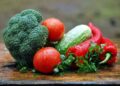
Broccoli might not have the glamorous reputation of avocado toast or an açai bowl, but nutritionally it deserves plenty of attention.
Like other cruciferous vegetables, broccoli gives us fiber along with vitamins, minerals, and various naturally occurring plant compounds.
Cruciferous vegetables include:
Broccoli
Cauliflower
Cabbage
Brussels sprouts
Kale
Bok choy
I wouldn’t buy into claims that broccoli can “detox estrogen” or instantly correct hormonal problems. That’s an oversimplification of extremely complicated biology.
Instead, I include cruciferous vegetables because eating plenty of vegetables is one of the foundations of a healthy diet. Current healthy-eating guidance continues to emphasize a varied intake of vegetables, fruits, whole grains, legumes, nuts, seeds, and other nutrient-dense foods.
6. Eggs
Eggs are wonderfully practical.
They provide high-quality protein plus several vitamins and minerals, which makes them an easy foundation for a balanced breakfast or lunch.
Protein becomes especially useful when I want a meal that actually keeps me satisfied rather than leaving me hunting through the cupboard an hour later.
Try:
Breakfast: scrambled eggs, spinach, avocado, and whole-grain toast.
Lunch: boiled eggs with a large salad, chickpeas, tomatoes, cucumber, and olive oil.
Quick snack: a hard-boiled egg with fruit.
Simple food doesn’t have to be boring food.
7. Greek Yogurt
Greek yogurt is another easy way to add protein to breakfast or snacks.
Choose plain yogurt and add your own fruit if you want more control over added sugar.
My easy skin-friendly breakfast would be:
Greek yogurt + berries + ground flaxseed + walnuts + a sprinkle of cinnamon.
In one bowl, you’ve got protein, healthy fats, fiber, fruit, and several different plant foods.
That’s the kind of “beauty food” I can actually get behind.
8. Walnuts
Nuts are another food group I try not to overlook.
Walnuts provide unsaturated fats, including the plant omega-3 fatty acid alpha-linolenic acid (ALA).
They’re incredibly easy to sprinkle onto meals, too.
Try them over:
Oatmeal
Yogurt
Salads
Roasted vegetables
Or just eat a small handful alongside a piece of fruit.
Other nuts including almonds, pistachios, pecans, and Brazil nuts can all contribute different nutrients, so there’s no need to choose only one type.
9. Sweet Potatoes
Sweet potatoes get their orange color from carotenoids, including beta-carotene, which the body can convert into vitamin A.
Vitamin A is involved in normal cell growth, development, immune function, and cellular communication.
Other carotenoid-rich foods include:
Carrots
Pumpkin
Butternut squash
Spinach
Kale
My favorite approach is simply to “eat the rainbow.”
Different-colored fruits and vegetables provide different combinations of nutrients and plant compounds, so variety matters more than obsessing over one particular superfood.
10. Olive Oil
Extra virgin olive oil is an easy swap if you’re trying to include more unsaturated fats in your diet.
I use it for salad dressings, drizzled over vegetables, or as part of Mediterranean-style meals containing vegetables, beans, fish, whole grains, herbs, and nuts.
That’s another recurring theme here: no individual food needs to do all the work.
The pattern of our overall diet matters much more.
11. Soy Foods
Soy often gets brought up whenever women and hormones are discussed.
Foods such as tofu, tempeh, edamame, and soy milk contain compounds known as isoflavones, which are plant-derived phytoestrogens.
Because of their name, phytoestrogens sometimes sound alarming. But they aren’t the same thing as the estrogen produced by our bodies.
I prefer to think of soy as what it fundamentally is: a nutritious source of plant protein that can fit perfectly well into a varied diet.
Rather than taking concentrated phytoestrogen supplements without medical guidance, food sources such as tofu or edamame make a straightforward addition to meals.
12. Pumpkin Seeds
Pumpkin seeds are tiny but extremely useful.
They’re particularly well known as a food source of zinc.
Zinc has numerous functions throughout the body and is involved in processes including immune function, DNA and protein synthesis, and wound healing. The NIH provides detailed guidance on dietary zinc sources and requirements.
Sprinkle pumpkin seeds onto salads, yogurt, oatmeal, or soup.
You can also make a simple seed mix using pumpkin, sunflower, sesame, and flax seeds.
13. Lentils and Beans
Beans and lentils don’t always appear on glamorous “glowing skin” lists, but I think they should.
They provide:
Plant protein
Fiber
Complex carbohydrates
Iron
Folate
Potassium
Various other micronutrients
They’re also one of my favorite foods for making meals more substantial without spending a fortune.
Try lentils in soups and curries, chickpeas in salads, or black beans in tacos and grain bowls.
Fiber-rich foods are also good for overall digestive health, and fiber should come primarily from foods rather than relying on supplements.
14. Citrus Fruits
Oranges, grapefruit, lemons, limes, and other citrus fruits are famous for their vitamin C content.
And since vitamin C is necessary for collagen biosynthesis, getting enough through the diet is genuinely relevant to healthy skin.
That doesn’t mean drinking gallons of lemon water will erase wrinkles.
But adding vitamin-C-rich foods throughout the day is a sensible habit.
Other excellent sources include:
Bell peppers
Strawberries
Kiwi
Broccoli
Tomatoes
15. Leafy Green Vegetables
Spinach, kale, arugula, Swiss chard, and other leafy greens give us an impressive range of nutrients for relatively few calories.
One of the easiest changes I’ve found is simply adding a handful of greens to meals I’m already making.
Add spinach to:
Scrambled eggs
Pasta sauce
Soup
Curry
Smoothies
Add kale or arugula to salads and grain bowls.
You don’t need enormous green juices or complicated detox routines. A handful here and there soon adds up.
16. Oats and Other Whole Grains
Carbohydrates aren’t automatically bad for hormones or skin.
What matters much more is the type of carbohydrate and the overall diet.
Oats, brown rice, quinoa, barley, whole-grain bread, and other minimally processed grains provide fiber along with valuable nutrients.
Rather than cutting carbohydrates completely, I prefer pairing them with protein, vegetables, and healthy fats.
For example:
Oatmeal + yogurt + berries + walnuts
is very different nutritionally from:
Sugary cereal + sweetened juice.
Both contain carbohydrates, but the overall meals aren’t comparable.
17. Dark Chocolate
Yes, chocolate can stay.
Dark chocolate contains cocoa-derived plant compounds and can certainly fit into a healthy diet.
The important part is remembering that it is still a treat rather than convincing ourselves an entire chocolate bar is medicinal skincare.
A couple of squares of good dark chocolate with berries makes a much more enjoyable approach to healthy eating than creating a diet so restrictive that it’s impossible to maintain.
Foods I Wouldn’t Rely On to “Balance Hormones”
This is where I’m cautious.
There are plenty of powders, teas, gummies, detox drinks, supplements, and “hormone-reset diets” promising to fix everything from acne and weight gain to menopause symptoms.
Hormones are far more complicated than that.
I would be particularly skeptical of products promising to:
“Detox” excess estrogen
Reset hormones in a week
Cure hormonal acne through one supplement
Correct thyroid problems through food alone
Replace prescribed hormonal treatment
Reverse menopause
Food absolutely matters for health, but it isn’t a substitute for proper medical assessment when symptoms suggest a genuine hormonal problem.
What About Supplements for Glowing Skin?
I prefer food first whenever practical.
Supplements are sometimes necessary—for example, when someone has a diagnosed deficiency or struggles to obtain enough of a nutrient through diet—but more isn’t automatically better.
It’s possible to take excessive amounts of certain nutrients, and supplements can interact with medications.
Even the American Academy of Dermatology cautions against casually taking supplements for hair-related concerns because excessive quantities of some nutrients can cause problems.
So before spending money on an impressive-looking “hormone balance beauty complex,” I’d look at my actual diet first.
My Simple Hormone-Supportive Glowing Skin Plate
If all of this sounds like too much information, I simplify it.
For most main meals, I try to include:
Protein
Fish, eggs, chicken, yogurt, tofu, beans, or lentils.
Vegetables or fruit
Ideally several different colors throughout the day.
High-fiber carbohydrates
Oats, potatoes, sweet potatoes, beans, brown rice, quinoa, or whole-grain bread.
Healthy fats
Olive oil, avocado, nuts, seeds, or oily fish.
It’s not dramatic.
It won’t sell many detox teas.
But it gives the body a broad range of nutrients without requiring an unnecessarily restrictive eating plan.
A Sample Day of Hormone-Friendly Foods for Skin
Breakfast
Greek yogurt topped with blueberries, strawberries, walnuts, and ground flaxseed.
Mid-Morning
An apple with a handful of almonds.
Lunch
Salmon salad with leafy greens, avocado, tomatoes, cucumber, pumpkin seeds, and an olive-oil dressing.
Afternoon
Carrot sticks with hummus.
Dinner
Tofu or chicken stir-fry with broccoli, peppers, edamame, and brown rice.
Dessert
A couple of squares of dark chocolate with berries.
That’s already an impressive variety of plant foods, protein sources, fats, fiber, vitamins, and minerals without anything resembling a “hormone detox.”
Perimenopause, Menopause, and Glowing Skin
Hormonal changes become particularly relevant to skin during perimenopause and menopause.
As estrogen declines, the skin can become thinner and drier and lose some elasticity and collagen.
Nutrition can support overall health during this transition, but it cannot completely prevent normal hormonal aging.
That’s why I think the best approach combines nutrition with straightforward skincare:
Eat a varied, nutritious diet.
Include adequate protein.
Eat sources of healthy fats.
Use a moisturizer suitable for your skin.
Protect your skin from excessive UV exposure.
Avoid smoking.
Get enough sleep where possible.
Speak to a healthcare professional if hormonal symptoms become troublesome.
And importantly, hormone therapy shouldn’t be started purely as a cosmetic treatment for aging skin. Current reviews note potential skin benefits from menopausal hormone therapy but also emphasize that the evidence isn’t sufficient to recommend it solely for treating estrogen-related skin aging.
Frequently Asked Questions
1. Can food really balance hormones?
Not in the simplistic way social media sometimes suggests.
A nutritious diet provides the fats, proteins, vitamins, minerals, and energy the body needs for normal physiological processes, including hormone production and metabolism.
But there isn’t one food that can simply “balance” estrogen, progesterone, testosterone, cortisol, or thyroid hormones.
2. What foods are best for hormonal skin?
Rather than looking for one miracle ingredient, I’d prioritize oily fish, vegetables, berries, whole grains, beans, lentils, nuts, seeds, avocado, olive oil, eggs, and other nutritious protein sources.
3. What should I eat for glowing skin during menopause?
Protein, vitamin-C-rich fruit and vegetables, omega-3-rich fish, nuts, seeds, legumes, whole grains, colorful vegetables, and unsaturated fats are all sensible additions.
Declining estrogen contributes to some of the dryness, collagen loss, and changes in elasticity associated with menopausal skin, so diet can’t completely prevent these changes.
4. Are phytoestrogens good for skin?
Foods containing phytoestrogens—including soy and flaxseed—can be part of a healthy diet. Research continues into their potential role in skin aging, but they shouldn’t be considered equivalent to estrogen therapy.
5. What vitamin helps skin glow?
There isn’t one single “glowing skin vitamin.”
Vitamin C is particularly important because it is required for collagen production, while vitamins A and other nutrients also contribute to normal cellular function.
6. Can diet help dry menopausal skin?
Eating well supports healthy skin, but menopausal dryness is partly driven by falling estrogen levels. Moisturizers, gentle skincare, adequate nutrition, and appropriate medical advice may therefore all have a role rather than relying on food alone.
Final Thoughts
When it comes to hormone balancing foods for glowing skin, I think the most useful thing we can do is forget about miracle ingredients.
No smoothie is going to reset our hormones overnight.
No seed is going to erase menopause.
And no detox tea is going to transform our skin in seven days.
What food can do is give our bodies the raw materials they need to function properly.
For me, that means eating plenty of colorful vegetables and fruit, adequate protein, oily fish, nuts, seeds, whole grains, legumes, and healthy fats—and enjoying treats without turning healthy eating into another source of stress.
It’s a much less dramatic promise than a “hormone reset.”
But it’s also far more realistic.
And when we’re talking about healthy, glowing skin, consistent everyday habits usually beat the latest miracle food every time.
Resources
NIH Office of Dietary Supplements – Omega-3 Fatty Acids
Useful for salmon, walnuts, flaxseed, and the role of omega-3 fats in healthy cell membranes.
https://ods.od.nih.gov/factsheets/Omega3FattyAcids-HealthProfessional/
NIH Office of Dietary Supplements – Vitamin C
Supports the sections on berries and citrus fruits, particularly vitamin C’s role in normal collagen production.
https://ods.od.nih.gov/factsheets/VitaminC-HealthProfessional/
American Academy of Dermatology – Caring for Your Skin in Menopause
A useful source for the relationship between menopause, hormonal changes, collagen loss, dryness, and skin aging.
https://www.aad.org/public/everyday-care/skin-care-secrets/anti-aging/skin-care-during-menopause













Comments 1