Acne is often treated as a temporary cosmetic problem, but managing acne properly can make a significant difference to the long-term appearance and health of your skin.
While an occasional whitehead or small pimple may disappear without leaving much evidence behind, persistent, inflamed or deep acne can result in pigmentation changes, permanent scarring and, in some cases, secondary skin infections.
View more Acne Tips >
This is particularly important with severe inflammatory acne, including cystic and nodular acne. These breakouts develop deeper within the skin and have a much greater chance of damaging surrounding tissue.
Effective acne management is therefore not simply about making your skin look clearer today. It is about reducing inflammation, protecting the skin barrier and lowering the likelihood of lasting damage.
Learn more about Acne: Causes, Types, Treatments & How to Get Clearer Skin
Why Some Types of Acne Need More Attention
Not every breakout carries the same risk.
A few small blackheads are very different from painful cysts developing beneath the skin. Understanding the type of acne you have can help you decide whether a basic skincare routine is sufficient or whether professional treatment may be more appropriate.
Some forms of acne particularly need careful management.
Cystic Acne
Cystic acne is one of the forms of acne most likely to cause long-term skin damage.
Cysts develop deep beneath the surface of the skin and can become swollen, painful and extremely inflamed. Unlike an ordinary whitehead, there is often no obvious surface opening to treat or extract.
Trying to squeeze a cyst can push inflammation deeper into surrounding tissue and may significantly increase the risk of scarring.
Cystic acne can result in:
Deep indented scars
Persistent redness
Post-inflammatory hyperpigmentation
Tenderness
Repeated breakouts in the same area
Large areas of inflammation
If you regularly experience deep or painful cysts, it is worth seeking advice from a dermatologist or healthcare professional rather than relying solely on spot treatments.
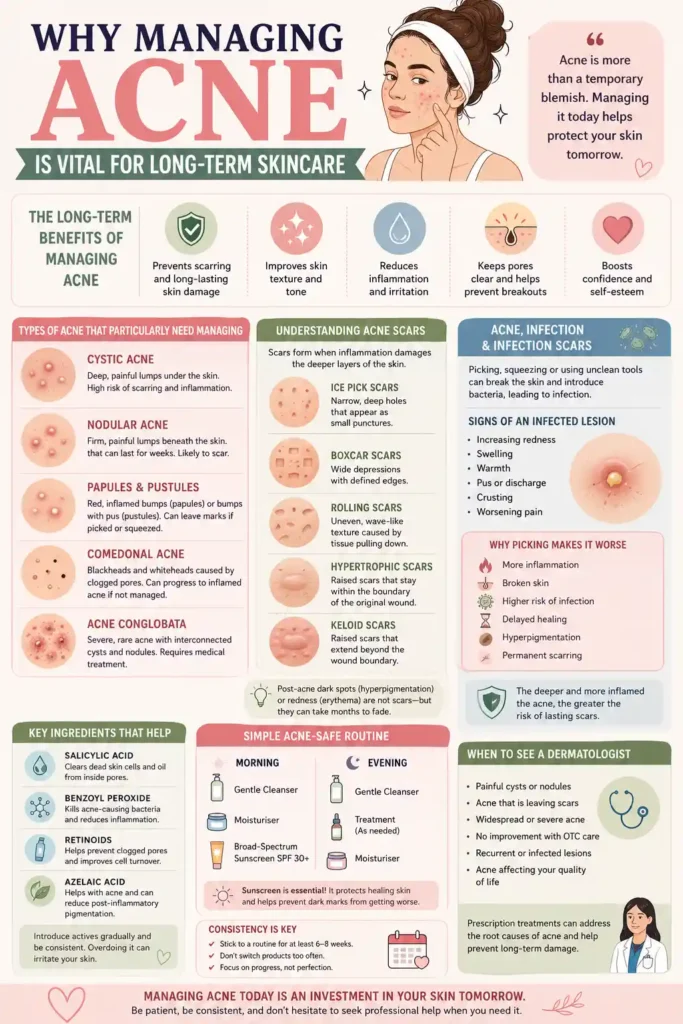
Nodular Acne
Nodules are another severe form of inflammatory acne.
They appear as firm, painful lumps beneath the skin and can remain for weeks. Because inflammation occurs deep within the tissue, nodules have a relatively high risk of leaving permanent scars.
Nodular and cystic acne are sometimes grouped together because they have similar characteristics and may require prescription treatment.
Papules and Pustules
Papules are inflamed red bumps without a visible centre, while pustules contain visible pus.
These are extremely common forms of inflammatory acne. Although individual papules and pustules may heal without permanent damage, repeatedly squeezing or scratching them can substantially increase the risk of pigmentation and scarring.
Frequent inflammatory breakouts should therefore be managed rather than simply picked whenever they appear.
Comedonal Acne
Comedonal acne consists mainly of blackheads and whiteheads.
Blackheads are open clogged pores, while whiteheads are closed clogged pores.
Although they tend to be less likely to produce scars than cystic acne, widespread comedonal acne can develop into more inflamed breakouts if pores remain blocked.
A routine designed to prevent pore congestion can therefore help stop mild acne progressing into something more difficult to manage.
Acne Conglobata
Acne conglobata is a rare but particularly severe form of acne involving numerous interconnected nodules, cysts and abscess-like lesions.
It can cause extensive scarring and should be treated medically rather than managed solely with cosmetic skincare products.
Anyone experiencing widespread, painful or rapidly worsening severe acne should seek professional medical advice.
Why Cystic Acne Is Particularly Likely to Scar
Acne scars form when inflammation damages the deeper layers of the skin.
During healing, your body attempts to repair the damaged tissue by producing collagen. Sometimes too little collagen is produced, leaving a depression in the skin. In other cases excessive scar tissue forms, producing a raised scar.
Because cystic acne develops much deeper than a typical surface pimple, there is considerably more opportunity for surrounding tissue to become damaged.
Repeated cysts in the same area can make the problem worse.
Early treatment of cystic acne may therefore reduce the amount of permanent scarring that develops.
Understanding Different Types of Acne Scars
Not every mark left behind by acne is technically a scar.
Red, purple or brown marks may gradually fade, whereas true acne scars involve a permanent alteration in the texture or structure of the skin.
Ice Pick Scars
Ice pick scars are narrow, deep depressions that resemble small holes or punctures in the skin.
They can occur after severe inflammatory acne and may be particularly difficult to improve using ordinary skincare products.
Boxcar Scars
Boxcar scars are broader depressions with relatively defined edges.
They develop when acne-related inflammation damages collagen beneath the skin.
Rolling Scars
Rolling scars create an uneven or wave-like appearance.
Bands of scar tissue beneath the surface can pull sections of skin downward, producing shallow depressions.
Hypertrophic Scars
Some people produce excess collagen while healing.
Instead of an indentation, a raised area of scar tissue forms.
Keloid Scars
Keloids are raised scars that extend beyond the boundaries of the original wound.
They are more likely to occur in people who are predisposed to keloid formation and may require specialist treatment.
Acne Marks Are Not Always Acne Scars
A flat dark spot left after a pimple is usually not the same as a permanent scar.
Two common post-acne changes are particularly worth recognising.
Post-inflammatory hyperpigmentation produces brown, grey or darker marks following inflammation.
Post-inflammatory erythema can leave pink, red or purplish marks after acne has healed.
These marks may gradually fade, although this can take months.
Sun exposure can make pigmentation more noticeable, which is one reason broad-spectrum sunscreen is an important part of long-term acne skincare.
Acne, Infection and Infection Scars
Acne itself is an inflammatory condition involving blocked hair follicles, oil production, skin cells and bacteria naturally associated with the skin. It should not simply be thought of as a contagious skin infection.
However, damaged acne lesions can sometimes develop secondary bacterial infections, particularly when spots are repeatedly picked, scratched, squeezed or pierced with unclean tools.
Breaking the surface of the skin creates an entry point for additional bacteria.
Signs that may suggest an infected skin lesion include:
Increasing redness
Increasing warmth
Swelling
Significant tenderness
Spreading inflammation
Increasing pus or discharge
Crusting
A wound that fails to heal
More serious symptoms such as rapidly spreading redness, substantial swelling, fever or feeling generally unwell warrant prompt medical attention.
An infected or repeatedly traumatised acne lesion may cause more tissue damage than an undisturbed spot, potentially increasing the likelihood of a noticeable scar afterwards.
Why Picking Acne Makes Scarring More Likely
Most of us know how tempting it is to squeeze a spot.
Unfortunately, squeezing does not necessarily push everything out of the pore. Pressure may rupture the follicle wall and force inflammatory material into surrounding tissue.
Picking also physically damages the surface of the skin.
The result can be:
More inflammation
Bleeding
Broken skin
Delayed healing
Secondary infection
Hyperpigmentation
Permanent scarring
The deeper and more inflamed the original spot, the greater the reason to leave it alone.
Which Types of Acne Are Most Likely to Cause Scars?
The greatest concern generally comes from deeply inflamed acne.
Particular attention should be paid to:
Cystic acne
Nodular acne
Severe inflammatory acne
Acne conglobata
Recurrent deep breakouts
Acne that is repeatedly squeezed or scratched
Acne already producing visible scars
Mild blackheads and whiteheads generally carry a lower scarring risk, but they still benefit from appropriate management to prevent worsening congestion and inflammation.
Long-Term Inflammation Can Affect Skin Texture
One reason chronic acne is worth treating is that repeated inflammation can gradually change the texture of the skin.
Each inflammatory lesion initiates a healing process.
When this occurs repeatedly across the same areas of the face, chest, back or shoulders, irregular collagen formation can eventually leave the surface uneven.
Someone who experiences inflammatory acne for several years may therefore accumulate scars gradually, even when no individual breakout initially appears particularly severe.
Protecting the Skin Barrier Matters Too
One mistake people frequently make with acne is trying to dry their skin out as much as possible.
Harsh scrubs, strong alcohol-based products and excessive exfoliation may make the skin feel temporarily clean but can also damage the skin barrier.
A compromised skin barrier may become:
Dry
Red
Tight
Flaky
Sensitive
Irritated
This can make acne treatments harder to tolerate.
Gentle cleansing and appropriate moisturising therefore remain important even for oily and acne-prone skin.
Look for products labelled non-comedogenic or suitable for acne-prone skin.
Ingredients Commonly Used to Manage Acne
Different treatments target different aspects of acne.
Salicylic Acid
Salicylic acid can help clear dead skin cells and oil from inside pores, making it particularly useful for blackheads, whiteheads and mild acne.
Benzoyl Peroxide
Benzoyl peroxide can reduce acne-associated bacteria and inflammation and is frequently used for inflammatory breakouts.
Retinoids
Topical retinoids help prevent blocked pores and can be highly effective for both comedonal and inflammatory acne.
Some retinoids are available over the counter in certain countries, while others require a prescription.
Azelaic Acid
Azelaic acid can help with acne and may also be useful for post-inflammatory pigmentation.
Strong active ingredients should generally be introduced gradually because excessive treatment can create irritation rather than clearer skin.
Sunscreen Is Part of Acne Management
Sunscreen might not immediately spring to mind as an acne treatment, but it plays an important role in long-term skincare.
Areas of post-inflammatory pigmentation can darken following sun exposure.
Daily broad-spectrum SPF 30 or higher can help protect healing skin and reduce additional UV-related damage.
People using certain acne treatments may also find that their skin becomes more sensitive or irritated by sunlight, making sun protection especially worthwhile.
Treating Scars Is Harder Than Preventing Them
Modern dermatology offers numerous treatments for acne scars, including:
Microneedling
Chemical peels
Laser treatments
Subcision
Dermal fillers
Scar revision procedures
The right treatment depends on the type and severity of the scar.
However, preventing scars by controlling inflammatory acne early is generally preferable to trying to correct extensive scarring later.
When Acne Needs Professional Treatment
You do not have to wait until acne becomes extremely severe before speaking with a healthcare professional.
Consider seeking medical advice if you have:
Painful cysts or nodules
Acne that is beginning to scar
Widespread inflammatory acne
Persistent acne that has not responded to over-the-counter treatment
Acne affecting your chest, shoulders and back as well as your face
Repeatedly infected-looking lesions
Sudden or unusual severe acne
Significant pigmentation following breakouts
Prescription treatments may include stronger topical medicines, oral antibiotics, hormonal treatments for appropriate patients or isotretinoin for certain forms of severe acne.
Build a Routine You Can Maintain
Acne management works best when it is consistent.
A complicated 12-product routine is rarely necessary.
A straightforward routine may include:
Morning: Gentle cleanser, suitable moisturiser and broad-spectrum sunscreen.
Evening: Gentle cleanser, an appropriate acne treatment and moisturiser.
Additional treatments can be introduced depending on your individual skin concerns.
Avoid introducing several powerful active ingredients simultaneously because this can make it difficult to distinguish acne from product irritation.
Why Early Acne Management Matters
It is easy to assume you should simply wait for acne to disappear with age.
For some people it does. For others it persists well into adulthood.
The problem with waiting is that scars accumulate gradually.
A person experiencing two or three deep inflammatory spots each month may not initially consider their acne severe. If every few spots leave a permanent indentation or dark mark, however, several years of untreated acne can produce a considerable amount of lasting skin damage.
Early and consistent management can reduce that risk.
The Bottom Line
Managing acne is about much more than eliminating an inconvenient spot before an important occasion.
Inflammatory acne can cause pigmentation, changes in skin texture and permanent scarring. Cystic and nodular acne are particularly important to treat because inflammation occurs deep within the skin and has a greater potential to damage surrounding tissue.
Picking and squeezing lesions may introduce additional bacteria, worsen inflammation and increase the possibility of secondary infection and subsequent scarring.
Blackheads and whiteheads usually carry less risk, but controlling clogged pores can help prevent them developing into inflammatory breakouts.
The best long-term approach is therefore a combination of gentle skincare, appropriate acne treatments, sun protection and professional advice when acne becomes persistent, painful or begins to scar.
Clearer skin is certainly one goal. Protecting the skin you will have five, ten or twenty years from now is an equally important one.
Resources
American Academy of Dermatology (AAD) – Acne Scars: Signs and Symptoms
Covers cystic and nodular acne, why deeper acne is more likely to scar, and different scar types including ice-pick, boxcar, rolling, hypertrophic and keloid scars.
https://www.aad.org/public/diseases/acne/derm-treat/scars/symptoms
Mayo Clinic – Acne: Symptoms and Causes
Explains whiteheads, blackheads, papules, pustules, nodules and cystic acne, as well as inflammation, infection, pigmentation and the risk of permanent scarring.
https://www.mayoclinic.org/diseases-conditions/acne/symptoms-causes/syc-20368047
MedlinePlus / U.S. National Library of Medicine – Acne
A useful US government health source covering acne causes, nodulocystic acne, pustules, cysts, scarring, treatment and when professional medical advice is recommended.
https://medlineplus.gov/ency/article/000873.htm