Using olive oil for hair has some incredible benefits for the health and beauty appearance of your mane. It shouldn’t come off as a surprise that olive oil is capable of doing so many good things for your beauty routine, though.
It’s by far one of the most popular ingredients on the plates of people with organic tastes. Luckily, its string of wonders doesn’t end with its culinary prowess.
View more Hair Care Ideas >
Below, you will find the precise results that an olive oil-based hair treatment can provide. Furthermore, for the practical side of the conversation, you’ll also find the best ways to apply it.
Results of Using Olive Oil for Hair
- Your hair will become softer and healthier thanks to the action of the antioxidants found in olive oil.
- It has high nourishing properties, moisturizing the scalp and getting rid of dry and flaky skin.
- Is rich in antibacterial and antifungal properties, making it great when trying to get rid of various scalp problems such as dandruff, itchiness, lice, etc.
- The mono-saturated fatty acids contained in olive oil contribute to better hair growth, rejuvenating your strands from the root to the ends. Moreover, your hair will also get thicker and stronger in the process.
Olive Oil for Hair: 4 Ways to Do It
#1 Overnight Application
Warm up some olive oil and then massage it into your scalp for thorough absorption into your skin. Wrap your hair inside of a head cap or a towel and go to bed for an overnight action.
Rinse off the following day by undergoing a normal shampooing session.
#2 Consuming Oil
Olive oil’s properties are powerful enough to reach your hair by extension. As a result, you don’t even need a topical application to start seeing improvements.
The easiest way to digest it is by incorporating the oil in your menu, using it for cooking or as a salad dressing.
Alternatively, try mixing some olive oil and lemon juice in a glass of water, drinking the mixture every day.
#3 Avocado and Olive Oil Mix
This recipe is a powerhouse of mono-saturated fatty acids, particularly useful for hair in dire need of some treatments.
Ingredients:
- 1/2 avocado
- 1 teaspoon olive oil
Directions: Mash the avocado half and mix it with the oil in a bowl until you get a paste with a consistent, lump-free texture. Keep the avocado in by wrapping a towel or a cap around your head.
Let the treatment sit for thirty minutes and then rinse off, washing your hair normally.
Repeat this at least three times a week for the results to start kicking in.
#4 Experiment
You can combine the olive oil with numerous other ingredients for extra effects.
Some excellent examples are: eggs, honey, coconut oil, tea tree oil, castor oil, cinnamon, cumin seeds, green tea, and other essential oils.
Olive oil is one of those beauty ingredients that seems almost too simple. Most of us already have a bottle sitting in the kitchen, yet it can double as a surprisingly useful hair treatment when used the right way.
I’ve always liked beauty treatments that don’t require a cupboard full of complicated ingredients, and olive oil definitely falls into that category. It’s rich, moisturizing, inexpensive, and incredibly easy to work into a hair-care routine.
That said, olive oil isn’t necessarily perfect for every hair type. If you have very fine hair or an oily scalp, for example, slathering it all over your head probably isn’t going to give you the light, bouncy finish you’re hoping for.
So, is olive oil actually good for hair? Here’s what I think is worth knowing before reaching for the bottle.
Is Olive Oil Good for Your Hair?
Olive oil can be a great option if your hair tends to feel dry, rough, frizzy, or difficult to manage.
Like other plant oils, olive oil works mainly by coating and lubricating the hair shaft. This can help hair feel smoother and softer while reducing some of the friction that occurs during brushing, styling, and detangling.
It doesn’t magically repair damaged hair or permanently fix split ends, but it can make dry or weathered hair look and feel healthier.
Olive oil is particularly rich in fatty acids, including oleic acid, which gives it that thick, conditioning texture.
For me, the key is using it as a treatment rather than assuming that more oil automatically means healthier hair.
A small amount can go a very long way.
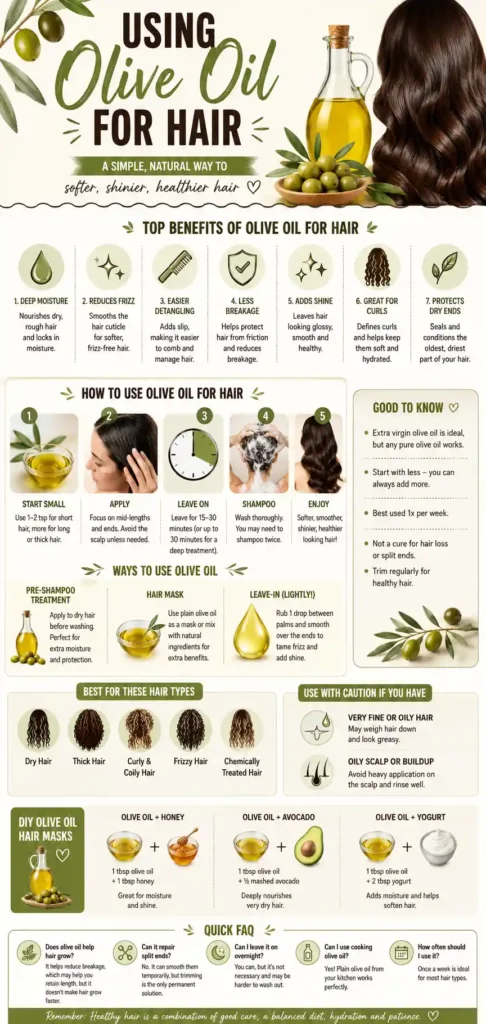
7 Benefits of Using Olive Oil for Hair
1. It Can Make Dry Hair Feel Softer
This is probably the biggest reason people use olive oil on their hair.
When hair is dry, the outer surface of each strand can become rough. Olive oil coats the hair and helps create a smoother feel.
I particularly like the idea of using it on dry ends, which tend to need more conditioning than the roots.
If your hair feels a little straw-like after coloring, heat styling, swimming, or spending lots of time in the sun, an occasional olive oil treatment may help restore some softness.
2. It Can Help Reduce Frizz
Frizz often becomes more noticeable when hair is dry or damaged.
Adding a little oil can help smooth the surface of the hair, which makes flyaways and fuzzy-looking strands less obvious.
You definitely don’t need much, though.
For everyday frizz control, I would use just a drop or two rubbed thoroughly between my palms before smoothing it lightly over the ends.
Too much can quickly turn silky-looking hair into greasy-looking hair.
3. It Makes Detangling Easier
If your hair tends to knot easily, olive oil can add slip to the strands.
That extra lubrication may make it easier to separate tangled hair without pulling or snapping it.
This can be especially useful for thick, curly, coily, or very dry hair.
I would still use a wide-tooth comb and work slowly from the ends upward rather than dragging a brush straight through tangles.
4. It May Help Reduce Breakage From Grooming
Olive oil can’t make a broken strand grow back together, but smoother, better-lubricated hair may experience less friction during brushing and styling.
That matters because repeated friction can contribute to breakage, particularly when hair is already dry or chemically treated.
Think of olive oil more as a protective conditioner than a miracle repair treatment.
5. It Can Add Shine
A very small amount of olive oil can give dull hair a beautiful glossy finish.
It works by smoothing the outer surface of the hair so that light reflects more evenly.
Again, the emphasis here is on small amount.
If I’m using olive oil purely for shine, I’d concentrate it on the mid-lengths and ends rather than putting it anywhere near the roots.
6. It Can Be Useful for Thick, Curly, and Coily Hair
Hair that naturally struggles to retain moisture may respond particularly well to heavier oils.
Thick curls and coils often tolerate olive oil better than very fine, straight hair because they can benefit from the extra weight and lubrication.
Olive oil can also be useful as part of a pre-shampoo treatment before cleansing textured hair.
7. It Can Help Protect Dry Ends
The ends of our hair are the oldest part, so it’s no surprise that they often become dry and fragile before the rest of the hair does.
Applying a little olive oil to the ends before shampooing can help keep them feeling conditioned.
I find this is one of the easiest ways to use olive oil without ending up with an oily scalp.
What Olive Oil for Hair Cannot Do
This is where it’s worth managing expectations.
Olive oil can condition hair, but it isn’t a cure-all.
It cannot permanently repair split ends. Once a strand has split, trimming is the only way to remove the damaged section.
It also isn’t a proven treatment for genetic hair loss, hormonal hair thinning, alopecia, or medical scalp conditions.
And while healthier-looking hair may appear fuller or shinier, olive oil doesn’t automatically make hair grow faster.
Hair growth happens at the follicle, so simply coating the strands with oil doesn’t directly speed up that process.
Which Hair Types Benefit Most From Olive Oil?
I would be most likely to recommend experimenting with olive oil if you have:
Dry hair
Thick hair
Coarse hair
Curly or coily hair
Frizzy hair
Chemically processed hair
Heat-damaged hair
Dry or brittle ends
That doesn’t mean everyone with these hair types will love it, but heavier oils are generally easier to use on hair that needs plenty of conditioning.
Who Should Be Careful With Olive Oil for Hair?
Olive oil isn’t always the best option for very fine or naturally oily hair.
If your hair becomes flat easily, olive oil can weigh it down.
You may also want to avoid applying oil directly to the scalp if your scalp is already oily, itchy, irritated, or prone to buildup.
People sometimes assume that a flaky scalp automatically means dryness, but dandruff and other scalp conditions can have different causes. Adding lots of oil isn’t necessarily helpful.
If you’re dealing with persistent itching, scaling, soreness, hair loss, or a scalp rash, I’d skip the DIY treatments and speak with a dermatologist or healthcare professional.
How to Use Olive Oil as a Hair Treatment
This is probably the easiest method if you’ve never tried olive oil on your hair before.
Step 1: Start With Dry or Slightly Damp Hair
You can apply olive oil to dry hair, although slightly damp hair may make it easier to distribute.
I wouldn’t soak the hair first. You want the oil to coat the strands rather than slide straight off them.
Step 2: Use a Small Amount
Start with around one teaspoon if your hair is short or fine.
Long, thick, or very curly hair may need more, but it’s much easier to add extra oil than it is to remove too much.
Warm the oil between your hands before applying it.
Step 3: Concentrate on the Ends
Unless your scalp is particularly dry and you already know it tolerates oils well, I’d focus on the mid-lengths and ends.
These areas are usually the driest anyway.
Step 4: Leave It on for 15 to 30 Minutes
You don’t need to leave olive oil on your hair all day to get the conditioning benefits.
Around 15 to 30 minutes is a sensible starting point.
You can cover your hair with a shower cap while you wait.
Step 5: Shampoo Thoroughly
Olive oil is heavy, so you may need to shampoo twice.
Apply shampoo carefully throughout the scalp and hair, rinse thoroughly, and see how your hair feels before repeating.
Olive Oil Pre-Shampoo Treatment
This is probably my favorite way to use olive oil.
Instead of applying it after shampooing, I use it before washing.
Apply a small amount to the dry ends and lengths, leave it for around 20 minutes, and then shampoo normally.
Using olive oil before washing lets you enjoy some of the smoothing effects without leaving your hair feeling coated afterward.
It’s particularly handy if your shampoo sometimes leaves your ends feeling dry.
Olive Oil Hair Mask
If your hair needs a little more pampering, you can turn olive oil into a simple hair mask.
You don’t actually need to mix it with anything.
Simple Olive Oil Hair Mask
You’ll need:
1 to 2 tablespoons olive oil, depending on your hair length and thickness
Apply the oil through the mid-lengths and ends.
Leave it on for around 20 to 30 minutes.
Shampoo thoroughly afterward.
For very thick or dry hair, you might occasionally leave it on slightly longer, but I wouldn’t assume that overnight treatments are automatically better.
More time isn’t always more effective, and sleeping with oil-coated hair can get messy quickly.
Olive Oil and Honey Hair Mask
Honey is another ingredient commonly used in DIY hair treatments because it helps create a thick, conditioning mixture.
Try combining:
1 tablespoon olive oil
1 tablespoon honey
Mix them together and apply mainly to the lengths and ends.
Leave the mask on for around 20 minutes before shampooing thoroughly.
Because honey is sticky, make sure you rinse very well.
Can You Put Olive Oil Directly on Your Scalp?
You can, but I wouldn’t automatically recommend it for everyone.
A small amount may feel soothing on a genuinely dry scalp, but applying heavy oil to the scalp can also increase buildup.
If you decide to try it, use only a small amount and shampoo thoroughly afterward.
Stop using it if you notice increased itching, redness, irritation, or flaking.
Does Olive Oil Help Hair Grow?
This is one of the biggest claims you’ll see online.
I wouldn’t rely on olive oil as a hair-growth treatment.
Olive oil can improve the feel and appearance of dry strands and potentially reduce breakage caused by friction, which might help you retain more length.
That isn’t the same thing as making follicles produce hair faster.
If you’re suddenly shedding much more hair than usual or noticing widening parts, bald patches, or significant thinning, it’s worth finding out what’s causing it instead of relying on oils.
Can Olive Oil Repair Split Ends?
Unfortunately, no.
Once the end of a strand has physically split, no oil can permanently fuse it back together.
What olive oil can do is temporarily smooth those ends and make them look less frayed.
Regular trims combined with gentle hair care are the better long-term solution.
Can I Leave Olive Oil in My Hair Overnight?
You can, but I don’t think it’s necessary for most people.
Leaving olive oil on overnight may make hair extremely difficult to wash, particularly if you use a lot.
It can also transfer onto your pillowcase and skin.
I’d start with 20 to 30 minutes and see how your hair responds.
If shorter treatments leave your hair soft and manageable, there’s really no need to turn bedtime into an olive oil experiment.
How Often Should You Use Olive Oil on Your Hair?
For most people, once a week is plenty.
Very dry or coarse hair might tolerate it more often, while fine hair may only need an occasional treatment.
Pay attention to how your hair responds.
If it feels soft, shiny, and manageable, you’re probably using the right amount.
If it starts feeling heavy, limp, sticky, or difficult to wash, reduce either the amount or frequency.
Can I Use Olive Oil as a Leave-In Treatment?
You can use an incredibly small amount.
When I say small, I mean small.
Try one drop rubbed between your palms and then lightly smooth your hands over the ends.
I wouldn’t pour olive oil directly onto freshly washed hair unless you have extremely thick or coarse hair.
For most people, that’s a fast route to greasy strands.
What Kind of Olive Oil Should I Use?
Plain olive oil is enough.
You don’t need an expensive beauty-branded version simply because you’re putting it on your hair instead of your salad.
Extra virgin olive oil is commonly used because it hasn’t undergone as much processing, but the most important thing is simply choosing a fresh, good-quality product.
Avoid heavily fragranced or flavored cooking oils.
Garlic-infused hair treatment probably isn’t the beauty experience you’re looking for.
Olive Oil vs Coconut Oil for Hair
Both oils are popular, but they don’t behave exactly the same way.
Coconut oil contains a particularly high proportion of lauric acid and has been studied more extensively for its ability to penetrate the hair shaft and reduce protein loss.
Olive oil is heavier and works beautifully as a lubricating and softening treatment.
Some hair types prefer coconut oil, while others find it makes their hair feel stiff or dry.
Likewise, olive oil can be wonderfully conditioning on thick hair but overwhelming on fine hair.
There’s no rule saying you have to choose the internet’s favorite oil. Use whichever one leaves your own hair feeling better.
Olive Oil vs Argan Oil
Argan oil tends to be lighter than olive oil, which can make it easier to use as a finishing oil.
If I wanted a treatment before shampooing, I’d be perfectly happy using olive oil.
If I wanted something to smooth over freshly styled hair without weighing it down, I’d probably reach for a lighter oil such as argan oil instead.
Possible Downsides of Using Olive Oil for Hair
As natural and simple as olive oil sounds, there are a few disadvantages worth considering.
It Can Make Hair Greasy
This is the obvious one.
Olive oil is thick. Use too much and you’ll know about it.
It Can Weigh Down Fine Hair
If you have fine strands, even a relatively small amount may flatten your hair.
It May Require Extra Shampooing
You might need to wash your hair twice to remove all the oil.
Repeated aggressive washing defeats the purpose, so it’s much better to start with less oil.
It Can Cause Buildup
Applying heavy oils frequently without cleansing properly may leave hair or the scalp feeling coated.
It Doesn’t Treat Medical Hair Problems
Hair thinning, severe dandruff, scalp inflammation, and sudden shedding deserve proper investigation rather than repeated DIY oil treatments.
My Tips for Using Olive Oil Without Greasy Hair
After experimenting with oils, I’ve found that the difference between beautifully soft hair and hair that looks like it hasn’t been washed in a week usually comes down to quantity.
My main tips would be:
Start with less than you think you need.
Apply mainly to the ends.
Use it as a pre-shampoo treatment.
Don’t automatically apply it to your scalp.
Shampoo thoroughly.
Reduce the frequency if your hair starts feeling heavy.
Don’t expect olive oil to repair serious damage or cure hair loss.
Olive Oil for Hair FAQs
1. Can olive oil moisturize hair?
Olive oil doesn’t hydrate hair in the same way water does, but it can coat, lubricate, and soften dry strands. That’s why hair often feels smoother after an olive oil treatment.
2. Can I use olive oil on wet hair?
Yes. You can use a small amount on damp hair, although I prefer using it before shampooing because there’s less chance of ending up with greasy-looking hair.
3. Can olive oil cause hair loss?
Olive oil itself isn’t generally considered a cause of hair loss when used normally. However, aggressive rubbing, pulling, or repeatedly trying to remove excessive amounts of oil could contribute to mechanical breakage.
If you’re experiencing genuine hair loss or increased shedding, investigate the underlying cause rather than assuming an oil treatment will solve it.
4. Is olive oil good for curly hair?
It can be. Curly and coily hair often benefits from heavier conditioning products because natural scalp oils don’t travel down curved hair shafts as easily.
That said, every head of curls is different, so start with a small amount.
5. Is olive oil good for damaged hair?
It can improve the appearance and feel of damaged hair by making strands smoother and more manageable.
It cannot reverse structural damage once it has occurred.
6. Can I use cooking olive oil on my hair?
Yes. Regular culinary olive oil can be used on hair. There’s no requirement to buy a product specifically marketed as a hair oil.
The Bottom Line
I’m a big fan of keeping beauty treatments simple, and olive oil is a perfect example.
No, it isn’t going to magically repair every split end, double your hair growth, or transform severely damaged hair overnight.
But used sensibly, it can be a wonderfully easy way to make dry hair feel softer, smoother, shinier, and easier to manage.
The trick is not drowning your hair in it.
I’d start with a small amount, focus primarily on the dry lengths and ends, leave it on for around 20 minutes, and shampoo it out thoroughly.
If your hair comes out soft and glossy, you’ve probably found the sweet spot.
And if your hair comes out looking like you’ve dunked your head into a deep-fat fryer?
Use considerably less next time.
Sources
American Academy of Dermatology Association. Hair Care Tips.
https://www.aad.org/public/everyday-care/hair-scalp-care/hair
American Academy of Dermatology Association. Curly Hair Care Tips.
https://www.aad.org/public/everyday-care/hair-scalp-care/hair/curly-hair-care
American Academy of Dermatology Association. Summer Hair Care Tips.
https://www.aad.org/public/everyday-care/hair-scalp-care/hair/summer-hair-care
National Library of Medicine, PubMed. Effect of Mineral Oil, Sunflower Oil, and Coconut Oil on Prevention of Hair Damage.
https://pubmed.ncbi.nlm.nih.gov/12715094/
National Institutes of Health, PubMed Central. Hair Cosmetics: An Overview.
https://pmc.ncbi.nlm.nih.gov/articles/PMC4387693/
Cleveland Clinic. How Often Should You Wash Your Hair?
https://health.clevelandclinic.org/the-dirty-truth-about-washing-your-hair
Cleveland Clinic. Argan Oil Benefits for Hair and Skin.
https://health.clevelandclinic.org/argan-oil-benefits
American Academy of Dermatology Association. Hair Loss: Diagnosis and Treatment.
https://www.aad.org/public/diseases/hair-loss