Lotus flower oil is an essential oil that can be used for many health and beauty purposes such as aromatherapy, bath soaps, body lotions, and more. You can use it as it is or in combination with other aromatherapy products.
Lotus oil was first used by Indians and Egyptians, as a symbol of enlightenment and spirituality. Below, we have described this oil’s main benefits for your skin, hair and health.
View more Beauty Tips >
What Is Lotus Flower Oil?
Lotus flower oil is an essential oil which has a nice floral scent and an earthy fragrance. It is mostly used in aromatherapy, but it has plenty of other benefits for your health and body.
Those who use it say it brings them the feeling of peacefulness.
In ancient times, people used this oil for respiratory problems like asthma. Its extraction process is costly which makes this oil one of the most expensive supplies in the market. The proper way to apply it is by diluting it first.
View Lotus Flower Oil on Amazon.com >
Lotus Flower Oil Uses
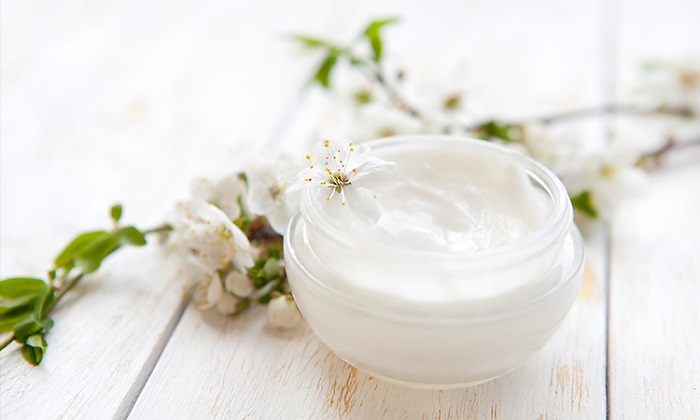
Benefits for Skin
- Improves your skin’s texture. Due to its elements, such as vitamin C and B, linoleic acid, protein and acid, this oil has soothing and cooling properties. It will restore your skin’s texture. It acts as a skin conditioner because it is rich in antioxidants.
- Treats blemishes and acne prone skin. Lotus flower oil has astringent properties which cool your acne prone complexion.
- Moreover, it hydrates and moisturizes your skin, increasing its elasticity. This way, it fights against aging signs.
- It balances your oily skin. Your skin will be rejuvenated and pimple-free.
Benefits for Hair
- Repairs split ends. Use a conditioner that contains lotus flower oil or extract. Your hair will look shinier, and you will not have split ends anymore.
- Your hair will have more volume and elasticity. Furthermore, lotus oil boosts your locks’ strength and prevents your hair from becoming damaged or dull.
- According to researchers, lotus flower oil stimulates melanin production, which prevents your hair from going gray.
Benefits for Health
- It is a great aromatherapy supply. To use it, you should dilute lotus essential oil with a carrier oil and put it in a diffuser. Another way to do it is by inhaling it directly. You can even use it as a room freshener.
- Lotus flower parts are used in traditional medicine as a natural cure. It treats several conditions such as fever, bleedings, blood in urine, and excessive sweating.
- Other health issues like fungal infections, vomiting, and diarrhea can also be treated with lotus essential oil.
- Lotus oil improves fertility in both men and women. Also, it reduces your cholesterol level as well as blood pressure.
- It keeps your heart healthy due to its potassium content. This oil controls homocysteine levels in your blood, which are directly connected to heart attacks.
There are some beauty ingredients that sound luxurious before you even know what they do, and lotus flower oil is definitely one of them. Delicate, fragrant, and associated with beauty and purity for centuries, the lotus flower has found its way into everything from perfumes and facial oils to bath products and hair treatments.
I love discovering plant-based ingredients that can do more than simply make a product smell nice, and lotus is particularly interesting because its flowers, seeds, leaves, and extracts contain a variety of naturally occurring plant compounds.
But what exactly is lotus flower oil, and is it really worth adding to your beauty routine?
Here’s what I’ve discovered about this rather precious botanical ingredient.
Lotus flower oil is a beauty ingredient derived from flowers of the lotus plant, most commonly Nelumbo nucifera, also known as the sacred or Indian lotus.
You may also come across products labelled blue lotus oil, pink lotus oil, white lotus oil, or lotus flower extract. These products aren’t necessarily identical.
Pure essential oil isn’t commonly produced from lotus in the same way that lavender or tea tree essential oils are.
What is sold as “lotus oil” may instead be:
A lotus flower extract blended into a carrier oil
A perfume oil containing lotus fragrance
A botanical infused oil
A concentrated lotus absolute used in fragrance
A skincare formula containing lotus extract alongside other oils
That distinction is worth knowing, especially if you’re buying lotus oil specifically for skincare rather than simply for its scent.
Always check the ingredients list rather than relying on the name on the front of the bottle.
Why Is the Lotus Flower Considered So Precious?
The lotus has a long cultural history, particularly throughout parts of Asia.
One reason it has become such a powerful symbol is the unusual way it grows. Lotus plants thrive in muddy ponds while sending their beautiful flowers above the water’s surface.
That ability to emerge looking pristine has helped the flower become associated with purity, renewal, beauty, and resilience.
It’s easy to see why beauty companies love it.
The flowers themselves are also wonderfully aromatic, giving lotus-based fragrances a soft, slightly sweet floral character that works beautifully in perfumes, body oils, soaps, and bath products.
Modern cosmetic research has also become interested in the plant because lotus contains naturally occurring compounds with antioxidant properties.
So lotus isn’t simply a pretty flower added to fancy packaging.
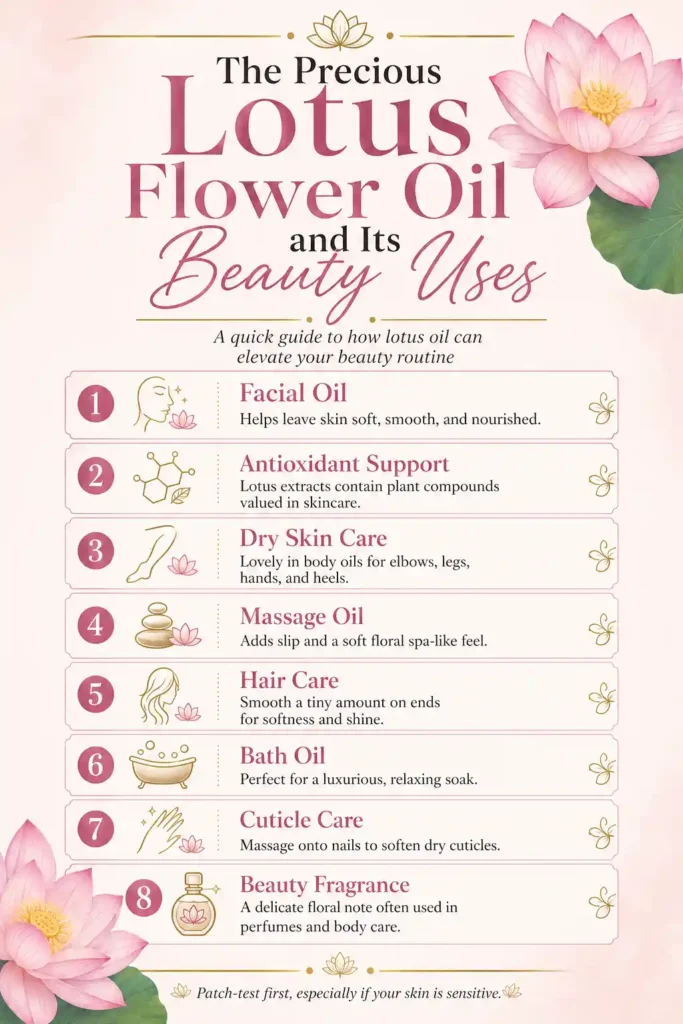
1. Lotus Flower Oil Can Make a Beautiful Facial Oil
One of my favourite ways to use botanical oils is as the final nourishing step in an evening skincare routine.
A properly formulated lotus facial oil can help soften the skin while reducing the dry, tight feeling that sometimes appears after cleansing.
However, most of the moisturizing effect will actually come from the carrier oils in the product.
For example, lotus extract might be combined with:
Jojoba oil
Sweet almond oil
Squalane
Sunflower seed oil
Apricot kernel oil
Grapeseed oil
These oils help reduce moisture loss from the skin while providing that smooth, silky finish we associate with facial oils.
How I would use it
After applying my usual water-based moisturizer, I’d warm one or two drops of lotus facial oil between my fingertips and gently press it over my face.
You really don’t need much.
Using too much facial oil can leave your skin looking greasy rather than glowing.
2. It May Help Support Antioxidant Skincare
One of the reasons lotus has attracted interest in cosmetics is its naturally occurring antioxidant compounds.
Our skin is continually exposed to environmental factors such as sunlight and pollution that can contribute to oxidative stress.
Antioxidants are popular skincare ingredients because they help neutralize unstable molecules known as free radicals.
Lotus plant extracts contain several types of plant compounds being studied for their antioxidant activity.
That doesn’t mean lotus oil should replace proven skincare ingredients such as sunscreen or vitamin C.
I think of botanical antioxidants as supporting players rather than miracle treatments.
A lotus-containing serum or moisturizer can be a lovely addition to a skincare routine, but daily broad-spectrum sunscreen remains far more important for protecting against premature skin ageing.
3. Lotus Oil Is Lovely for Dry Skin
If your skin tends to feel dry or uncomfortable, oil-based lotus products can be especially appealing.
Oils create an emollient layer on the skin that helps make rough areas feel smoother and softer.
I particularly like the idea of using lotus body oil after bathing.
Instead of drying the skin completely, gently pat yourself with a towel and massage a little oil onto slightly damp skin.
This helps trap some of that moisture.
Try it on areas that commonly become dry, including:
Elbows
Knees
Shins
Hands
Cuticles
Heels
A lotus-infused body oil can also leave behind a subtle floral scent, making the whole routine feel rather luxurious.
4. It Can Be Used as a Massage Oil
Lotus is frequently associated with spa treatments, and it’s easy to understand why.
The fragrance can be soft, floral, and relaxing, while the carrier oil provides enough slip for massage.
You could use lotus massage oil on your shoulders, arms, legs, or feet after a long day.
Just remember that heavily fragranced massage oils aren’t ideal for everyone.
If you’re sensitive to perfume or have eczema-prone skin, I’d choose an unscented oil or perform a patch test first.
5. Lotus Flower Oil Can Be Used on Hair
Lotus-containing oils aren’t limited to facial skincare.
You may also find lotus in hair oils, conditioning treatments, shampoos, and scalp products.
The oil component of these products can help smooth the hair shaft, which may make hair feel softer and look shinier.
I wouldn’t expect lotus itself to magically repair damaged hair or make hair grow dramatically faster, though.
Those are the kinds of marketing claims I approach cautiously.
For dry lengths and ends, however, a lightweight lotus hair oil can be very useful.
Try this simple method
Place one or two drops into the palms of your hands.
Rub them together and lightly smooth the oil over the ends of your hair.
Start with less than you think you need. You can always add another drop.
Fine hair can become weighed down very quickly.
6. It Makes a Luxurious Bath Oil
This may be one of the nicest ways to enjoy lotus purely for pleasure.
Lotus fragrances work beautifully in bath products because of their delicate floral aroma.
Rather than adding concentrated fragrance or essential oil directly to bathwater, I’d choose a properly formulated lotus bath oil.
This is important because concentrated fragrance materials don’t dissolve evenly in water and can potentially irritate skin.
A ready-made bath oil has usually been formulated so the fragrance is appropriately diluted.
Add the amount recommended on the bottle, soak, and enjoy.
7. Lotus Oil Can Help Soften Cuticles
Dry cuticles are one of those tiny beauty annoyances that can make otherwise neat nails look neglected.
A small drop of lotus-infused oil massaged into each nail can help soften the surrounding skin.
You don’t need a specialist product either.
If your lotus facial or body oil contains skin-friendly carrier oils, you can often use a tiny amount around your nails too.
Massage it in before bed and leave it overnight.
Your hands may feel noticeably softer by morning.
8. Lotus Is Popular in Anti-Ageing Beauty Products
You’ll often see lotus promoted as an “anti-ageing” ingredient.
I prefer the term healthy-ageing skincare, because no cosmetic ingredient can stop skin from ageing.
Lotus extracts are interesting because of their antioxidant plant compounds, but it’s important to keep expectations realistic.
If preventing premature skin ageing is your main goal, the foundations of your routine should still be:
Broad-spectrum sunscreen
Gentle cleansing
Moisturizer
Proven active ingredients where appropriate
Lotus can then be an enjoyable botanical addition.
In other words, buy it because you enjoy how it makes your skin feel—not because you’re expecting it to erase wrinkles overnight.
9. It Works Beautifully in Body Moisturizers
You don’t necessarily have to buy pure lotus oil to enjoy it.
In fact, I often prefer lotions and creams containing lotus extract because they’re easier to apply and usually less greasy.
Look for formulas that combine lotus with moisturizing ingredients such as:
Glycerin
Shea butter
Ceramides
Squalane
Hyaluronic acid
Jojoba oil
These ingredients do much of the heavy lifting when it comes to hydration, while lotus adds botanical appeal and, depending on the formulation, additional antioxidant compounds.
10. Lotus Flower Oil Makes a Gorgeous Natural-Feeling Perfume
Of all its beauty uses, fragrance is probably where lotus truly shines.
Lotus scents can vary depending on the variety and fragrance formulation, but they’re generally described as soft, aquatic, floral, fresh, and slightly sweet.
That makes them particularly lovely if you enjoy floral perfumes but find heavy rose or jasmine fragrances overpowering.
You’ll find lotus notes in:
Perfume oils
Eau de parfum
Body sprays
Lotions
Soaps
Bath oils
Candles and home fragrances
Just remember that something described as “lotus perfume oil” may contain synthetic fragrance ingredients designed to recreate the scent rather than actual lotus extract.
There’s nothing necessarily wrong with that—it simply helps to understand what you’re buying.
Pink Lotus, Blue Lotus, and White Lotus: Are They the Same?
This is where shopping for lotus products becomes slightly confusing.
Sacred or Pink Lotus
Nelumbo nucifera is the traditional sacred lotus and is commonly associated with Asian herbal traditions and cosmetics.
Its flowers may be pink or white.
Blue Lotus
Products marketed as blue lotus often refer to Nymphaea caerulea, which is technically a water lily rather than a true lotus.
It’s another plant entirely.
Blue lotus has become particularly fashionable in wellness and fragrance products, but you shouldn’t assume research involving Nelumbo nucifera automatically applies to blue lotus.
White Lotus
“White lotus” can refer to white-flowered varieties of Nelumbo nucifera, although product names aren’t always botanically precise.
This is another reason I recommend checking the botanical name on the ingredient list whenever possible.
How to Choose a Good Lotus Flower Oil
Lotus products vary enormously in quality.
A beautiful bottle and the word “lotus” written in gold lettering don’t necessarily mean you’re getting much lotus.
When I’m shopping for botanical skincare, I look beyond the marketing and examine the ingredients.
Ideally, the manufacturer should clearly explain:
Which lotus species is used
Whether the product contains an extract, infusion, absolute, or fragrance
What carrier oils are included
Whether additional fragrance has been added
How the product should be used
I’d be wary of products promising dramatic skin whitening, instant wrinkle removal, acne cures, permanent scar removal, or miraculous hair growth.
Botanical skincare can be wonderful without making impossible promises.
Is Lotus Flower Oil Suitable for Sensitive Skin?
Possibly—but the formula matters more than the word “lotus.”
A gentle moisturizer containing a small amount of lotus extract could be perfectly comfortable for sensitive skin.
A heavily perfumed lotus oil could be irritating.
Natural fragrance ingredients can cause reactions just as synthetic fragrances can.
If you’re prone to sensitive skin, allergies, eczema, or contact dermatitis, perform a patch test before applying a new product widely.
Apply a small amount to a limited area and watch for redness, itching, burning, swelling, or irritation.
Stop using it if your skin reacts.
Can You Put Lotus Oil Directly on Your Face?
It depends entirely on what the product actually contains.
A ready-to-use lotus facial oil can normally be applied according to the manufacturer’s directions.
A concentrated fragrance oil, perfume absolute, or essential-oil-type product shouldn’t automatically be applied directly to your face.
Always check the label.
If the manufacturer says the product requires dilution, dilute it appropriately before use.
Does Lotus Flower Oil Clog Pores?
There’s no simple yes-or-no answer.
Most lotus oils are blends, so whether a product feels heavy or contributes to clogged pores depends largely on the carrier oils and the rest of the formula.
Someone with very dry skin might love a rich oil blend that someone with acne-prone skin finds too heavy.
If you tend to break out easily, I’d choose a lightweight facial formulation and introduce it gradually rather than covering your entire face with a thick layer of oil.
Can Lotus Oil Lighten Skin?
You’ll sometimes see lotus marketed for “brightening.”
There’s an important difference between making dull skin appear brighter and actually bleaching or changing your natural skin colour.
Keeping skin hydrated and supporting the skin barrier can certainly make your complexion look smoother and more radiant.
However, I wouldn’t rely on lotus oil as a treatment for stubborn hyperpigmentation.
Ingredients with stronger evidence for pigmentation concerns include vitamin C, azelaic acid, retinoids, niacinamide, and certain exfoliating acids, depending on your skin type.
And sunscreen is particularly important because UV exposure can make pigmentation darker.
A Simple Lotus Flower Oil Beauty Routine
If you’re interested in trying lotus without completely changing your beauty routine, keep things simple.
Morning
Cleanse your skin, apply moisturizer, and finish with broad-spectrum SPF.
You could use a lotus-containing moisturizer if you like.
Evening
Cleanse your face and apply your normal serum or moisturizer.
Finish with one or two drops of lotus facial oil if your skin enjoys oils.
After bathing
Massage lotus body oil onto slightly damp skin.
Hair
Smooth one drop through dry or damp ends when your hair needs extra softness.
Nails
Massage a tiny amount into your cuticles before bed.
You certainly don’t need lotus in every product you own.
One well-formulated product is plenty.
Are There Any Downsides?
Despite its luxurious reputation, lotus flower oil isn’t automatically better than less exotic skincare ingredients.
There are a few disadvantages worth considering.
It can be expensive. Products containing unusual botanical extracts or floral absolutes often come with premium price tags.
Some products are mostly fragrance. A bottle labelled “lotus oil” might contain very little actual lotus.
Fragrance can irritate sensitive skin. Beautiful-smelling skincare isn’t always sensitive-skin friendly.
Evidence is still limited. Laboratory research into lotus compounds is interesting, but that doesn’t mean every commercial lotus cream has proven anti-ageing or therapeutic effects.
Marketing can be exaggerated. Claims about detoxification, wrinkle removal, skin whitening, or miraculous regeneration deserve skepticism.
Lotus Flower Oil FAQs
1. Is lotus oil good for your face?
A properly formulated lotus facial oil can be a lovely option for softening and conditioning the skin, particularly if your complexion is dry. Most of the moisturizing benefits will come from the carrier oils within the formula.
2. Can I use lotus flower oil every day?
If the product has been formulated for everyday skincare and your skin tolerates it, you generally can. Start slowly if you’re trying it for the first time.
3. Is lotus flower oil good for mature skin?
It can certainly be used on mature skin. Oil-based products are particularly helpful when skin becomes drier with age because they can reduce that rough, tight feeling.
Lotus shouldn’t replace proven skincare ingredients or sun protection, though.
4. Does lotus oil help hair grow?
I wouldn’t rely on it as a proven hair-growth treatment. Oils can improve the appearance and condition of the hair shaft, but that isn’t the same thing as stimulating new hair growth.
5. Is lotus oil an essential oil?
Not necessarily. Products sold as lotus oil may be infused oils, fragrance oils, absolutes, carrier-oil blends, or formulas containing lotus extract.
Read the ingredient list carefully.
6. What does lotus flower oil smell like?
Lotus-inspired fragrances are typically soft and floral with fresh, watery, slightly sweet notes, although the exact aroma depends on the species and how the fragrance has been formulated.
7. Can I use lotus oil around my eyes?
I wouldn’t apply fragranced oils close to the eyes unless the product has specifically been formulated for the eye area.
8. Is lotus suitable for acne-prone skin?
It depends on the complete formulation. Some lightweight products may work well, while richer oil blends may feel too heavy for acne-prone complexions.
9. Should I patch-test lotus skincare?
Yes. Patch testing is sensible whenever you’re introducing a new botanical or fragranced skincare product, particularly if you have sensitive or reactive skin.
The Bottom Line
Lotus flower oil is one of those beauty ingredients where the experience is almost as appealing as the skincare benefits.
There’s something wonderfully indulgent about using an oil inspired by a flower that has represented beauty, renewal, and purity for centuries.
For me, its best uses are fairly simple: softening dry skin, adding shine to hair, conditioning cuticles, creating luxurious body oils, and bringing a beautiful floral fragrance to everyday beauty products.
There are also genuinely interesting antioxidant compounds within the lotus plant that continue to attract cosmetic research.
At the same time, I wouldn’t treat lotus as a miracle ingredient.
The biggest mistake you can make is assuming that an expensive little bottle of exotic flower oil automatically does more for your skin than a well-formulated moisturizer, sunscreen, or proven skincare active.
Choose your lotus products carefully, check exactly what’s inside them, and use them because they make your beauty routine feel—and hopefully leave your skin feeling—a little more special.