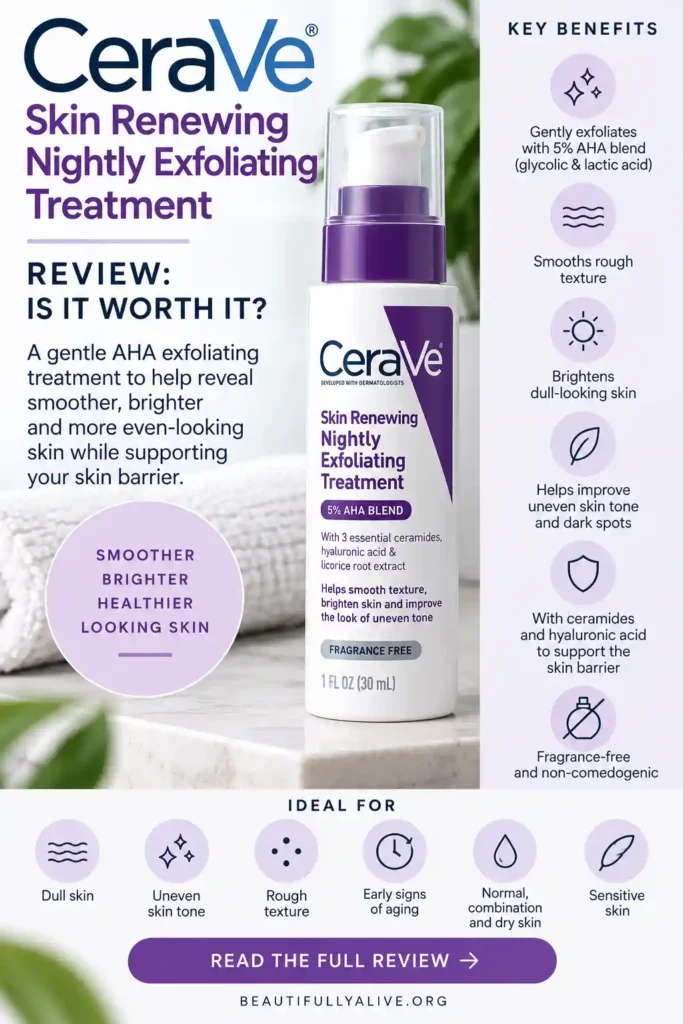
CeraVe Skin Renewing Nightly Exfoliating Treatment is one of those products that sounds much stronger than it actually feels.
The name suggests an intensive overnight peel, but in reality this is a relatively gentle leave-on AHA treatment designed to smooth rough texture, brighten dull-looking skin and support more even-looking skin over time.
What makes it particularly appealing is that CeraVe hasn’t simply filled the formula with exfoliating acids and left it there.
Alongside glycolic and lactic acids, you also get ceramides and hyaluronic acid, which makes this feel more like a balanced skincare treatment than an aggressive peel.
So, is CeraVe Skin Renewing Nightly Exfoliating Treatment worth buying?
Let’s look at what it does, who it’s best for, how to use it and whether it’s a good choice compared with other exfoliators.
Looking for more options? Read our guide to the Best Skin Exfoliators.
What Is CeraVe Skin Renewing Nightly Exfoliating Treatment?
CeraVe Skin Renewing Nightly Exfoliating Treatment is a leave-on facial serum designed to be used in the evening.
Its main exfoliating ingredients are glycolic acid and lactic acid, which together make up a 5% AHA blend.
AHA stands for alpha hydroxy acid.
Unlike a physical facial scrub, AHAs don’t rely on gritty particles or rubbing. Instead, they help loosen dead surface skin cells so they can shed more easily.
That can make the skin look:
Smoother
Brighter
More even
Less dull
Softer
More refined
The treatment is also aimed at visible signs of aging, including fine lines, uneven texture and dark spots.
What’s in CeraVe Nightly Exfoliating Treatment?
The formula is interesting because it combines exfoliation with ingredients designed to support hydration and the skin barrier.
Glycolic Acid
Glycolic acid is one of the best-known AHAs.
It works on the skin’s surface to promote exfoliation and help remove accumulated dead cells.
That can make the complexion look smoother and brighter over time.
Glycolic acid is especially useful when your main concerns are:
Dullness
Rough texture
Uneven-looking skin
Fine surface lines
Post-sun unevenness
Lactic Acid
Lactic acid is another AHA.
It also exfoliates the surface of the skin, but it tends to be associated with a slightly gentler and more hydrating feel than some stronger acid treatments.
I like seeing glycolic and lactic acid combined here because the formula is clearly intended to improve texture without feeling like a harsh peel.
Ceramides
As you’d expect from CeraVe, the formula includes ceramides.
Ceramides are important components of the skin barrier and help reduce moisture loss.
This makes sense in an exfoliating product because over-exfoliation can leave the skin feeling dry and uncomfortable.
Hyaluronic Acid
Hyaluronic acid helps attract and retain moisture.
Again, I think this is a sensible addition.
If you’re going to exfoliate, pairing that treatment with ingredients designed to support hydration is much more appealing than simply stripping the skin and hoping for the best.
Licorice Root Extract
The formula also contains licorice root-derived ingredients, which CeraVe includes to help brighten and even the appearance of the skin.
What Does the 5% AHA Blend Do?
The main purpose is surface exfoliation.
Dead skin cells naturally shed, but that process can become less efficient with age and can also contribute to roughness and dullness.
AHAs help loosen those surface cells.
Over time, that may improve the appearance of:
Rough texture
Dull skin
Uneven tone
Fine lines
Dark spots
Enlarged-looking pores
I wouldn’t expect overnight miracles.
The more realistic benefit is gradually smoother, fresher-looking skin with consistent use.
Is 5% AHA Strong?
Compared with many at-home peels, 5% is relatively moderate.
You’ll find acid treatments containing much higher concentrations.
That doesn’t mean 5% can’t irritate your skin, though.
Skin sensitivity varies enormously.
Someone who’s used acids for years may find this very gentle, while someone with reactive skin may feel tingling or dryness.
I wouldn’t judge the strength of an exfoliator only by the percentage printed on the bottle.
Your skin’s reaction matters more.
What Does CeraVe Nightly Exfoliating Treatment Feel Like?
This isn’t a watery toner or gritty scrub.
It’s more like a lightweight, creamy serum.
CeraVe describes it as fast-absorbing and non-greasy, which suits the way I’d want to use an overnight treatment.
There’s also no added fragrance.
That’s a definite plus for me in a product that’s already doing something active to the skin.
I don’t particularly need perfume added to my exfoliating serum.
How to Use CeraVe Skin Renewing Nightly Exfoliating Treatment
The routine is simple.
Step 1: Cleanse
Start with clean skin.
Use a gentle cleanser and pat your face dry.
Step 2: Apply One Pump
CeraVe recommends one pump.
Spread it evenly across the face, avoiding the eye area and lips.
You don’t need to keep layering more product in the hope that it will work faster.
Step 3: Let It Absorb
Massage gently until absorbed.
This is a leave-on treatment, so you don’t rinse it away.
Step 4: Moisturize If Needed
You can use the treatment alone or follow it with a moisturizer.
Personally, I’d be inclined to use a moisturizer afterward, especially if my skin tends to become dry.
How Often Should You Use It?
CeraVe markets this as a nightly treatment.
That doesn’t necessarily mean everyone should start using it every night immediately.
If you’re new to exfoliating acids, I prefer a gradual introduction.
You might begin with a few evenings per week and see how your skin responds.
If everything feels comfortable, you can increase frequency.
If your skin starts becoming:
Tight
Red
Dry
Flaky
Sore
Sensitive
Stingy
I’d reduce how often I use it.
Exfoliation isn’t supposed to become an endurance test.
Is It Good for Dull Skin?
Yes — this is one of the stronger reasons to consider it.
Dead surface cells can make the skin look flat and lackluster.
AHAs help remove some of that buildup, which can make the complexion look fresher and more radiant.
If your skin doesn’t necessarily break out but simply looks a little tired and uneven, I think this kind of AHA treatment makes more sense than a BHA product aimed primarily at clogged pores.
Does It Help Rough Skin Texture?
This is another area where AHAs can be particularly useful.
If your skin feels slightly bumpy, rough or uneven when you run your fingertips across it, regular gentle exfoliation can help smooth the surface.
I would expect texture improvement to be one of the most noticeable benefits over time.
Can It Help Fine Lines?
Potentially, but expectations matter.
AHAs can make the skin surface appear smoother, which can soften the appearance of fine lines.
CeraVe specifically positions this treatment as an anti-aging product.
However, I wouldn’t use it as my only anti-aging skincare step.
For long-term skin aging, I’d still put more emphasis on:
Daily sunscreen
Retinoids where appropriate
Moisturization
Consistency
Gentle skincare
Think of the CeraVe exfoliant as a useful supporting treatment rather than the entire anti-aging routine.
Can It Help Dark Spots?
AHAs can help improve uneven-looking skin tone because they encourage surface cell turnover.
That can make certain superficial dark marks look less noticeable over time.
But pigmentation isn’t something I’d expect a single exfoliating product to completely solve.
Sun protection is particularly important.
Without sunscreen, you’re working against yourself when trying to improve uneven pigmentation.
Does It Shrink Pores?
Not literally.
Skincare products can’t permanently change your natural pore size.
However, smoother skin and less surface buildup can make pores look more refined and less noticeable.
That’s a much more realistic way to interpret pore claims.
Is It Good for Dry Skin?
Possibly.
This formula has some advantages for dry skin because it combines AHAs with ceramides and hyaluronic acid.
However, dry skin can also be more easily irritated by exfoliation.
If my skin was already flaky, cracked or uncomfortable, I’d concentrate on restoring hydration first.
Once it felt stable, I’d introduce exfoliation slowly.
Is It Good for Oily or Combination Skin?
It can be.
AHAs aren’t limited to dry skin.
Oily and combination skin can also benefit from smoother texture and brighter-looking skin.
However, if blackheads and deeply clogged pores were my main concern, I’d be more likely to choose a BHA such as salicylic acid.
That’s where the distinction between AHAs and BHAs becomes useful.
What About Sensitive Skin?
CeraVe says the product is suitable for sensitive skin, but I’d still be cautious.
No exfoliating acid is guaranteed to suit every sensitive complexion.
The formula being fragrance-free and containing barrier-supporting ingredients is encouraging.
But if your skin reacts easily, I’d still:
Start slowly
Use a small amount
Avoid layering several strong actives
Stop if irritation develops
Sensitive skin doesn’t need to be pushed simply because a label says a product is gentle.
Can You Use It With Retinol?
Potentially, but I’d be careful.
Retinol and AHAs can both cause irritation, dryness and sensitivity.
Some people tolerate both perfectly well.
Others find the combination too much.
If I was using a retinoid, I’d probably alternate evenings rather than immediately layering both.
For example:
Monday: CeraVe AHA treatment
Tuesday: Retinol
Wednesday: Simple skincare
Thursday: CeraVe AHA treatment
There’s nothing magical about that exact schedule.
The point is to avoid overwhelming your skin.
Can You Use It With Paula’s Choice 2% BHA?
You can theoretically use AHAs and BHAs in the same routine.
But that doesn’t mean you need to.
If you’re using Paula’s Choice 2% BHA specifically for clogged pores, I’d be cautious about adding an AHA treatment on top.
You could alternate them instead.
For example:
BHA: congestion and blackhead-focused nights
AHA: texture and dullness-focused nights
That gives you the benefits of both without immediately doubling your exfoliation.
Can You Use It With Vitamin C?
Yes, many people can include both in the same overall skincare routine.
If your skin is easily irritated, I think the simplest setup would be:
Morning: Vitamin C + sunscreen
Evening: CeraVe Nightly Exfoliating Treatment
That keeps the routine straightforward.
CeraVe Nightly Exfoliating Treatment Pros and Cons
Pros
Gentle 5% AHA blend
The combination of glycolic and lactic acids provides surface exfoliation without being positioned as an aggressive peel.
Good for dullness and texture
These are probably the strongest reasons to use it.
Contains ceramides
I like the inclusion of barrier-supporting ingredients in an exfoliating product.
Contains hyaluronic acid
This gives the formula a more hydrating feel.
Fragrance-free
Useful for anyone who prefers active skincare without unnecessary fragrance.
No physical scrubbing
You get exfoliation without abrasive particles.
Easy nighttime routine
Apply it after cleansing and follow with moisturizer if needed.
Cons
It can still irritate sensitive skin
Gentle doesn’t mean irritation is impossible.
Not the best choice for stubborn blackheads
A BHA may make more sense if clogged pores are your main issue.
Results take time
This isn’t an instant peel.
Can be overused
Using acids too frequently can damage the skin barrier.
Not a complete anti-aging treatment
You still need sunscreen and a sensible overall routine.
Who Is CeraVe Nightly Exfoliating Treatment Best For?
I’d consider it particularly suitable if your main concerns are:
Dull skin
Rough texture
Uneven-looking tone
Fine surface lines
Mild dark spots
Skin that looks tired
Early signs of aging
It’s also a good option if you want chemical exfoliation but don’t want to jump straight into a much stronger acid peel.
Who Should Probably Skip It?
I’d be cautious if:
Your skin barrier is already damaged
You have very irritated or inflamed skin
You’re already using several strong exfoliating acids
You’re experiencing peeling from retinoids
Your primary concern is severe acne
Blackheads are your main problem
You expect overnight dramatic results
Sometimes the right skincare decision is to simplify rather than add another treatment.
CeraVe AHA vs Paula’s Choice 2% BHA
These products are aimed at slightly different concerns.
CeraVe Skin Renewing Nightly Exfoliating Treatment
I’d choose this more for:
Dullness
Rough surface texture
Fine lines
Uneven tone
General skin renewal
Paula’s Choice 2% BHA Liquid
I’d choose this more for:
Blackheads
Clogged pores
Oiliness
Congestion
Acne-prone skin
If pores and blackheads were driving me crazy, I’d lean toward Paula’s Choice.
If my skin simply looked dull, rough and a little tired, I’d be more interested in CeraVe.
CeraVe vs Dr. Brandt Microdermabrasion
Again, these offer very different exfoliating experiences.
CeraVe
Chemical exfoliation with glycolic and lactic acids.
Best suited to someone who wants gradual surface renewal without physically scrubbing.
Dr. Brandt
Primarily gives you that immediate polished feeling associated with physical exfoliation.
If I preferred a gentler, leave-on approach, CeraVe would win for me.
If I absolutely loved the feel of a facial scrub, Dr. Brandt would be more satisfying.
Is CeraVe Skin Renewing Nightly Exfoliating Treatment Worth the Price?
For me, the appeal of this product is that it’s relatively straightforward.
You’re not paying for an elaborate luxury experience.
You’re getting:
A 5% AHA blend
Glycolic acid
Lactic acid
Ceramides
Hyaluronic acid
Fragrance-free formulation
That makes it quite an attractive option if you want to introduce AHA exfoliation without buying something extremely strong.
I also like that the formula isn’t focused purely on stripping away dead skin.
The inclusion of barrier-supporting and hydrating ingredients makes the whole concept feel more balanced.
A Simple Routine With CeraVe Nightly Exfoliating Treatment
I wouldn’t make this complicated.
Morning
Gentle cleanser
Moisturizer
Broad-spectrum sunscreen
Evening
Gentle cleanser
CeraVe Skin Renewing Nightly Exfoliating Treatment
Moisturizer
If you’re also using retinol or other acids, introduce them separately rather than changing five things at once.
That way, if your skin becomes irritated, you’ll actually have some idea which product caused it.
Don’t Forget Sunscreen
This is especially important with AHA products.
Alpha hydroxy acids can increase sun sensitivity.
CeraVe specifically recommends using sunscreen, protective clothing and limiting sun exposure while using this treatment and for a week afterward.
So if you’re going to invest in an exfoliating treatment to improve dark spots and signs of aging, don’t undermine it by skipping sun protection.
Frequently Asked Questions
1. What acids are in CeraVe Nightly Exfoliating Treatment?
It contains a 5% blend of glycolic acid and lactic acid.
2. Is CeraVe Nightly Exfoliating Treatment an AHA?
Yes. Both glycolic acid and lactic acid are alpha hydroxy acids.
3. Do you wash it off?
No. It’s a leave-on nighttime treatment.
4. Can I use it every night?
CeraVe recommends nightly use, but if you’re new to acids or have sensitive skin, introducing it gradually may be more comfortable.
5 Does it help dark spots?
AHAs can help improve the appearance of uneven tone and superficial dark marks over time.
6. Is it good for wrinkles?
It may improve the appearance of fine lines and skin texture, but it isn’t a complete anti-aging treatment.
7. Is it good for blackheads?
It may improve general texture, but I’d usually choose a salicylic acid BHA if stubborn blackheads and clogged pores were my primary concern.
8. Is it suitable for sensitive skin?
CeraVe describes it as suitable for sensitive skin, but individual reactions vary, so I’d still introduce it cautiously.
9. Can you use moisturizer afterward?
Yes. You can follow it with moisturizer, and I’d particularly recommend doing so if your skin tends toward dryness.
10. Can I use it with retinol?
Some people can use both, but alternating nights may reduce the likelihood of irritation.
Final Verdict: Is CeraVe Skin Renewing Nightly Exfoliating Treatment Worth It?
I think CeraVe Skin Renewing Nightly Exfoliating Treatment makes a lot of sense for someone who wants gentle chemical exfoliation without jumping straight into a strong peel.
Its biggest strengths are dullness, rough texture, uneven-looking skin and early signs of aging.
I also like the fact that the formula combines glycolic and lactic acids with ceramides and hyaluronic acid.
That makes it feel more balanced than an exfoliating product that’s focused entirely on acids.
It wouldn’t be my first choice for someone primarily dealing with blackheads or clogged pores — I’d probably look toward a BHA for that.
But if your complexion feels rough, looks tired or simply isn’t as smooth and radiant as you’d like, this is an appealing option.
My overall verdict: a well-balanced, approachable AHA treatment for smoother and brighter-looking skin, particularly if you want something gentler than a high-strength peel.
Read next: The Best Skin Exfoliators – Our Top 5 Picks
Useful Links
American Academy of Dermatology – How to Safely Exfoliate at Home
https://www.aad.org/public/everyday-care/skin-care-secrets/routine/safely-exfoliate-at-home
Useful for explaining chemical exfoliation, skin-type considerations and the risks of over-exfoliating.
Cleveland Clinic – Glycolic Acid: Benefits for Skin and How to Use
https://health.clevelandclinic.org/glycolic-acid
A strong reference for glycolic acid benefits, including smoother texture, brighter skin, pigmentation and safe introduction into a routine.
Cleveland Clinic – Popular Skin Care Ingredients Explained
https://health.clevelandclinic.org/skin-care-ingredients-explained
Helpful background on AHAs such as glycolic and lactic acid, including exfoliation, fine lines, pigmentation and sun sensitivity.