I have to admit, red algae extract is one of those skincare ingredients that sounds a little odd at first.
Seaweed on my face? Not exactly the most glamorous image.
But once I started noticing red algae popping up in moisturizers, serums, eye creams, and anti-aging products, I got curious. And the more I looked into it, the more interesting it became.
Red algae isn’t just there to make a product sound exotic or expensive. Depending on the species and how it’s processed, it can contain polysaccharides, minerals, amino acids, pigments, and antioxidant compounds that may be useful for the skin.
That said, I don’t think red algae is some kind of miracle anti-aging ingredient. I see it more as a really nice supporting ingredient that can help with hydration, softness, and overall skin comfort.
View more Skin Care Tips >
So, if you’ve spotted red algae extract on a skincare label and wondered whether it’s worth getting excited about, here’s what I think you should know.
What Exactly Is Red Algae?
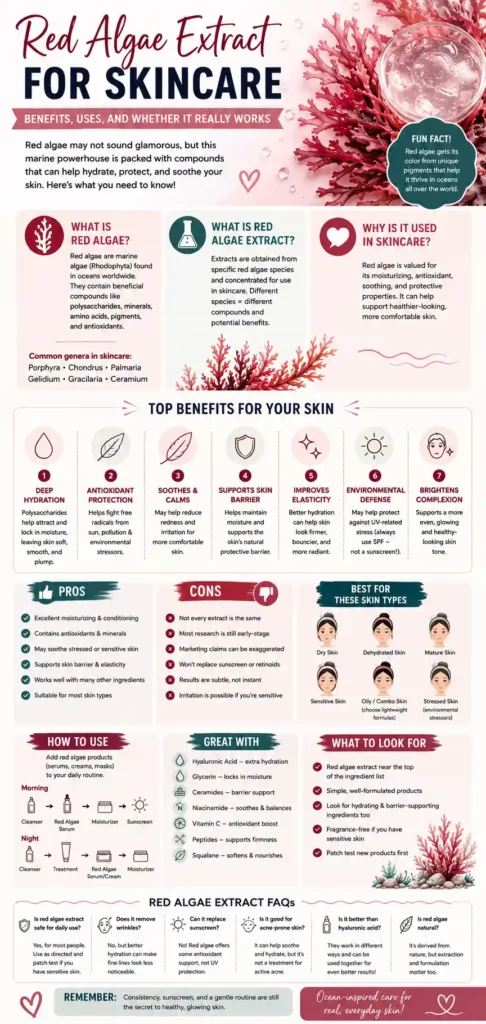
Red algae is a type of marine algae belonging to a group called Rhodophyta.
Despite the name, it isn’t always bright red. Different types can look red, pink, purple, brown, or even very dark.
Most red algae live in the sea, and they’ve been used for years in food, supplements, cosmetics, and even medical research.
For skincare, companies usually extract specific components from the algae rather than simply putting raw seaweed into a jar of face cream.
You may see ingredients from red algae species such as:
Porphyra
Chondrus
Palmaria
Gelidium
Gracilaria
Ceramium
Now, I’ll be honest: I don’t expect anyone to memorize those names.
The main thing to know is that “red algae extract” isn’t just one ingredient. Different types of algae can contain different compounds, so one red algae product may behave quite differently from another.
Why Is Red Algae Used in Skincare?
This is where things start to get interesting.
Red algae can contain compounds that help attract and hold onto water, which is one reason it’s so useful in moisturizing skincare.
It can also contain antioxidants and other bioactive compounds that researchers are looking at for their possible skin-protective and soothing properties.
In skincare, red algae is often added because it’s supposed to help with things like:
Hydration
Dryness
Dullness
Fine lines
Skin softness
Environmental stress
Loss of elasticity
Barrier support
Some of those claims are more convincing than others.
For me, the strongest benefits are hydration, conditioning, and antioxidant support.
1. It Can Help Your Skin Feel More Hydrated
This is probably the main reason I’d personally choose a red algae skincare product.
Red algae contains polysaccharides, and many of these can hold water or form a light film over the skin.
In simple terms, that can help your skin feel:
Softer
Smoother
Less tight
Less flaky
More comfortable
And if your skin is dehydrated, improving moisture levels can make a surprisingly big difference to how it looks.
Fine dehydration lines may appear softer, and your skin can look a little plumper and healthier.
That doesn’t mean red algae is filling in wrinkles permanently.
It’s more like giving thirsty skin a decent drink.
2. It May Give Your Skin Some Antioxidant Support
I always like seeing antioxidant ingredients in skincare, especially when they’re part of a well-rounded formula.
Our skin deals with a lot during the day, including UV exposure, pollution, and other environmental stressors.
These can contribute to oxidative stress, which is linked with premature skin aging.
Red algae can contain antioxidant compounds that may help support the skin’s defenses.
I wouldn’t rely on it as my main anti-aging strategy, though.
If I had to choose between a red algae serum and daily sunscreen, sunscreen would win every single time.
I think of red algae as an extra layer of support rather than the main event.
3. It May Help Soothe Stressed Skin
This is another reason red algae catches my attention.
Some marine-derived ingredients are being studied for their potential anti-inflammatory and soothing effects.
That could make red algae useful if your skin often feels:
Dry
Tight
Uncomfortable
Easily stressed
Sensitive after cleansing
Of course, the whole formula matters.
If a red algae cream is packed with fragrance or other ingredients your skin hates, the algae isn’t going to magically cancel that out.
For sensitive skin, I always think simpler is usually better.
4. It May Support the Skin Barrier
Your skin barrier does a huge amount of work for you.
It helps keep moisture in and irritants out.
When that barrier isn’t happy, your skin often lets you know very quickly.
It might feel:
Tight
Dry
Flaky
Itchy
Rough
Sensitive
Because red algae contains moisture-binding compounds, it may help support the outer layers of the skin and improve overall comfort.
That said, if repairing my skin barrier was my number one goal, I’d still look for ingredients like ceramides, glycerin, squalane, and petrolatum too.
For me, red algae is a nice addition to those ingredients rather than a replacement.
5. It Could Help Skin Look Plumper
I think this is where skincare marketing sometimes gets carried away.
Can red algae make your skin look smoother and a bit plumper?
Possibly, yes.
Can it erase deep wrinkles?
No.
When skin is well hydrated, tiny lines often look less obvious.
That’s why a good moisturizer can sometimes make your face look fresher within hours.
Red algae may contribute to that effect by helping the skin hold onto moisture.
So if you see a red algae product promising “younger-looking skin,” I’d translate that in my head as:
better hydrated skin may look smoother and plumper.
That’s a much more realistic expectation.
6. Red Algae May Have Anti-Aging Potential
There is some genuinely interesting research into algae compounds and skin aging.
Scientists have studied marine algae for antioxidant, anti-inflammatory, and photoprotective properties.
But this is where I always think we need to be careful.
A laboratory study showing that a compound extracted from algae does something interesting is not the same as proving that a moisturizer containing a tiny amount of that extract will reverse skin aging.
So yes, red algae has anti-aging potential.
But I wouldn’t ditch proven ingredients like sunscreen or retinoids for it.
I’d use red algae alongside them.
7. It May Help Protect Against Environmental Stress
Some red algae compounds are being researched for their ability to help protect skin against damage associated with UV exposure.
That’s exciting from a cosmetic science point of view.
But—and this is important—red algae is not sunscreen.
I would never apply a red algae serum in the morning and assume my skin is protected from the sun.
Always use proper broad-spectrum SPF.
If the algae gives you a little extra antioxidant support underneath, great.
Think bonus, not replacement.
Is Red Algae Good for Dry Skin?
Yes, this is probably where I think it makes the most sense.
If your skin constantly feels dry or tight, red algae could be a lovely ingredient to try.
I’d look for it in a moisturizer containing other hydrating ingredients like:
Glycerin
Hyaluronic acid
Ceramides
Squalane
Shea butter
Petrolatum
That kind of formula is much more appealing to me than a fancy algae cream where the algae is basically doing all the marketing work.
Is Red Algae Good for Mature Skin?
I think it can be.
As skin gets older, it often becomes drier and may not hold onto moisture quite as effectively.
That makes hydrating ingredients increasingly useful.
Red algae may help mature skin look:
Softer
Smoother
More comfortable
Slightly plumper
But again, I wouldn’t buy it expecting dramatic lifting or wrinkle removal.
If mature skin is your concern, I’d still focus on a routine built around:
Daily sunscreen
Moisturizer
Retinoids if suitable
Gentle cleansing
Consistency
Red algae can fit nicely into that routine.
Is Red Algae Good for Sensitive Skin?
Potentially, yes.
Some marine ingredients are being investigated for soothing and barrier-supporting properties.
But “natural” doesn’t automatically mean gentle.
Sensitive skin can react to almost anything.
If I had very reactive skin, I’d look for a product that’s:
Fragrance-free
Simple
Moisturizing
Designed for sensitive skin
And I’d patch test it first.
Is Red Algae Good for Oily Skin?
It can be.
The algae itself isn’t necessarily oily or heavy.
What matters more is the product texture.
A lightweight red algae serum could work beautifully for oily skin, while a thick red algae cream may feel too rich.
So I’d choose based on the whole formula, not just the star ingredient.
What About Acne-Prone Skin?
I wouldn’t use red algae as my main acne treatment.
That’s not really what it’s best at.
If you’re dealing with clogged pores, blackheads, or active breakouts, ingredients like these have much stronger evidence:
Salicylic acid
Benzoyl peroxide
Adapalene
Azelaic acid
Red algae may still be useful for hydration and comfort, especially if acne treatments are drying your skin out.
But I wouldn’t expect it to clear acne by itself.
Can Red Algae Remove Wrinkles?
No.
I know that’s probably not the most exciting answer, but it’s the realistic one.
It may help your skin look smoother because hydrated skin naturally looks fuller.
It may also provide antioxidant support.
But it isn’t going to erase deep lines or sagging.
Whenever I see a seaweed cream promising dramatic lifting, I become very skeptical very quickly.
What Is Carrageenan?
Carrageenan is one of the ingredients that can come from certain red seaweeds.
It’s a type of polysaccharide and is often used because it can help thicken products, create a smooth texture, and hold onto water.
In skincare, that can contribute to a more moisturizing feel.
This is actually a good reminder that an ingredient doesn’t have to penetrate deep into your skin to be useful.
Sometimes simply helping the surface stay smooth and hydrated is enough to make a visible difference.
Red Algae vs. Green Algae vs. Brown Algae
I used to think algae was basically algae.
It isn’t.
Red, green, and brown algae contain different compounds and can have different cosmetic uses.
For example, brown algae is often associated with fucoidan, while red algae is known for compounds such as sulfated polysaccharides.
So if a skincare brand simply says “algae extract,” that doesn’t really tell you very much.
I’d always be more interested in the actual ingredient list.
What Ingredients Work Well With Red Algae?
One thing I really like about red algae is that it’s easy to slot into a normal skincare routine.
It works well alongside plenty of familiar ingredients.
Hyaluronic Acid
Great for boosting hydration.
Glycerin
One of the simplest and most reliable moisturizing ingredients around.
Ceramides
Ideal if you’re focusing on barrier repair.
Niacinamide
A nice all-rounder that can help with barrier function and uneven-looking skin.
Vitamin C
Adds extra antioxidant support.
Peptides
Often combined with algae in anti-aging products.
Squalane
Lovely for dry skin and helps reduce moisture loss.
How I Would Use a Red Algae Product
I wouldn’t overcomplicate it.
If I were using a red algae serum, I’d probably apply it after cleansing and before moisturizer.
My morning routine might look like:
Cleanser → Red algae serum → Moisturizer → Sunscreen
At night:
Cleanser → Treatment product → Red algae serum or moisturizer
You definitely don’t need three different algae products at once.
One good serum or moisturizer is enough.
What Should You Look for in a Red Algae Product?
I always think the ingredient list matters more than the marketing on the front.
I’d look for red algae alongside proven moisturizing ingredients.
Good combinations might include:
Red algae + glycerin
Red algae + hyaluronic acid
Red algae + ceramides
Red algae + niacinamide
Red algae + squalane
I also wouldn’t automatically assume that a very expensive marine cream is better.
Sometimes you’re paying for beautiful packaging and the word “ocean.”
Red Algae Extract: Pros and Cons
Pros
It’s hydrating.
This is probably the biggest benefit for me.
It may help dry skin feel more comfortable.
A good formula can leave skin softer and less tight.
It contains antioxidant compounds.
That gives it some interesting skin-protective potential.
It may suit mature skin.
Especially if dryness is becoming more noticeable.
It fits easily into most skincare routines.
Cons
Not all red algae extracts are the same.
A lot of the research is still early-stage.
Some anti-aging claims are exaggerated.
It doesn’t replace sunscreen.
It won’t erase wrinkles.
The rest of the formula still matters enormously.
Are There Any Side Effects?
Most people will probably tolerate a well-formulated red algae cosmetic without a problem.
But any skincare product can cause irritation.
Watch out for:
Redness
Itching
Burning
Stinging
Breakouts
Rash
And remember, the algae may not even be the problem.
Fragrance, essential oils, preservatives, or other active ingredients could be responsible.
If something makes your skin angry, stop using it.
Is Natural Red Algae Better?
Not automatically.
I don’t really buy into the idea that “natural” always means better.
I’d much rather use a well-formulated, properly preserved skincare product than something natural but unstable or irritating.
For me, what matters is:
The quality of the formula
The concentration
The supporting ingredients
How my skin reacts
Whether I actually see a benefit
So, Does Red Algae Extract Really Work?
I think it does—but within reason.
Red algae looks most useful to me as a hydrating, conditioning, and antioxidant-supporting skincare ingredient.
It can help dry skin feel better.
It may help the surface look smoother and a little plumper.
It may also provide useful antioxidant compounds.
What it probably won’t do is:
Erase wrinkles
Lift sagging skin
Replace sunscreen
Cure acne
Completely reverse sun damage
And I’m perfectly fine with that.
Not every ingredient needs to be revolutionary.
Sometimes “makes my skin feel softer and more comfortable” is actually a pretty good result.
My Verdict
Would I use red algae extract in skincare?
Yes, I would.
I especially like the idea of it in a hydrating serum or moisturizer for dry, dehydrated, or mature skin.
But I wouldn’t buy a product just because the words RED ALGAE are printed in huge letters on the jar.
I’d still turn the bottle around and look at the full ingredient list.
If it contains red algae plus glycerin, ceramides, squalane, or hyaluronic acid, then I’m much more interested.
For me, red algae is a nice supporting ingredient rather than a skincare superstar.
And honestly, that’s probably where it works best.
Red Algae Extract FAQs
1. Is red algae extract good for your face?
Yes, it can be. It’s mainly interesting for its moisturizing, conditioning, and antioxidant properties.
2. Can I use red algae every day?
If the product is designed for daily use and your skin likes it, yes.
3. Does red algae hydrate skin?
That’s one of its most useful potential benefits. Red algae contains polysaccharides that can help with moisture retention and skin conditioning.
4. Is red algae good for mature skin?
I think it can be particularly useful for mature skin because hydration often becomes more important as skin gets older.
5. Can red algae tighten your skin?
I wouldn’t expect genuine tightening. Better hydration may make skin look smoother and temporarily plumper, though.
6. Is red algae the same as retinol?
No. They’re completely different ingredients.
Sources
National Library of Medicine (NIH/PMC) – Marine Algae-Derived Carbohydrates for Skin Health
This scientific review covers how algae-derived compounds may provide antioxidant, anti-inflammatory, moisturizing, and skin-protective benefits.
https://pmc.ncbi.nlm.nih.gov/articles/PMC6266229/
PubMed – Marine Ingredients for Sensitive Skin
A useful source for claims about marine ingredients potentially helping reduce inflammation and support the skin barrier, especially in sensitive-skin formulations.
https://pubmed.ncbi.nlm.nih.gov/34436303/
U.S. Food & Drug Administration – Allergens in Cosmetics
Ideal for your safety section. The FDA explains that skincare and other cosmetic products can cause allergic reactions or irritation in some people, which supports your advice about patch testing and monitoring skin reactions.
https://www.fda.gov/cosmetics/cosmetic-ingredients/allergens-cosmetics