
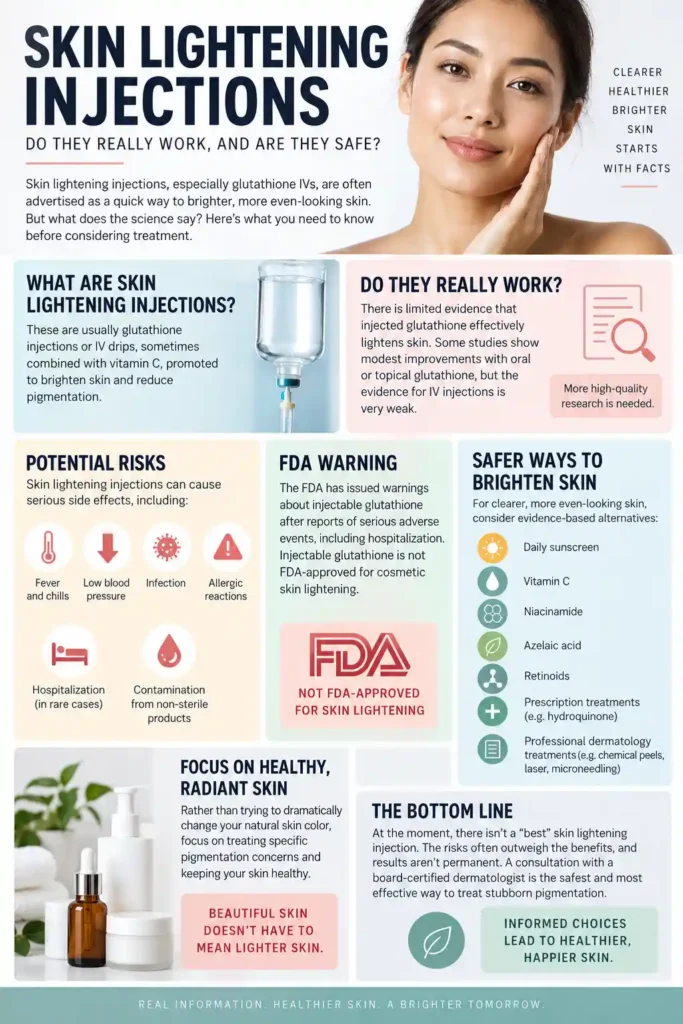
Skin lightening injections have attracted a lot of attention over the past few years, particularly injections and IV drips containing glutathione. They’re often advertised as a quick way to achieve brighter, more radiant or more even-looking skin.
It certainly sounds appealing. Instead of waiting months for creams or serums to improve dark spots, you simply have an injection or IV infusion and supposedly brighten your skin from the inside out.
Unfortunately, the reality isn’t nearly that simple.
Research into injectable skin lightening is still surprisingly limited, and there are some genuine safety concerns to consider. In fact, recent warnings from the FDA have made me much more cautious about recommending this type of treatment.
So if you’ve been searching for the “best skin lightening injections,” here’s what I think you really need to know before booking an appointment.
Learn more about Skin Lightening >
What Are Skin Lightening Injections?
When people talk about skin lightening injections, they’re usually referring to glutathione injections or IV glutathione infusions.
Glutathione is an antioxidant naturally produced by our bodies. It plays an important role in protecting cells against oxidative stress and is involved in many normal biological processes.
Researchers also discovered that glutathione can influence melanin production, which is why it eventually found its way into the beauty and skin-lightening industry.
Some clinics now offer glutathione intravenously, sometimes combined with ingredients such as vitamin C.
You’ll also see these treatments described using terms such as:
glutathione injections
glutathione IV drips
skin whitening injections
skin brightening injections
whitening drips
complexion-brightening IV therapy
Whatever terminology is used, I’d be cautious about assuming that an IV treatment is automatically more effective simply because it sounds more medical.
Do Glutathione Injections Really Lighten the Skin?
This is where the marketing and scientific evidence start to separate.
There is some evidence that glutathione can influence pigmentation. However, the strongest research has generally involved oral or topical glutathione rather than injections.
A 2025 systematic review examining glutathione for skin lightening and melasma found several studies suggesting that topical and oral glutathione may produce modest improvements in pigmentation.
But when researchers looked at intravenous glutathione, the evidence was extremely weak.
The review found only one placebo-controlled IV study, and the authors concluded that intravenous glutathione should not be used for skin lightening because of its limited evidence of effectiveness and potential side effects.
A more recent 2026 review examining systemic glutathione has again highlighted the limited evidence surrounding its use for cosmetic skin lightening.
In other words, glutathione is biologically interesting, but that doesn’t mean an IV drip has been proven to safely transform your complexion.
Why Is Glutathione Used for Skin Brightening?
To understand the idea behind glutathione treatments, it helps to understand melanin.
Melanin is the pigment responsible for much of the natural color of our skin, hair and eyes.
The amount and type of melanin your skin produces are strongly influenced by genetics, but pigmentation can also change because of:
sun exposure
inflammation
acne
hormonal changes
pregnancy
certain medications
skin injuries
melasma
Glutathione may interfere with processes involved in melanin formation, which is where the theory behind its skin-brightening effect comes from.
Some studies of oral and topical glutathione have reported reductions in measurements of skin pigmentation.
However, results have been inconsistent and improvements may disappear after treatment stops. Earlier systematic reviews also concluded that the overall evidence for glutathione as a skin-lightening ingredient remained inconclusive.
Are Skin Lightening Injections FDA Approved?
This is an important distinction.
Injectable glutathione is not an FDA-approved cosmetic treatment for skin lightening.
The FDA has previously taken action against companies marketing injectable skin-whitening products as unapproved drugs, and the agency has warned that injectable products marketed for whitening or lightening skin may present serious safety concerns.
That doesn’t necessarily mean every medical use of glutathione is dangerous.
It does mean that you shouldn’t assume that something advertised by a spa, wellness center or online seller has been evaluated and approved by the FDA specifically for cosmetic skin lightening.
The Latest FDA Warning About Injectable Glutathione
There’s an especially important update if you’re reading this in 2026.
On August 27, 2026, the FDA issued a warning concerning glutathione being used to prepare injectable products.
The FDA reported being aware of at least 30 patients experiencing adverse events after receiving IV glutathione alone or combined with other ingredients.
Reported symptoms included:
fever
chills
pain
dizziness
low blood pressure
shock-like symptoms
sepsis-like symptoms
Some patients required hospitalization.
The problem involved glutathione labeled as dietary-supplement grade being used to compound injectable medications. The FDA explained that ingredients manufactured for supplements may contain impurities or contaminants that aren’t suitable for injection.
This isn’t the first time problems have occurred either.
In 2019, the FDA investigated adverse reactions after patients received compounded intravenous glutathione containing potentially high levels of endotoxins. Some patients developed symptoms including vomiting, fever, chills, low blood pressure and breathing difficulties.
For me, this is a major reason not to view cosmetic IV glutathione as an ordinary beauty treatment.
What Are the Risks of Glutathione Injections?
Any intravenous treatment introduces risks that simply aren’t present when you’re applying skincare to your face.
Possible concerns include reactions to the ingredient itself as well as complications related to injections or IV administration.
Reported or potential problems include:
Allergic reactions
Any injected substance can potentially cause an allergic reaction. Severe reactions require urgent medical treatment.
Infection
Breaking the skin introduces an infection risk, particularly when appropriate sterile medical procedures aren’t followed.
Contamination
This is one of the concerns highlighted by recent FDA reports.
A product designed to be swallowed isn’t necessarily pure or sterile enough to be injected directly into the bloodstream.
Unpredictable formulations
Some skin-brightening drips combine glutathione with vitamin C or other compounds.
The more ingredients a treatment contains, the harder it can become to determine exactly what you’re receiving and how those substances might interact.
Unknown long-term effects
Perhaps the biggest problem is simply a lack of high-quality long-term research.
IV glutathione has become popular for cosmetic purposes much faster than researchers have been able to establish its long-term safety.
What About Vitamin C Skin Lightening Injections?
Vitamin C is another ingredient sometimes added to skin-brightening IV treatments.
Vitamin C absolutely has a role in healthy skin. It acts as an antioxidant and is involved in collagen production, and topical vitamin C can be useful in a skincare routine targeting dullness and uneven pigmentation.
That doesn’t automatically make high-dose intravenous vitamin C an appropriate cosmetic skin-lightening treatment.
A nutrient can behave very differently when injected directly into your bloodstream compared with consuming it in food or applying it to your skin.
I wouldn’t use an IV simply because a clinic markets the ingredients as “natural.”
Learn about Vitamins for Acne >
Can Skin Lightening Injections Permanently Change Your Skin Color?
There’s no good evidence that glutathione injections permanently change your natural skin color.
Even studies reporting some pigmentation improvement have raised questions about how long those changes last.
In research reviewed by the FDA, some apparent skin-lightening effects gradually disappeared after glutathione treatment stopped. The FDA’s scientific review described the evidence for IV glutathione and pigmentation as minimal and contradictory.
That means repeated treatments may be needed to maintain any effect — something that potentially increases both cost and exposure to risk.
Skin Brightening and Skin Whitening Aren’t Really the Same Thing
I think this distinction is worth making.
Trying to dramatically change your natural skin tone is very different from treating unwanted pigmentation.
If what you’re actually bothered by is:
acne marks
sun spots
melasma
post-inflammatory hyperpigmentation
uneven pigmentation
dull-looking skin
then you don’t necessarily need to “whiten” your skin.
Treating the underlying pigmentation problem is generally a much more sensible goal.
For example, fading an acne mark is about reducing excess pigment in one area rather than changing the natural color of all your skin.
Safer Ways to Brighten Uneven Skin
If your goal is clearer, brighter or more even-looking skin, I’d start with treatments that have considerably more dermatological evidence behind them.
1. Use Sunscreen Every Day
This may sound less exciting than an injection, but it’s arguably the most important step.
UV exposure stimulates pigmentation and can make existing dark spots considerably harder to fade.
The American Academy of Dermatology recommends a broad-spectrum, water-resistant SPF 30 or higher for people dealing with melasma.
Tinted sunscreen containing iron oxides can be particularly useful because visible light can also worsen melasma, especially in darker skin tones.
If you’re spending money on brightening products but not protecting your skin from the sun, you’re making their job much harder.
2. Vitamin C
Topical vitamin C can be a nice option for dull-looking or uneven skin.
It isn’t going to change your natural skin color overnight, but it can complement sunscreen and other pigmentation treatments while providing antioxidant protection.
3. Niacinamide
Niacinamide is one of my favorite ingredients for a gentle brightening routine.
It’s generally easy to incorporate into everyday skincare and can help improve the appearance of uneven tone while also supporting the skin barrier.
4. Azelaic Acid
Azelaic acid can be particularly useful when pigmentation accompanies acne or inflammation.
It’s often used for acne, rosacea and post-inflammatory pigmentation and tends to be better tolerated than some more aggressive lightening ingredients.
5. Retinoids
Retinoids encourage normal skin-cell turnover and can gradually improve uneven pigmentation alongside other signs of sun damage.
Prescription tretinoin is considerably stronger than cosmetic retinol products and should be used under appropriate medical guidance.
6. Prescription Hydroquinone
Hydroquinone remains an established medical treatment for certain pigmentation problems.
In the United States, hydroquinone for treating melasma is now available by prescription rather than as an ordinary over-the-counter skin-lightening product.
Dermatologists sometimes prescribe it alone or as part of a combination containing tretinoin and a corticosteroid.
It isn’t something I’d use indefinitely without professional supervision.
7. Professional Dermatology Treatments
Depending on what’s causing your pigmentation, a dermatologist may suggest treatments such as:
chemical peels
prescription creams
laser treatments
light-based treatments
microneedling
combination therapy
The important part is getting the pigmentation diagnosed correctly first.
Melasma, freckles, post-acne marks and sun damage don’t necessarily respond in the same way.
What About Oral Glutathione?
Oral glutathione is another frequently marketed skin-lightening option.
The evidence here is somewhat more encouraging than it is for IV injections, but I still wouldn’t call glutathione a proven miracle treatment.
Several small randomized trials have found reductions in melanin measurements using oral glutathione.
The 2025 systematic review found that studies using oral doses between 250 and 500 mg reported some pigmentation improvements. However, study quality varied and the results weren’t necessarily permanent.
That’s very different from saying that everyone taking a glutathione supplement will noticeably lighten their complexion.
Supplements can also interact with health conditions or medications, so it’s sensible to speak to your doctor before taking something specifically for cosmetic purposes.
Should You Buy Glutathione Injections Online?
I wouldn’t.
Injectable products are very different from ordinary skincare.
You need to know:
exactly what’s in the vial
where it was manufactured
whether it was made for injection
whether it was correctly stored
whether it’s sterile
who prepared it
whether the person administering it is medically qualified
An online seller cannot necessarily provide those guarantees.
The FDA has previously seized and recalled unapproved injectable products marketed specifically for skin whitening.
Self-injecting products purchased online adds another layer of unnecessary risk.
What Should I Ask a Clinic Offering Skin Brightening IVs?
If you’re still considering treatment, don’t be embarrassed about asking questions.
I’d want to know exactly what substance is being administered and why.
Questions worth asking include:
What exactly is in the IV?
Is glutathione included?
Who manufactured the injectable product?
Is the ingredient pharmaceutical/injectable grade?
Is this treatment FDA approved for the purpose you’re recommending it for?
Who will administer the IV?
What medical qualifications do they have?
What are the known side effects?
What happens if I have a serious reaction?
What evidence shows that the treatment works?
How long are the results expected to last?
Be especially cautious if you’re promised permanent whitening, dramatic changes after one treatment or guaranteed results.
Who Should Treat Stubborn Hyperpigmentation?
If pigmentation is significant enough that you’re considering injections, I’d personally spend the money on an appointment with a board-certified dermatologist first.
Sometimes what looks like simple pigmentation can actually be melasma, post-inflammatory hyperpigmentation, medication-related pigmentation or another skin condition.
A dermatologist can identify what’s causing it and build a treatment plan around the problem rather than simply trying to lighten your entire complexion.
So, What Is the Best Skin Lightening Injection?
At the moment, I don’t think there’s enough reliable evidence to name a “best” skin-lightening injection.
Glutathione is certainly the most widely discussed injectable ingredient, but IV glutathione hasn’t been convincingly shown to be a safe, effective or long-lasting cosmetic skin-lightening treatment.
Current research is much more supportive of investigating topical and, to a lesser extent, oral glutathione than intravenous treatment. Even then, we still need better long-term studies.
And with the FDA reporting new adverse events involving compounded IV glutathione as recently as August 2026, I’d be particularly cautious about undergoing these treatments purely for cosmetic reasons.
My Bottom Line
I understand why skin-lightening injections sound tempting.
If you’re struggling with dark marks, melasma or uneven pigmentation, the idea of quickly correcting everything with an IV drip can be very appealing.
But quick doesn’t necessarily mean better.
For most of us, a combination of daily sun protection, evidence-based skincare and dermatologist-guided pigmentation treatments is a much more sensible route to brighter, healthier-looking skin.
Rather than trying to dramatically change your natural complexion, I’d focus on keeping your skin healthy and treating the specific pigmentation that’s bothering you.
Beautiful skin doesn’t have to mean lighter skin. Clearer, smoother and more even-looking skin is a much more realistic — and healthier — goal.
This article is for general informational purposes only and isn’t a substitute for medical advice. If you’re considering injectable, prescription or professional pigmentation treatments, speak to a qualified healthcare professional or board-certified dermatologist first.
Useful Links
U.S. Food & Drug Administration (FDA) – Glutathione Injectable Safety Warning
Very current source covering adverse events associated with IV glutathione, including fever, chills, low blood pressure, sepsis-like reactions and hospitalizations.
https://www.fda.gov/drugs/human-drug-compounding/fda-reminds-compounders-not-use-dietary-supplement-grade-glutathione-injectables
American Academy of Dermatology – Melasma: Diagnosis and Treatment
Useful authoritative resource covering safer pigmentation treatments including sunscreen, hydroquinone, tretinoin, azelaic acid and vitamin C.
https://www.aad.org/public/diseases/a-z/melasma-treatment
PubMed – Glutathione as a Skin-Lightening Agent and in Melasma: A Systematic Review
A 2025 scientific review assessing topical, oral and IV glutathione. Importantly, it found very limited evidence for intravenous glutathione and concluded IV use was not supported because of insufficient effectiveness and safety concerns.
https://pubmed.ncbi.nlm.nih.gov/39444151/
FDA – Recall of Compounded Glutathione Injections
Details a 2026 U.S. recall of compounded glutathione injections after elevated endotoxin levels were discovered. Reported reactions included fever, chills, severe headache, nausea, vomiting and blood-pressure changes.
https://www.fda.gov/safety/recalls-market-withdrawals-safety-alerts/victory-medical-center-pharmacy-issues-voluntary-nationwide-recall-certain-lots-compounded
American Academy of Dermatology – Melasma Self-Care
Good reader-friendly source for your safer-alternatives section, particularly daily SPF 30+, tinted sunscreen containing iron oxide and gentle skincare for pigmentation.
https://www.aad.org/public/diseases/a-z/melasma-self-care














Comments 1