So, what might your acne actually be telling you? Here is a head-to-toe guide.
Acne has an annoying habit of appearing exactly where you do not want it. One week it might be scattered across your forehead, while the next you have a painful spot sitting stubbornly on your chin. Then there is back acne, chest acne and those uncomfortable breakouts that appear along the hairline, neck or even bottom.
It is tempting to believe that the location of every pimple provides a secret map of what is happening inside your body. You may have seen acne “face maps” claiming that forehead acne means digestive problems, cheek spots indicate lung trouble or pimples on the nose suggest problems with your heart.
Unfortunately, there is little scientific evidence supporting that kind of precise face mapping.
That does not mean the location of your acne is completely meaningless, though.
Learn more about Acne: Causes, Types, Treatments & How to Get Clearer Skin
Certain areas really can offer clues. Hormones, sweat, friction, hair products, cosmetics, medications and other factors can influence where breakouts appear.
Adult hormonal acne, for example, commonly affects the chin and jawline, while acne frequently develops on the face, chest, shoulders and upper back because these areas contain large numbers of oil-producing glands.
First: What Actually Causes Acne?
Before looking at individual areas of the body, it helps to understand what is happening inside a spot.
Acne develops when hair follicles become clogged with oil and dead skin cells. Bacteria and inflammation can then contribute to the familiar collection of:
Blackheads
Whiteheads
Papules
Pustules
Nodules
Cysts
Hormonal changes can increase oil production, while stress may aggravate acne that you already have. Certain medications, including some containing corticosteroids, testosterone or lithium, can also trigger or worsen breakouts.
And acne is not a sign that your skin is dirty. Scrubbing aggressively can actually irritate your skin and make matters worse.
1. Forehead Acne
The forehead is one of the most common places for clogged pores, blackheads and small pimples.
What might be going on?
The forehead naturally produces plenty of sebum, so clogged pores are common here.
However, your beauty routine might also contribute.
Think about anything regularly touching your forehead:
Hair oils
Leave-in conditioner
Styling creams
Dry shampoo
Heavy sunscreen
Makeup
Hats
Headbands
Sports helmets
If you have a fringe, oil and hair products can also sit against the forehead throughout the day.
Comedonal acne — primarily blackheads and whiteheads — commonly develops on the forehead and chin.
Is forehead acne caused by poor digestion?
You may have heard claims that forehead acne means your digestive system is struggling.
There is currently no reliable evidence showing that the exact position of forehead spots can diagnose digestive problems.
Diet may influence acne in some people, but it is much more complicated than “spots here equal problems with this organ.”
What can help?
Keep hair products away from your forehead wherever possible and choose skincare labelled non-comedogenic.
Salicylic acid can also be useful for clogged pores because it helps remove oil and dead skin cells from inside the follicle.
2. Hairline Acne
Those annoying little bumps around the edges of your forehead may have a surprisingly straightforward explanation.
Hair products are common suspects.
Pomades, waxes, conditioners and oils can transfer onto the surrounding skin and clog pores.
You may sometimes hear this called pomade acne.
Try switching to lighter hair products and make sure you properly cleanse around the hairline when washing your face.
Do not forget hats, headbands, scarves and pillowcases either. Anything repeatedly carrying oil, sweat or product residue against the skin can contribute to irritation and clogged follicles.
3. Acne Between the Eyebrows
Traditional face maps sometimes associate spots between the eyebrows with the liver.
There is no good evidence that a pimple appearing here means you have liver trouble.
It is much more likely to involve the same factors responsible for acne elsewhere:
Excess oil
Blocked follicles
Hormonal fluctuations
Cosmetics
Sweat
Friction
If breakouts consistently occur around your brows, take a look at the makeup, eyebrow gels, oils and skincare products you use in that area.
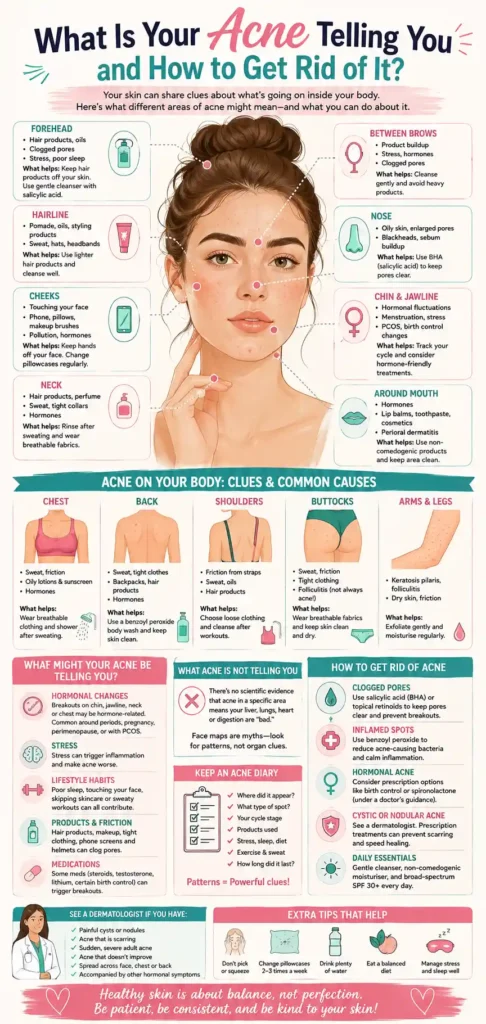
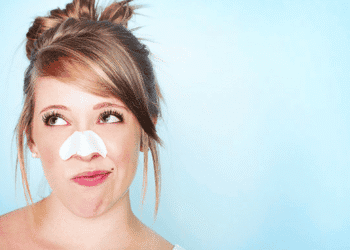
4. Nose Acne
The nose can be particularly oily because it contains numerous sebaceous glands.
This makes it an ideal location for blackheads and clogged pores.
Those tiny dark dots across your nose are not necessarily all blackheads, though. Some may be sebaceous filaments, which are normal structures that help transport sebum to the skin surface.
Does nose acne indicate heart problems?
No reliable evidence shows that having acne on your nose can diagnose heart problems or high blood pressure.
A persistent red, swollen or unusual-looking bump on the nose that does not behave like normal acne should, however, be assessed by a healthcare professional.
5. Cheek Acne
Cheek breakouts can have several potential triggers.
Hormones may be involved, but it is also worth considering what repeatedly touches your cheeks.
That could include:
Your phone
Pillowcases
Makeup brushes
Hands
Scarves
Helmets
Face masks
Friction and pressure against the skin are recognised factors that can contribute to acne.
Do cheek spots mean lung problems?
Another popular face-mapping claim links cheek acne to the lungs.
Again, acne location cannot reliably diagnose the health of your lungs.
If cheek acne is persistent, think first about skincare products, cosmetics, hormones and anything regularly touching the area.
6. Chin Acne
The chin is where acne location becomes somewhat more informative.
Persistent adult acne around the chin is frequently associated with hormonal fluctuations.
Hormonal acne may include:
Painful bumps
Deep cysts
Recurring breakouts
Spots that appear before your period
Breakouts that repeatedly affect the same areas
The chin and jawline are particularly common locations for hormonal acne in adults.
What might be happening inside your body?
Changes in androgen activity can stimulate sebaceous glands and increase oil production.
Hormonal changes associated with menstruation, pregnancy, stopping hormonal contraception, perimenopause and menopause may therefore affect acne.
A hormonal cause does not mean there is necessarily anything medically wrong.
However, acne accompanied by additional symptoms may sometimes warrant investigation.
For example, persistent acne alongside irregular periods or excess facial or body hair can be associated with hormonal conditions.
7. Jawline Acne
Jawline acne is another classic location for adult hormonal breakouts.
These spots can be frustrating because they are often deeper than ordinary whiteheads.
You might notice painful:
Papules
Nodules
Cysts
Under-the-skin lumps
Hormonal breakouts around the lower face can become particularly inflamed.
Look for patterns
Rather than concentrating on one individual spot, pay attention to when the acne appears.
Does it consistently worsen:
Before your period?
During stressful periods?
After changing contraception?
During pregnancy?
Around perimenopause or menopause?
Patterns over several months can tell you much more than the precise location of one pimple.
8. Acne Around the Mouth
Spots around the mouth can sometimes be hormonal, particularly when they occur alongside chin and jawline acne.
However, products are also worth investigating.
Potential triggers include:
Lip balm
Heavy moisturisers
Makeup
Shaving products
Facial oils
And remember that not every rash around your mouth is acne.
Perioral dermatitis, for example, can produce small acne-like bumps around the mouth and nose and requires a different approach.
If your “acne” is persistent, itchy, burning or does not respond to normal acne treatments, a dermatologist can help establish what it actually is.
9. Neck Acne
Acne can extend from the jawline onto the neck, particularly when hormones are involved.
Hormonal period-related acne may appear on the neck as well as the lower face.
Other possible contributors include:
Hair products
Perfume
Sweat
Tight collars
Sports clothing
Shaving
If you regularly exercise, showering and changing sweaty clothing soon afterwards may help reduce prolonged exposure to sweat and friction.
10. Chest Acne
The chest contains numerous oil glands, which is why acne frequently appears there.
You might notice anything from tiny clogged pores to inflamed pustules and cysts.
Common contributors include:
Sweating
Tight sportswear
Oily body lotions
Sunscreen
Hormonal changes
Friction
Hair conditioner running over the chest
Adult hormonal acne can also affect the chest.
Try choosing non-comedogenic body products and changing out of sweaty clothing after exercise.
A benzoyl peroxide body wash can sometimes be helpful for inflammatory body acne, although it can bleach towels and clothing.
11. Back Acne
Back acne — inevitably nicknamed bacne — is extremely common.
Your upper back contains plenty of sebaceous glands, making it a natural acne hotspot.
Acne commonly affects the back and shoulders as well as the face and chest.
Potential aggravating factors include:
Sweat
Tight clothing
Backpacks
Sports equipment
Oily sunscreen
Hair products
Hormonal changes
Back acne can be particularly troublesome because it is difficult to reach and deeper spots may go unnoticed until they become painful.
Do not assume you need to scrub harder.
Aggressive scrubbing can increase irritation without fixing the blocked follicles responsible for acne.
12. Shoulder Acne
Your shoulders sit directly beneath straps, clothing and hair, creating the perfect opportunity for a combination of oil, sweat and friction.
Backpack straps, sports bras and tight workout clothing can all repeatedly rub against this area.
Severe acne may affect the shoulders as well as the chest, face and back.
If you are frequently breaking out in exactly the same location beneath a strap or item of sports equipment, friction may be contributing.
13. Bottom and Buttock Acne
Those bumps on your bottom might look like acne, but they are not always true acne.
One common possibility is folliculitis, inflammation of hair follicles that can resemble pimples.
Heat, sweat, friction and tight clothing can all contribute to follicle irritation.
Severe true acne can sometimes affect the buttocks, but if bumps are itchy, widespread, recurrent or unusually painful, it is worth getting them properly diagnosed rather than assuming they are ordinary spots.
What About “Fungal Acne”?
Despite the nickname, fungal acne is not actually ordinary acne.
The term usually refers to Malassezia folliculitis, in which yeast affects hair follicles.
It can produce clusters of small, fairly uniform bumps that may be itchy.
Because fungal folliculitis and acne can look similar, using more and more traditional acne treatment may not necessarily solve the problem.
Cleveland Clinic notes that yeast-related follicular breakouts may be confused with hormonal acne.
If your spots are very itchy, remarkably uniform or failing to respond to normal acne treatments, see a healthcare professional.
Could Hormones Be Behind Your Acne?
Hormones are one of the most important internal influences on acne.
Androgens can increase sebum production, which makes pores more likely to become clogged.
Hormonal breakouts can occur during:
Puberty
Menstruation
Pregnancy
Postpartum hormonal changes
Perimenopause
Menopause
Changes in hormonal contraception
Adult acne can continue well into the 30s, 40s and 50s, and adult-onset acne is particularly common among women.
Hormonal acne does not always stay neatly on the jawline either. It can occur on the cheeks, neck, chest, shoulders and back.
Could Acne Be Connected to PCOS?
Persistent adult acne can sometimes occur alongside polycystic ovary syndrome (PCOS).
Acne alone does not mean you have PCOS.
However, it is worth speaking with a doctor if persistent acne accompanies symptoms such as:
Irregular or absent periods
Increased facial or body hair
Scalp hair thinning
Difficulty conceiving
Other signs of hormonal imbalance
The important point here is to look at the whole picture rather than diagnosing a hormonal condition based simply on where a spot appears.
Could Stress Be Causing Your Breakouts?
Stress does not simply create acne from nothing, but it may aggravate acne you already have.
And stress can affect your routine in other ways.
During stressful periods you may:
Sleep less
Touch your face more
Pick at spots
Eat differently
Skip skincare
Experience hormonal changes
If you repeatedly notice your acne worsening during difficult weeks, stress management may be a useful part of your overall approach — although it should not replace genuine acne treatment.
Could Your Diet Be Involved?
Diet and acne is a complicated subject.
There is some evidence that certain dietary patterns may influence acne in susceptible people, but food does not explain every breakout and specific pimple locations cannot tell you what foods you should stop eating.
Rather than eliminating entire food groups based on a face map, look for genuine repeated patterns and discuss major dietary changes with an appropriate healthcare professional.
Could Medication Be Causing Your Acne?
Sometimes a sudden breakout has less to do with skincare and more to do with medication.
Medicines containing substances such as corticosteroids, testosterone or lithium can contribute to acne in some people.
Never stop a prescribed medication because you suspect it is affecting your skin.
Speak to the healthcare professional who prescribed it instead.
Sudden Severe Adult Acne Deserves Attention
A few hormonal pimples are very different from suddenly developing severe acne when your skin was previously clear.
Mayo Clinic advises that sudden severe acne in an older adult can occasionally signal an underlying condition that requires medical attention.
That does not mean you should panic over a sudden spot.
It does mean an unusual, persistent or dramatic change in your skin is worth discussing with a healthcare professional.
What Your Acne Probably Isn’t Telling You
This is where I would be particularly cautious about traditional acne face maps.
There is no reliable diagnostic rule saying:
Forehead acne = digestive trouble
Between-the-brows acne = liver trouble
Nose acne = heart trouble
Cheek acne = lung trouble
Chin acne = reproductive-organ trouble
Your skin does not provide that precise an organ-by-organ diagnostic map.
There are, however, useful location patterns involving hormones, oil production, friction, sweat and products.
That is why acne location can provide clues without providing a diagnosis.
How to Get Rid of Acne
The best approach depends on whether you are dealing with clogged pores, inflammatory spots or deep cystic acne.
See: Why Managing Acne Is Vital for Long-Term Skincare >
For Blackheads and Whiteheads
Look for ingredients such as:
Salicylic acid
Helps clear oil and dead cells from clogged pores.
Topical retinoids
Help prevent dead skin cells from accumulating inside follicles and can be useful for long-term acne prevention.
See also: 11 Home Remedies to Try and Get Rid of Whiteheads >
For Red and Inflamed Spots
Benzoyl peroxide can help reduce acne-associated bacteria and inflammation.
Products come in various strengths, and stronger is not always better. Beginning gently can reduce dryness and irritation.
For Hormonal Acne
Topical treatments may still help, but stubborn hormonal acne sometimes responds better when the underlying hormonal component is addressed.
Dermatologists may consider treatments such as combined oral contraceptives or spironolactone for appropriate patients.
These are prescription treatments and are not suitable for everyone.
For Cystic and Nodular Acne
This is the acne I would be most reluctant to manage solely with DIY skincare.
Deep cysts and nodules have a much greater risk of scarring.
Severe acne commonly involves painful lesions extending deep into the skin, and scars frequently remain after these breakouts heal.
A dermatologist can offer treatments that go far beyond what an over-the-counter spot cream can achieve.
Don’t Squeeze the Clues Away
There is another reason to resist attacking every spot you see.
Picking can:
Increase inflammation
Damage surrounding tissue
Prolong healing
Increase pigmentation
Increase the likelihood of scarring
Instead of squeezing the latest breakout, start asking what has changed.
Did you switch conditioner?
Have your periods become irregular?
Are you wearing a new helmet?
Did the breakouts start after a medication change?
Are you suddenly experiencing lots of painful cysts?
Those questions are much more useful than asking which organ corresponds to which part of your face.
Keep a Breakout Diary
If your acne seems mysterious, try tracking it for two or three months.
Write down:
Where the acne appeared
What type of spot it was
Where you were in your menstrual cycle, if relevant
New skincare or makeup products
Hair products
Exercise
Stress
Medication changes
Whether you picked the spots
How long they lasted
Patterns that are impossible to notice from one breakout can become surprisingly obvious over time.
When Should You See a Dermatologist?
Get professional advice if you are experiencing:
Deep cysts
Painful nodules
Acne that is scarring
Persistent acne that does not improve
Widespread acne across the chest and back
Sudden severe adult acne
Acne accompanied by other possible hormonal symptoms
Skin bumps you are not sure are actually acne
Early treatment can reduce the risk of permanent acne scars.
So, What Is Your Acne Really Telling You?
Your spots probably cannot tell you exactly what is happening with your liver, lungs, kidneys or digestive system simply because of where they appear.
But your acne can still provide useful information.
Breakouts around your chin and jawline may point towards a hormonal pattern. Spots around your hairline may make you reconsider your styling products. Back and shoulder acne may be aggravated by sweat and friction. Chest breakouts might encourage you to change your body products or workout clothes.
The trick is to look for patterns rather than myths.
Pay attention to the location, timing, severity and type of breakout, as well as what else is happening in your life and body.
Sometimes the answer really is a clogged pore.
Sometimes it is your new conditioner.
Sometimes hormones are playing havoc with your skin.
And occasionally persistent or unusual acne is worth discussing with a healthcare professional.
Learning to read those genuine clues gives you a much better chance of treating your acne effectively — without blaming your liver every time a pimple appears between your eyebrows.
Resources
American Academy of Dermatology (AAD) – Adult Acne
Covers adult acne triggers, hormonal patterns, treatment options, and when to see a dermatologist.
https://www.aad.org/public/diseases/acne/really-acne/adult-acne
Mayo Clinic – Acne: Symptoms and Causes
Explains different acne types, common causes, risk factors, body areas where acne appears, and scarring.
https://www.mayoclinic.org/diseases-conditions/acne/symptoms-causes/syc-20368047
Cleveland Clinic – Acne Face Map: What Your Breakouts May Mean
Useful for discussing acne location, hormonal chin and jawline breakouts, hairline acne, and why traditional organ-based face mapping is not medically reliable.
https://health.clevelandclinic.org/acne-face-map