
Pregnancy can bring plenty of changes to your skin. While some people experience the famous pregnancy “glow,” others suddenly find themselves dealing with oily skin, clogged pores and breakouts they thought they had left behind years ago.
Pregnancy acne is extremely frustrating, particularly because many of the acne treatments you may normally reach for aren’t recommended while you’re expecting. The good news is that pregnancy acne is usually temporary, and there are still plenty of ways to care for your skin safely.
Here’s why those pregnancy pimples appear and what you can do about them.
Why Does Acne Occur During Pregnancy?
Hormones are largely responsible.
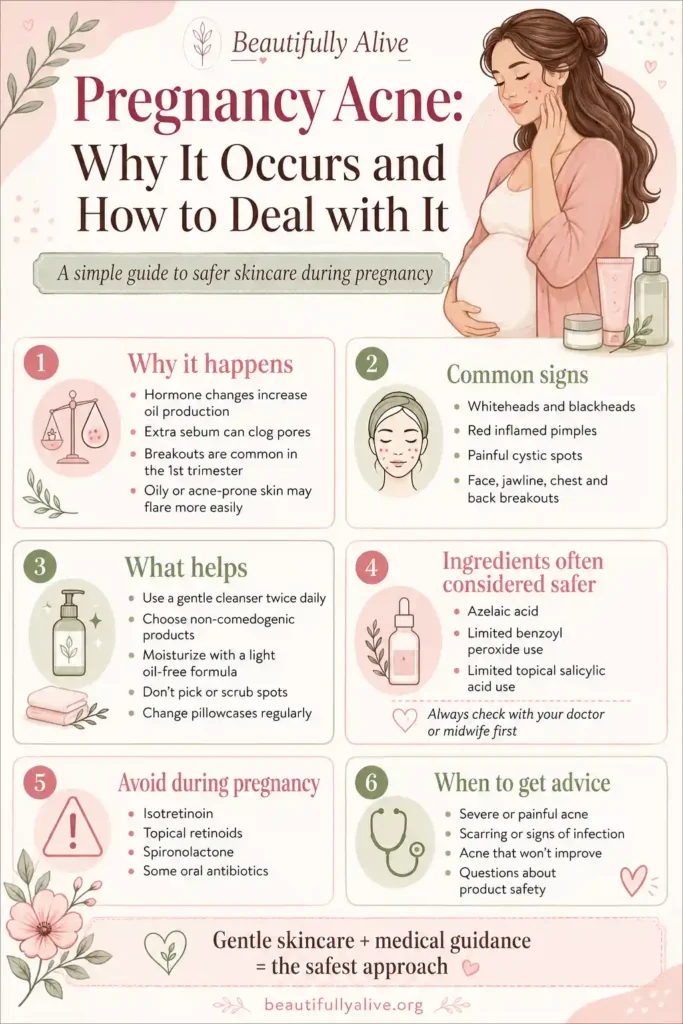
During pregnancy, your hormone levels change dramatically. These hormonal fluctuations can stimulate the sebaceous glands in your skin, encouraging them to produce more sebum, the natural oil that keeps your skin lubricated.
When too much sebum mixes with dead skin cells, pores can become blocked. Add bacteria and inflammation to the equation, and you have the perfect environment for spots to develop.
The NHS notes that pregnancy is one of the times when hormonal changes can trigger acne, particularly during the first three months of pregnancy.
You may be more likely to experience pregnancy acne if:
You already had acne before becoming pregnant.
Your skin normally breaks out around your period.
You naturally have oily or combination skin.
Acne runs in your family.
Your skin becomes noticeably oilier during pregnancy.
However, pregnancy skin is unpredictable. Someone who has never experienced much acne can suddenly break out, while someone who normally struggles with spots may discover that their skin becomes clearer.
Learn more about Acne: Causes, Types, Treatments & How to Get Clearer Skin
What Does Pregnancy Acne Look Like?
Pregnancy acne isn’t really a separate type of acne. It can appear in many of the same forms as ordinary acne.
You might notice:
Whiteheads: Small clogged pores covered by a thin layer of skin.
Blackheads: Open clogged pores that appear dark when their contents react with the air.
Papules: Small red or inflamed bumps.
Pustules: Inflamed pimples containing pus.
Nodules or cysts: Larger, deeper and often painful spots beneath the skin.
Breakouts commonly develop around the face, jawline, chin and cheeks, but they can also appear on the neck, chest, shoulders and back.
When Does Pregnancy Acne Start?
Pregnancy acne can develop at virtually any stage, although hormonal changes during the first trimester make early pregnancy a particularly common time for breakouts.
You may notice acne settling down as your pregnancy progresses, or it may come and go throughout the nine months.
Unfortunately, there isn’t a reliable way to predict exactly how your skin will react.
How to Deal With Pregnancy Acne
Pregnancy probably isn’t the best time to throw every powerful acne product in your bathroom cabinet at your skin.
Instead, I would concentrate on keeping your routine simple, gentle and consistent.
1. Cleanse Your Skin Gently
Wash acne-prone areas with a gentle cleanser, usually morning and evening.
You don’t need to scrub your face aggressively. In fact, harsh scrubbing can irritate already inflamed skin and potentially make redness more noticeable.
Use lukewarm rather than very hot water and gently pat your skin dry afterwards.
2. Avoid Over-Washing
When your face feels oily, washing it repeatedly can be tempting.
More cleansing doesn’t necessarily mean fewer spots.
Over-cleansing may strip away too much of your skin’s natural oils and leave the skin irritated, dry and uncomfortable.
A gentle twice-daily cleansing routine is normally much more sensible than continually washing your face throughout the day.
3. Choose Non-Comedogenic Products
Take a look at your moisturizer, sunscreen and makeup.
Where possible, choose products labelled:
Non-comedogenic
Oil-free
Won’t clog pores
These products aren’t guaranteed to prevent acne, but they are designed to be less likely to block pores.
4. Don’t Stop Moisturizing
It might seem strange to moisturize oily, acne-prone skin, but skipping moisturizer can leave your skin dry and irritated.
Instead, choose a lightweight moisturizer that suits acne-prone skin.
Pregnancy can also make skin more sensitive than usual, so fragrance-free products may be worth considering if your normal skincare suddenly starts causing irritation.
5. Avoid Picking Your Spots
I know how difficult this one can be, especially when you have a very visible whitehead.
However, squeezing or picking acne increases inflammation and can damage the surrounding skin.
It may also increase your chances of developing:
Dark marks
Red marks
Infection
Acne scars
For a particularly angry spot, a cold compress wrapped in a clean cloth can sometimes help calm temporary swelling and discomfort.
Which Acne Ingredients Can Be Used During Pregnancy?
This is where pregnancy skincare becomes particularly important.
Being available without a prescription doesn’t automatically make an acne ingredient suitable during pregnancy.
The American Academy of Dermatology (AAD) recommends discussing acne treatments with your obstetrician or dermatologist because safety varies considerably between ingredients.
Azelaic Acid
Azelaic acid is one ingredient that commonly comes up when dermatologists discuss pregnancy acne.
The AAD says azelaic acid is thought to be safe during pregnancy, based on the available evidence.
It can help with:
Blocked pores
Inflammation
Acne-causing bacteria
Post-acne discoloration
It can also be a useful alternative for people who find stronger acne ingredients irritating.
The NHS notes that azelaic acid is commonly used as an alternative acne treatment when benzoyl peroxide or topical retinoids cause troublesome irritation.
Benzoyl Peroxide
Benzoyl peroxide is another common acne ingredient.
The AAD states that experts generally consider limited amounts of benzoyl peroxide acceptable during pregnancy, but recommends discussing its use with your obstetrician or dermatologist first.
Benzoyl peroxide can help reduce acne-causing bacteria while also tackling inflammation and clogged pores.
One downside is dryness and irritation, so more certainly isn’t better.
It can also bleach towels, pillowcases and clothing.
Salicylic Acid
Salicylic acid is found in everything from cleansers to concentrated exfoliating treatments.
According to the AAD, topical salicylic acid is generally considered acceptable for limited periods during pregnancy, although it recommends checking with your doctor before using it.
Because products vary enormously in concentration and the area being treated matters, this isn’t an ingredient I’d assume is automatically pregnancy-safe simply because it’s in a face wash.
Acne Treatments to Avoid During Pregnancy
This part is especially important.
Some highly effective acne treatments aren’t appropriate during pregnancy.
Isotretinoin
Oral isotretinoin must not be taken during pregnancy.
It can cause miscarriage and serious problems with fetal development. The NHS specifically states that isotretinoin should not be taken while pregnant or trying to become pregnant.
If you’re taking isotretinoin and discover that you’re pregnant, contact your prescribing healthcare professional promptly.
Topical Retinoids
Retinoids are extremely popular in modern skincare, so check your labels carefully.
Examples include:
Tretinoin
Adapalene
Tazarotene
The NHS advises that topical retinoids aren’t suitable during pregnancy, while the AAD advises stopping tretinoin and adapalene and says tazarotene should not be used during pregnancy.
That means your trusty pre-pregnancy retinoid routine may need to go into storage for a while.
Spironolactone
Spironolactone is sometimes prescribed for hormonal acne in women, but it isn’t appropriate during pregnancy.
The AAD lists spironolactone among the acne medicines that should not be taken during pregnancy.
Certain Oral Antibiotics
Some antibiotics used for acne also need to be avoided or restricted during pregnancy.
For example, the AAD advises stopping doxycycline, minocycline and tetracycline by the 15th week of pregnancy.
If you’re already taking prescription acne medication when you discover you’re pregnant, contact the clinician who prescribed it rather than simply switching yourself to another treatment.
Don’t Forget Vitamin A in Supplements
Skincare isn’t the only place you’ll find retinoids and vitamin A.
Check supplements too.
The NHS specifically advises pregnant women not to take cod liver oil or supplements containing vitamin A in the form of retinol, because excessive vitamin A can harm a developing baby.
Pregnancy supplements designed specifically for pregnancy are formulated with this in mind, but it’s still worth checking everything you’re taking with your midwife, pharmacist or doctor.
A Simple Pregnancy Acne Skincare Routine
If my skin suddenly became acne-prone during pregnancy, I’d resist the temptation to introduce six new products at once.
A straightforward routine might look something like this:
Morning
Gentle cleanser → pregnancy-appropriate treatment recommended by your healthcare professional → lightweight moisturizer → broad-spectrum sunscreen.
Evening
Gentle cleanser → pregnancy-appropriate acne treatment → moisturizer.
Keeping your routine simple also makes it easier to work out which product is causing irritation if your skin suddenly becomes unhappy.
What About Makeup?
You don’t necessarily have to stop wearing makeup because you have pregnancy acne.
I’d simply be a little more selective.
Look for non-comedogenic foundations and concealers, remove makeup properly before bed and keep your makeup brushes and sponges clean.
Another habit worth breaking is repeatedly touching your face or trying to cover every emerging spot with thick layers of concealer.
Heavy products aren’t automatically bad, but anything that contributes to clogged pores may make acne more difficult to manage.
Can Diet Cause Pregnancy Acne?
It’s tempting to blame chocolate, cheese or whatever you happened to eat the evening before a breakout.
Pregnancy acne is usually much more strongly connected with hormonal and oil-production changes than one particular food.
Rather than adopting a restrictive “anti-acne diet” during pregnancy, concentrate on eating the balanced pregnancy diet recommended by your healthcare team.
Pregnancy isn’t a good time to eliminate major food groups unnecessarily.
If you think a particular food consistently affects your skin, mention it to your midwife, doctor or dietitian before making significant dietary changes.
What About Natural Acne Remedies?
Pregnancy can make “natural” skincare particularly appealing, but natural doesn’t automatically mean gentle or safe.
Essential oils, strong acids, concentrated botanical extracts and homemade remedies can all irritate sensitive skin.
I’d be particularly wary of internet remedies involving substances such as:
Undiluted essential oils
Lemon juice
Baking soda
Toothpaste
Strong apple cider vinegar
Aggressive facial scrubs
They may irritate or damage your skin barrier without providing a reliable acne treatment.
Change Your Pillowcase Regularly
This won’t magically sooth acne, but good skin hygiene can help.
Pillowcases accumulate oil, skincare products, sweat and hair products.
Changing yours regularly is an easy habit to adopt, particularly if you experience acne around the cheeks and sides of your face.
The same principle applies to anything repeatedly touching your skin, including phones, makeup brushes and face cloths.
Keep Hair Products Away From Acne-Prone Skin
If your breakouts are concentrated around the forehead, temples or hairline, look at your hair products as well as your skincare.
Oily conditioners, styling creams and hair oils can occasionally transfer onto facial skin.
Try keeping hair away from your face where practical and rinse the hairline carefully after conditioning.
Protect Your Skin From the Sun
A tan may temporarily make acne look less noticeable, but deliberate sun exposure isn’t an acne treatment.
Inflamed acne can also leave areas of discoloration behind, and sunlight can make pigmentation more noticeable.
A broad-spectrum sunscreen suitable for your skin type is therefore an important part of your routine.
If you’re uncertain which sunscreen ingredients you’re comfortable using during pregnancy, a pharmacist, dermatologist or obstetric professional can help you choose one.
When Should You See a Doctor?
Pregnancy acne doesn’t always need medical treatment, particularly when you’re dealing with the occasional small breakout.
However, speak to your GP, midwife or dermatologist if you develop:
Large, painful nodules or cysts
Widespread acne across the face, chest or back
Significant inflammation
Acne that is leaving scars
Signs of infection
Acne that isn’t responding to a gentle routine
Skin problems you’re uncertain are actually acne
The NHS recommends speaking to a GP for moderate or severe acne and particularly when painful nodules or scarring are present.
You should also seek professional advice if your acne is having a significant effect on how you feel.
There is absolutely no requirement to simply tolerate severe acne because you’re pregnant. A dermatologist can help identify treatment options appropriate for pregnancy.
Will Pregnancy Acne Go Away?
In many cases, yes.
Pregnancy acne is driven largely by temporary hormonal changes, so it may improve as hormone levels change later in pregnancy or following delivery.
Unfortunately, there isn’t a fixed timetable.
Your skin might improve after the first trimester, remain acne-prone throughout pregnancy or continue fluctuating for a while after your baby arrives.
Postpartum hormonal changes can bring yet another change to your complexion.
If you’re breastfeeding, remember that medication choices can still require special consideration, so don’t automatically restart every pre-pregnancy acne treatment without checking first.
The Bottom Line
Pregnancy acne may be annoying, uncomfortable and sometimes surprisingly severe, but it is also very common.
Changing hormones can stimulate oil production, clog pores and trigger breakouts even in people who haven’t experienced acne for years.
The safest approach is usually to simplify your skincare rather than aggressively treating every spot. Cleanse gently, moisturize, avoid picking your skin and check the ingredients in acne treatments carefully.
Ingredients such as azelaic acid and limited use of benzoyl peroxide may be options under professional guidance, whereas isotretinoin, spironolactone and topical retinoids should be avoided during pregnancy.
Most importantly, don’t assume that something is pregnancy-safe because it’s sold over the counter or described as natural. When you’re unsure, show the exact product or ingredient list to your pharmacist, midwife, GP, obstetrician or dermatologist.
Pregnancy already gives you enough things to think about. Your skincare routine doesn’t need to become another complicated one.
Resources
American Academy of Dermatology (AAD) – Is Any Acne Treatment Safe to Use During Pregnancy?
Covers acne treatments considered safer during pregnancy, including azelaic acid and limited benzoyl peroxide use, plus medications that should be avoided.
https://www.aad.org/public/diseases/acne/derm-treat/pregnancy
Mayo Clinic – Pregnancy Acne: What’s the Best Treatment?
Explains why pregnancy acne occurs and provides practical advice on cleansing, skincare and pregnancy-appropriate treatment options.
https://www.mayoclinic.org/healthy-lifestyle/pregnancy-week-by-week/expert-answers/pregnancy-acne/faq-20058045
American Pregnancy Association – Acne During Pregnancy
Discusses hormonal causes of pregnancy acne, treatment considerations and why certain prescription acne medicines should be avoided.
https://americanpregnancy.org/pregnancy/acne-during-pregnancy/
Disclaimer: This article is for general informational purposes only and is not a substitute for professional medical advice, diagnosis or treatment. Pregnancy can affect which skincare ingredients and acne medications are considered appropriate, so always check with your doctor, midwife, obstetrician, dermatologist or pharmacist before starting, stopping or changing any treatment during pregnancy. If you have severe, painful or worsening acne, signs of infection, significant scarring, or concerns about a product or medication you are using, seek advice from a qualified healthcare professional.











Comments 1