
A good night serum is one of those skincare products that can quietly make a big difference to your routine.
While I’m sleeping, I want my skincare to concentrate on the things I actually care about: keeping my skin hydrated, smoothing the appearance of fine lines, improving uneven texture and helping my complexion look a little fresher when I wake up.
But choosing a night serum has become much more complicated than it used to be. There are retinol serums, retinal serums, peptide serums, niacinamide formulas, hyaluronic acid treatments and increasingly complicated blends promising to do everything at once.
The good news is that you don’t necessarily need the strongest or most expensive serum.
You need the one that suits your skin.
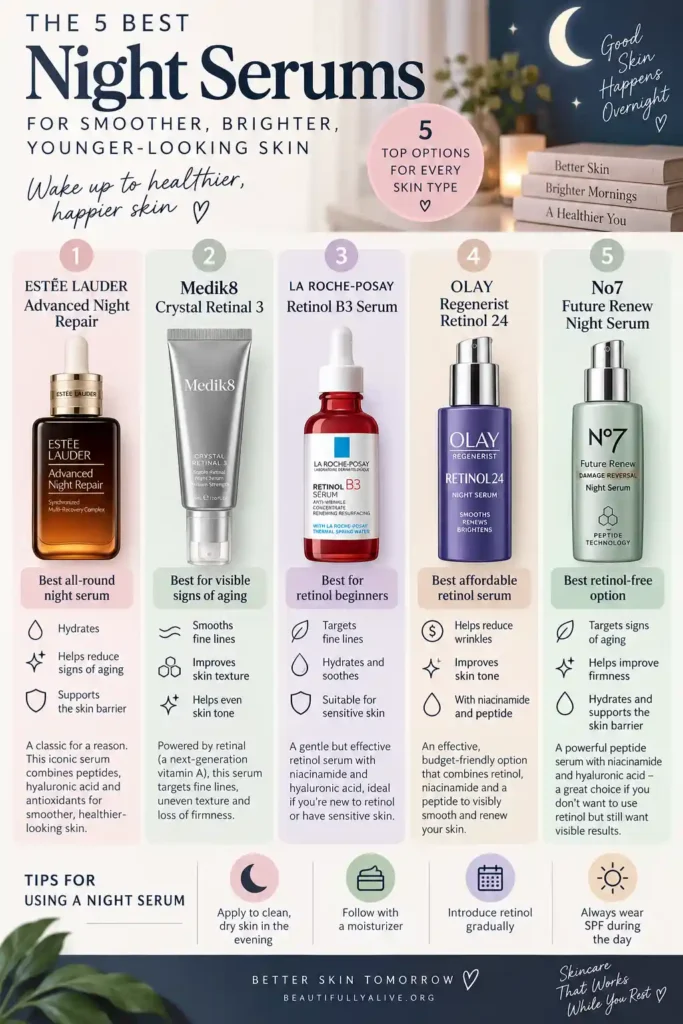
For this guide, I’ve picked five very different night serums so there’s an option whether you want serious anti-aging ingredients, extra hydration, a beginner-friendly retinol or a retinol-free alternative.
My 5 Best Night Serum Options
Night Serum |
Best For |
Key Ingredients |
|---|---|---|
Estée Lauder Advanced Night Repair |
Hydration and overall skin aging |
Peptides, hyaluronic acid, antioxidants |
Medik8 Crystal Retinal 3 |
Fine lines and uneven texture |
Retinal, hyaluronic acid, squalane |
La Roche-Posay Retinol B3 Serum |
Retinol beginners and sensitive skin |
Retinol, niacinamide, hyaluronic acid |
Olay Regenerist Retinol 24 Night Serum |
Affordable anti-aging |
Retinoids, niacinamide, peptide |
No7 Future Renew Damage Reversal Night Serum |
Retinol-free anti-aging |
Peptides, niacinamide, hyaluronic acid |
1. Estée Lauder Advanced Night Repair Synchronized Multi-Recovery Complex
Best all-round night serum
Estée Lauder Advanced Night Repair has been around for decades, but unlike many older beauty products, it has continued to evolve.
Today’s formula combines the brand’s peptide technology with hyaluronic acid and antioxidants. Estée Lauder describes it as suitable for normal, dry, oily and combination skin, including sensitive skin.
What I like about Advanced Night Repair is that it doesn’t rely on one particularly aggressive active ingredient.
Instead, it concentrates on hydration, supporting the skin barrier and improving the appearance of several signs of aging at once.
That makes it particularly appealing if your skin is becoming drier or more easily irritated and you don’t necessarily want to use retinol every night.
Hyaluronic acid helps attract and retain moisture, while peptides are increasingly common in modern anti-aging skincare. Peptides are short chains of amino acids associated with proteins such as collagen and elastin, although different peptides perform different functions and results depend heavily on the particular formulation.
Why I like it
It’s a particularly good choice if you want one sophisticated serum rather than layering several different treatments.
The lightweight texture should also work well underneath a moisturizer.
It isn’t the product I would choose if my only goal were maximum-strength retinoid treatment, but for dehydration, dullness, fine lines and general signs of aging, it remains a very versatile option.
Best suited to: dry, normal, combination or mature skin, particularly if hydration and fine lines are your main concerns.
Possible drawback: it sits firmly in the premium skincare category.
2. Medik8 Crystal Retinal 3
Best for visible signs of aging and skin texture
If you want to move beyond conventional retinol, Medik8 Crystal Retinal is one of the more interesting options.
The key ingredient here is retinal, also known as retinaldehyde.
Retinol and retinal are both vitamin A derivatives, but retinal is one conversion step closer to retinoic acid, the form the skin ultimately uses.
Crystal Retinal 3 contains retinal alongside glycerin, squalane, sodium hyaluronate and vitamin C derivatives.
I particularly like the fact that Medik8 offers its Crystal Retinal range in different strengths. That makes it easier to build up your tolerance rather than immediately reaching for something unnecessarily powerful.
Crystal Retinal 3 is positioned toward the gentler end of the range and is therefore the version I would consider first if you’re relatively new to retinal.
Retinoids remain among the most established topical ingredients for improving visible fine lines and photoaging, which is why they continue to feature so heavily in dermatologist-led anti-aging routines.
Why I like it
This is probably the option I’d look at if wrinkles, rough texture and uneven-looking skin were higher priorities than simple hydration.
The inclusion of humectants and emollients such as glycerin, sodium hyaluronate and squalane also helps make the overall formula more balanced.
Best suited to: people who have already used gentler anti-aging skincare and want to introduce retinal.
Possible drawback: retinoids can cause dryness, flaking or irritation, particularly when you first introduce them.
3. La Roche-Posay Retinol B3 Pure Retinol Serum
Best retinol option for a gentler routine
La Roche-Posay Retinol B3 is a useful middle ground between a basic hydrating serum and a stronger retinoid treatment.
It combines retinol with niacinamide, hyaluronic acid, glycerin and other moisturizing ingredients.
La Roche-Posay recommends it for fine lines, wrinkles and premature sun damage and describes it as suitable for all skin types, including sensitive skin.
Niacinamide is one of my favorite supporting ingredients in formulas like this because it works well alongside a wide variety of other skincare ingredients and can help support the skin barrier.
The hyaluronic acid and glycerin provide extra hydration, which is particularly useful in a retinol serum since dryness is one of the most common reasons people stop using retinoids.
One thing worth knowing, however, is that this serum does contain fragrance as well as alcohol denat. People who know that either ingredient irritates their skin may therefore prefer another option.
Why I like it
It’s a sensible introduction to retinol if you want a recognizable skincare brand and a formula containing several hydrating ingredients rather than retinol alone.
I’d still introduce it gradually.
For example, you might begin using it two nights a week and increase the frequency only if your skin remains comfortable.
Best suited to: people wanting to introduce retinol for fine lines, uneven skin texture or sun-related signs of aging.
Possible drawback: fragrance and alcohol mean it won’t suit every sensitive complexion.
4. Olay Regenerist Retinol 24 Night Facial Serum
Best affordable retinol night serum
You certainly don’t have to spend $100 on a night serum to get recognizable skincare ingredients.
Olay’s Regenerist Retinol 24 Night Serum combines retinol and retinyl propionate with niacinamide and palmitoyl pentapeptide-4.
It’s an interesting combination because you’re getting both retinoid ingredients and a peptide rather than relying exclusively on retinol.
Olay says its retinoid complex targets concerns including fine lines, wrinkles, dark spots, skin tone and visible pores, while niacinamide helps with moisture retention and surface renewal.
I think this is particularly appealing for someone who wants an accessible anti-aging serum without creating a huge skincare routine.
You could use a gentle cleanser, this serum, moisturizer and daytime sunscreen and have a perfectly respectable basic routine.
Why I like it
It’s relatively straightforward and combines several of the ingredients people commonly look for in nighttime anti-aging skincare.
It also demonstrates something important: a useful skincare routine doesn’t have to contain a dozen separate serums.
Best suited to: anyone looking for an affordable retinol-based anti-aging treatment.
Possible drawback: as with other retinoids, irritation is possible, particularly if you introduce it too quickly.
5. No7 Future Renew Damage Reversal Night Serum
Best retinol-free option
Not everyone wants to use retinol.
Some people simply don’t tolerate it well, while others prefer to concentrate on peptides, hydration and barrier-friendly ingredients.
That’s where No7 Future Renew Damage Reversal Night Serum becomes particularly interesting.
The current formula includes niacinamide, glycerin, panthenol, sodium hyaluronate, vitamin C derivative ascorbyl glucoside and two peptides: palmitoyl tetrapeptide-94 and palmitoyl tetrapeptide-95.
It’s therefore quite different from the retinol-heavy options in this guide.
No7’s Future Renew range has also received attention because of its proprietary peptide blend, with the night serum positioned as a multi-purpose treatment for concerns including lines, uneven tone and loss of firmness.
Why I like it
This is the option I’d look at if you want something more active than a simple hyaluronic acid serum but don’t want a retinoid.
Niacinamide, peptides and humectants make it a particularly interesting combination for mature or dehydrated skin.
Best suited to: people who don’t want retinol but still want to target visible signs of aging.
Possible drawback: the formula contains fragrance, which some sensitive skin types may prefer to avoid.
What Does a Night Serum Actually Do?
The term “night serum” can be slightly misleading because there isn’t one specific ingredient that turns an ordinary serum into a night serum.
Some products are designed specifically for nighttime use because they contain ingredients such as retinoids.
Others are simply concentrated treatments that work particularly well as part of an evening routine.
A serum generally contains a relatively lightweight base designed to deliver skincare ingredients before your moisturizer.
Depending on the formula, a night serum might concentrate on hydration, pigmentation, wrinkles, skin texture, barrier support or several concerns simultaneously.
Night Serum vs Night Cream
I don’t really see night serum and night cream as competing products.
They do different jobs.
A serum tends to contain concentrated treatment ingredients in a lightweight formula. A night cream generally contains more emollient or occlusive ingredients and concentrates on moisturization and reducing water loss.
For dry skin, using both can make sense.
Apply the serum first and then your moisturizer or night cream.
If you have oily skin, however, you may find that a serum plus a lightweight moisturizer is plenty.
Which Ingredients Should I Look For?
Rather than buying something simply because the label says “anti-aging,” I prefer looking at the ingredient list.
Retinoids are worth considering if fine lines, sun damage and uneven texture are major concerns. They are among the most established ingredients used in topical anti-aging skincare.
Peptides can be useful in formulas aimed at supporting smoother and firmer-looking skin. Peptides are now extremely common in modern anti-aging serums, although the evidence varies according to the specific peptide and formula.
Hyaluronic acid is primarily a hydration ingredient. If your skin feels tight or looks temporarily more lined when dehydrated, a hyaluronic-acid-containing serum can be very useful.
Niacinamide is another excellent multi-tasker and appears in several of my choices above. It works particularly well in formulas designed to support the skin barrier while addressing uneven-looking skin.
Glycerin isn’t particularly glamorous, but it’s an excellent humectant and one of the ingredients I’m always pleased to see in hydrating skincare.
How I Would Choose Between These Five
If hydration and generally healthier-looking skin were my main goals, I’d lean toward Estée Lauder Advanced Night Repair.
If I specifically wanted a more serious vitamin A treatment for fine lines and texture, I’d look at Medik8 Crystal Retinal 3.
For someone introducing retinol relatively cautiously, La Roche-Posay Retinol B3 Serum is another interesting option.
If keeping the routine relatively affordable mattered most, I’d consider Olay Retinol 24 Night Serum.
And if I wanted to avoid retinol altogether while still using ingredients such as peptides and niacinamide, No7 Future Renew Night Serum would make the most sense.
There’s no single serum that will be the best choice for every face.
Matching the formula to your skin is much more important.
How to Use a Night Serum
My evening routine would normally be cleanser, serum and moisturizer.
If you’re using a hydrating or peptide serum, you may be able to use it every evening straight away.
Retinoids deserve a little more caution.
I would start with a small amount a couple of evenings each week and increase gradually if my skin tolerated it. Introducing several acids, retinol products and exfoliating treatments simultaneously makes it much harder to work out what’s causing irritation.
Retinoid users should also be particularly conscientious about daytime sunscreen.
La Roche-Posay additionally advises avoiding retinol products during pregnancy and breastfeeding as a precaution. If you’re pregnant, breastfeeding or receiving treatment from a dermatologist, discuss active skincare products with an appropriate healthcare professional.
Do You Need a Separate Night Serum?
Not necessarily.
This is one of those beauty categories where marketing sometimes makes skincare sound more complicated than it needs to be.
You don’t need a product labelled “night serum” simply because you’ve reached a particular age.
If your regular serum already contains ingredients that suit your skin, you may be perfectly happy using it morning and evening.
Where a dedicated evening serum becomes useful is when you want to introduce ingredients that you don’t necessarily want in your daytime routine, particularly retinoids.
Can I Use More Than One Serum at Night?
You can, but I rarely think piling on lots of serums is necessary.
A simple routine that’s comfortable enough to use consistently is usually preferable to an elaborate routine that leaves your skin irritated.
If you’re combining products, pay particular attention to potent actives.
For example, I wouldn’t introduce a strong retinoid, exfoliating acid and several other active treatments on the same evening when my skin wasn’t already accustomed to them.
Hydrating products are generally easier to combine.
How Long Does a Night Serum Take to Work?
Hydration can make your skin feel softer surprisingly quickly, sometimes after the first few applications.
Changes involving fine lines, pigmentation or skin texture normally require much more patience.
Don’t judge a skincare product after two evenings.
Equally, don’t keep using a product for months if it’s repeatedly leaving your skin red, sore or uncomfortable in the hope that irritation means it’s “working.”
Are Expensive Night Serums Better?
Not automatically.
Luxury serums can contain sophisticated formulations, elegant textures and proprietary ingredient combinations, but price alone doesn’t tell you whether a product will suit your skin.
That’s one reason I’ve included everything from Olay to Estée Lauder in this guide.
Look at the ingredients, your skincare goals and how your skin actually responds.
A $30 serum that you use consistently can be far more useful than a $150 serum sitting untouched in your bathroom cabinet.
My Final Thoughts
Night serums have changed considerably since I first looked at this category.
The biggest difference is that shoppers now have much more choice.
You can choose established retinoids, newer retinal formulas, sophisticated peptide blends or simple hydrating treatments depending on what you’re trying to achieve.
For an all-round hydrating anti-aging serum, Estée Lauder Advanced Night Repair remains a strong option.
For someone specifically interested in vitamin A and visible skin aging, Medik8 Crystal Retinal 3 stands out.
La Roche-Posay Retinol B3 provides another approachable retinol formula, while Olay Retinol 24 offers an affordable alternative.
And if retinol isn’t for you, No7 Future Renew Damage Reversal Night Serum gives you a completely different peptide-focused route.
Whichever you choose, I’d concentrate less on finding a miracle overnight transformation and more on finding a serum your skin actually enjoys using.
Consistency is where good skincare becomes interesting.
See more Serum, Moisturizer and Body Wash Reviews >
Useful Links
American Academy of Dermatology – Retinoid or Retinol?
Useful for explaining the difference between retinol and retinoids, their benefits for fine lines and uneven skin tone, and how to introduce them gradually.
https://www.aad.org/public/everyday-care/skin-care-secrets/anti-aging/retinoid-retinol
Cleveland Clinic – Retinol: Benefits, Uses and How to Use It
A clear medical overview of retinol, including its effects on collagen, wrinkles, acne, skin texture and possible irritation.
https://my.clevelandclinic.org/health/treatments/23293-retinol
Cleveland Clinic – Anti-Aging Skin Care: Ingredients and Routine
Helpful broader source covering retinol as part of an anti-aging skincare routine and why it can help with fine lines and cell turnover.
https://health.clevelandclinic.org/anti-aging-skin-care