A good skin exfoliator can make a surprisingly big difference when your complexion starts looking dull, rough or uneven.
I find exfoliation particularly useful when my skin feels as though skincare products are just sitting on top of it or when makeup isn’t going on as smoothly as usual. Removing excess dead surface cells can leave skin feeling softer and looking fresher, but exfoliation is definitely one of those areas where more isn’t always better.
Scrubbing harder, using stronger acids or exfoliating every day can quickly turn glowing skin into red, irritated skin.
See lots more Beautifully Alive Reviews >
The real secret is finding the right type of exfoliator for your skin and using it at a frequency your skin actually tolerates.
In this guide, I’ll explain the different types of skin exfoliators, which ingredients are worth knowing about and my five favorite types of products to consider — including the cult-favorite Dr. Brandt Microdermabrasion Exfoliator.
What Is a Skin Exfoliator?
A skin exfoliator helps remove dead cells from the outer surface of your skin.
Your skin naturally sheds old cells as newer ones replace them, but those dead cells don’t always disappear evenly.
They can accumulate and contribute to:
Dull-looking skin
Rough texture
Flakiness
Clogged-looking pores
Blackheads
Uneven-looking tone
Makeup that doesn’t apply smoothly
Exfoliation helps remove some of that buildup.
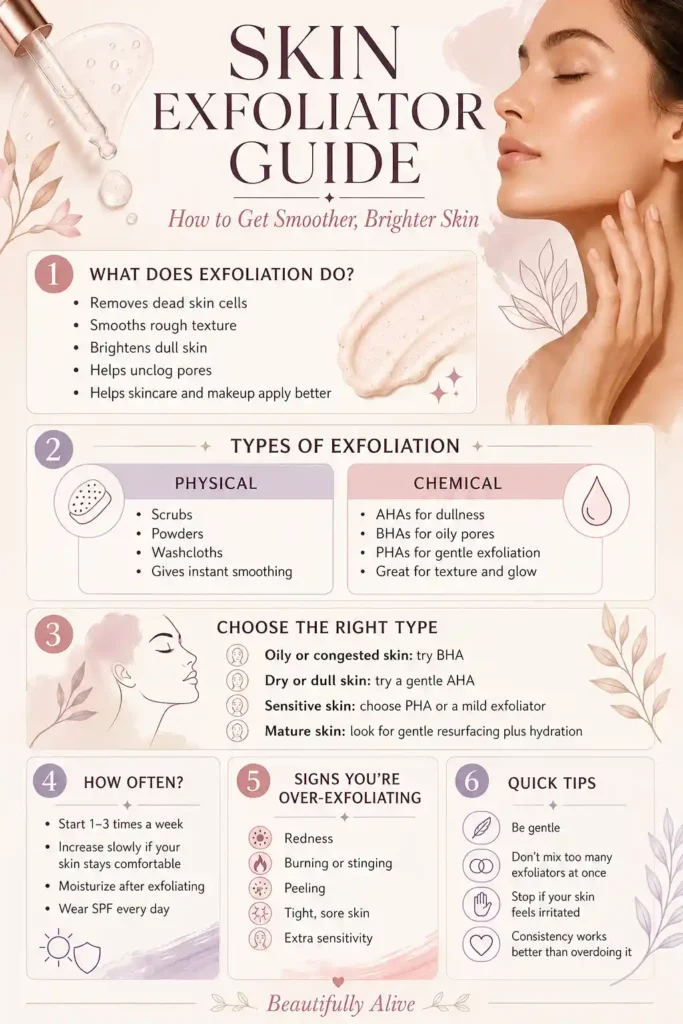
There are two main types: physical exfoliation and chemical exfoliation.
Physical vs. Chemical Exfoliation
Neither method is automatically better. The important thing is choosing one that suits your skin.
Physical Exfoliators
Physical exfoliators manually polish away dead surface cells.
They include:
Facial scrubs
Microdermabrasion-style exfoliators
Exfoliating powders
Facial sponges
Washcloths
Cleansing brushes
Physical exfoliation can give you an immediate smooth feeling, which is why I understand its appeal.
The danger is being too enthusiastic.
You don’t need to scrub until your face turns pink. A good physical exfoliator should be massaged over the skin gently rather than aggressively rubbed into it.
One of the more interesting products in this category is Dr. Brandt Advanced Microdermabrasion Face Exfoliator because it actually combines physical and chemical exfoliation.
Its formula uses fine aluminum oxide crystals for physical resurfacing alongside lactic acid for additional chemical exfoliation. The manufacturer recommends using it only once or twice weekly and leaving at least three days between applications.
Chemical Exfoliators
Chemical exfoliators loosen dead surface cells using exfoliating acids rather than relying primarily on friction.
The three categories you’re most likely to encounter are:
AHAs
BHAs
PHAs
AHAs
Alpha hydroxy acids, or AHAs, include:
Glycolic acid
Lactic acid
Mandelic acid
AHAs primarily work on the surface of the skin.
I particularly like them for concerns such as:
Dullness
Uneven texture
Roughness
Uneven-looking pigmentation
Signs of photoaging
Glycolic Acid
Glycolic acid is probably the most familiar AHA.
You’ll find it in everything from inexpensive exfoliating toners to professional-style peels.
It can be very effective, but stronger isn’t necessarily better. If you’ve never used acids before, I would start with a moderate formulation rather than immediately reaching for the highest percentage you can find.
Lactic Acid
Lactic acid is another AHA and is frequently found in products aimed at dry, dull or mature skin.
It’s also one of the exfoliating ingredients used in the current Dr. Brandt Advanced Microdermabrasion formula.
BHAs
The BHA most of us encounter in skincare is salicylic acid.
Because salicylic acid is oil-soluble, it is particularly useful for oily and congested skin.
If your main concerns are:
Blackheads
Oily skin
Congested pores
Breakouts
I’d probably look at a salicylic acid exfoliator before an aggressive facial scrub.
PHAs
Polyhydroxy acids, or PHAs, are another option.
They tend to appear in products designed to offer gentler surface exfoliation.
If your skin struggles with stronger acids, a PHA formula may be worth considering.
What Are the Benefits of Exfoliating Your Skin?
Used sensibly, exfoliation can improve both how your skin feels and how it looks.
Smoother Skin
This is usually the benefit I notice first.
Removing excess dead cells can leave rough areas feeling considerably smoother.
Brighter-Looking Skin
Dead-cell buildup can make the complexion appear dull.
Exfoliating away some of that surface buildup can reveal fresher-looking skin underneath.
Less Visible Congestion
Salicylic acid is particularly useful here.
It’s one reason BHA exfoliants have become so popular among people dealing with blackheads and oily pores.
More Even Texture
Regular exfoliation can gradually improve the appearance of rough or uneven skin.
Better Makeup Application
Foundation doesn’t look particularly flattering when it’s clinging to patches of flaky skin.
Keeping the surface smooth generally helps makeup apply more evenly.
Which Skin Exfoliator Is Best for My Skin Type?
Oily and Congested Skin
I’d look for salicylic acid.
A 2% BHA leave-on exfoliant is a popular place to start.
Dry Skin
I’d lean toward a gentle AHA such as lactic acid, preferably in a moisturizing formulation.
Mature Skin
AHAs can be particularly appealing when the main concerns are:
Dullness
Rough texture
Uneven-looking pigmentation
Fine lines
A product containing glycolic or lactic acid can therefore make sense.
I’d also prioritize products containing hydrating and barrier-supportive ingredients.
Sensitive Skin
Sensitive skin requires considerably more caution.
I’d look for:
PHAs
Gentle lactic acid formulations
Very mild exfoliating powders
Products specifically designed for sensitive skin
I’d also exfoliate much less frequently.
My Top 5 Skin Exfoliators
There isn’t one exfoliator that will be best for everybody, so I’ve chosen products that suit different skin types and different approaches to exfoliation.
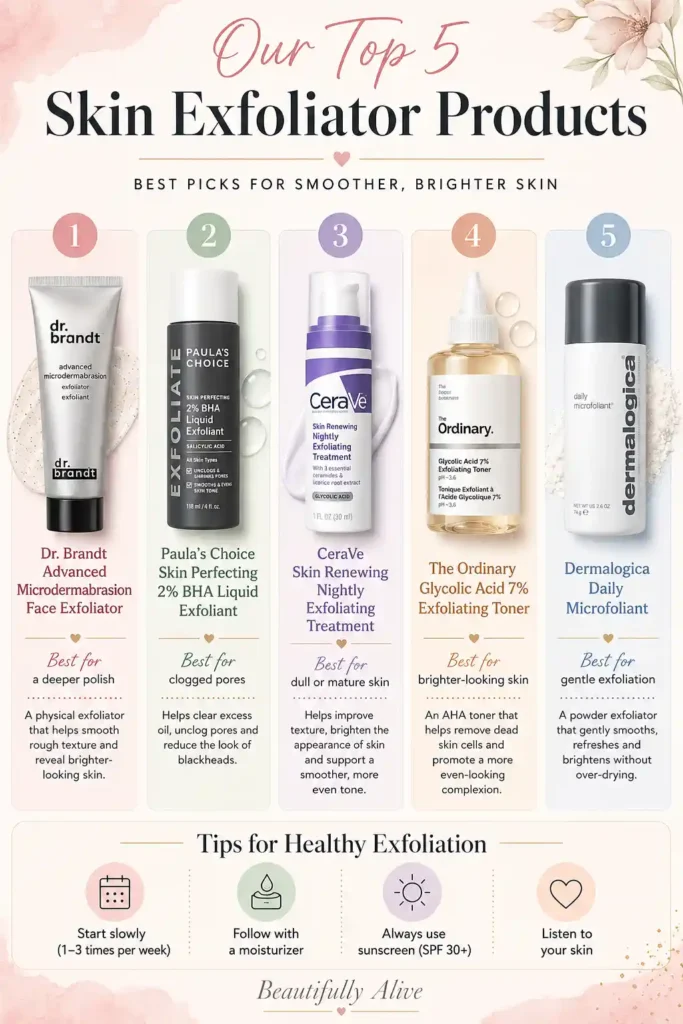
1. Dr. Brandt Advanced Microdermabrasion Face Exfoliator
Best for: Rough texture and an intensive at-home polish
If you enjoy the immediate smooth feeling you get from physical exfoliation, Dr. Brandt Advanced Microdermabrasion Face Exfoliator is one of the most interesting products I’ve come across.
This is essentially an at-home microdermabrasion-inspired treatment.
The current formula uses aluminum oxide crystals to physically polish away dead surface cells while lactic acid adds chemical exfoliation.
It also contains ingredients including jojoba oil, allantoin, aloe and botanical extracts.
Why I Like It
Combines physical and chemical exfoliation
Particularly useful for rough texture
Gives an immediate polished feeling
Contains lactic acid
Designed as an occasional treatment rather than an everyday scrub
How to Use It
This is definitely one product where I would follow the instructions carefully.
Dr. Brandt recommends applying a small amount to damp skin, gently massaging it for around one to two minutes and rinsing thoroughly.
It should only be used once or twice a week, with at least three days between treatments.
Who Should Avoid It?
This wouldn’t be my first choice if your skin is highly sensitive, inflamed or currently irritated.
In fact, Dr. Brandt specifically positions its Advanced version for skin types other than sensitive skin and sells a separate Gentle Microdermabrasion Face Exfoliator for sensitive skin.
My verdict: A great choice if you love that super-smooth post-exfoliation feeling but don’t want to use a strong exfoliating treatment every day.
View our Dr. Brandt Microdermabrasion Skin Exfoliant Review
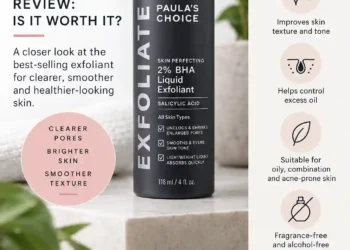
2. Paula’s Choice Skin Perfecting 2% BHA Liquid Exfoliant
Best for: Blackheads and clogged pores
This is probably one of the best-known salicylic acid exfoliators around.
It contains 2% salicylic acid in a leave-on formula.
I’d particularly look at this product if your main problems are:
Blackheads
Oily areas
Congested pores
Uneven texture
Why I Like It
2% salicylic acid
Leave-on formula
Excellent option for oily skin
Particularly suited to blackheads
Easy to incorporate into a routine
Potential Downside
It can be tempting to start using a product like this every day because it’s a leave-on liquid.
I’d resist that temptation initially.
Start perhaps two or three times a week and see how your skin reacts.
View our Paula’s Choice 2% BHA Review
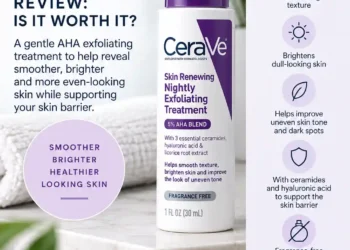
3. CeraVe Skin Renewing Nightly Exfoliating Treatment
Best for: Mature and dry-leaning skin
This is probably my favorite option here for somebody who wants exfoliation while still paying attention to their skin barrier.
It combines glycolic and lactic acids with ingredients CeraVe is particularly well known for, including ceramides and hyaluronic acid.
Why I Like It
Contains glycolic acid
Contains lactic acid
Includes ceramides
Includes hyaluronic acid
Fragrance-free
Good option for dull, mature-looking skin
If you’re in your 40s, 50s or beyond and your main concerns are dullness and uneven texture rather than acne, this is the type of formulation I’d investigate first.
Potential Downside
Even a carefully formulated AHA product can irritate sensitive skin.
Introduce it gradually rather than immediately using it every night.
View our CeraVe Skin Renewing Nightly Exfoliating Treatment Review
4. The Ordinary Glycolic Acid 7% Exfoliating Toner
Best budget exfoliator
If you want a straightforward glycolic acid product without spending very much money, The Ordinary is difficult to ignore.
Its Glycolic Acid 7% Exfoliating Toner targets dullness and uneven surface texture.
Why I Like It
7% glycolic acid
Very affordable
Good for dull-looking skin
Helps target rough texture
Large bottle
Potential Downside
Seven-percent glycolic acid isn’t necessarily gentle just because the product is inexpensive.
If you’re new to acids, use it cautiously.
I’d begin around twice a week and increase only if my skin remained perfectly comfortable.
5. Dermalogica Daily Microfoliant
Best powder exfoliator
Dermalogica Daily Microfoliant takes a different approach.
It’s a powder that you mix with water before applying to the face.
I like this type of product because you have quite a lot of control over how much powder you use and how gently you massage it.
The formula combines physical polishing with exfoliating ingredients including salicylic acid and papain.
Why I Like It
Powder formulation
Provides gentle physical polishing
Contains salicylic acid
Easy to control
Particularly useful for dullness and uneven texture
Potential Downside
It’s more expensive than a basic exfoliating toner.
And despite being called Daily Microfoliant, there’s no rule saying you have to use it every day.
If your skin feels perfectly smooth using it two or three times weekly, there’s little reason to increase the frequency.
Best Skin Exfoliators at a Glance
Product |
Best For |
Type |
|---|---|---|
Rough texture and intensive polishing |
Physical + AHA |
|
Blackheads and clogged pores |
BHA |
|
Mature or dry-leaning skin |
AHA |
|
The Ordinary Glycolic Acid 7% |
Affordable brightening |
AHA |
Dermalogica Daily Microfoliant |
Gentle powder exfoliation |
Physical + chemical |
Chemical Exfoliators: Which Should I Choose?
This really comes down to what you want from an exfoliator.
If I wanted an immediate polished feeling, I’d consider Dr. Brandt Microdermabrasion.
If I were dealing primarily with blackheads, I’d choose Paula’s Choice BHA.
If my concerns were dullness, mature skin and uneven texture, I’d lean toward CeraVe or The Ordinary.
And if I liked the idea of a wash-off powder rather than a leave-on acid, I’d choose Dermalogica Daily Microfoliant.
You don’t need all of them.
In fact, using several exfoliating products together is exactly what I’d avoid.
How Often Should You Exfoliate?
For most people, I think one to three times per week is a sensible starting point.
How often you ultimately exfoliate depends on:
Your skin type
The strength of the product
Whether you use retinoids
Whether you use acne treatments
How sensitive your skin is
Whether the product is leave-on or rinse-off
A strong microdermabrasion-style exfoliator shouldn’t be treated the same way as a very mild daily exfoliating cleanser.
Dr. Brandt, for example, specifically recommends its Advanced Microdermabrasion product only once or twice weekly.
Signs You’re Exfoliating Too Much
This is something worth watching for.
Possible signs of over-exfoliation include:
Redness
Burning
Stinging
Flaking
Tightness
Increased dryness
Sudden sensitivity to products
Skin that feels sore
An unusually shiny but dehydrated appearance
If this happens, stop exfoliating for a while.
I would switch back to a very simple routine of gentle cleansing, moisturizing and sunscreen until the skin feels comfortable again.
How to Exfoliate Your Face Properly
Step 1: Cleanse
Start with clean skin.
Remove makeup, sunscreen and surface oils using a gentle cleanser.
Step 2: Apply Your Exfoliator
How you do this depends on the product.
A chemical exfoliating toner is normally applied and left on.
A scrub, powder exfoliator or microdermabrasion treatment generally needs to be massaged onto damp skin and then rinsed away.
Step 3: Don’t Overdo the Massage
This is especially important when using something like Dr. Brandt Microdermabrasion.
Let the exfoliating particles do the work.
You don’t need to apply heavy pressure.
Step 4: Moisturize
Follow exfoliation with moisturizer.
Keeping your skin adequately hydrated becomes particularly important when you’re using acids.
Step 5: Use Sunscreen
Exfoliating and sunscreen really belong together.
I recommend a broad-spectrum SPF every morning, particularly if you’re using AHAs.
Can You Use Exfoliator and Retinol Together?
You can have both in your overall skincare routine.
That doesn’t necessarily mean you should use both during the same skincare session.
If you’re new to retinoids or acids, I’d alternate them.
For example:
Monday: Exfoliation
Tuesday: Retinoid
Wednesday: Simple moisturizer
Thursday: Exfoliation
Friday: Retinoid
Weekend: Moisturizer/barrier-focused routine
Your own skin may need considerably fewer active-treatment nights than this.
Is Exfoliation Good for Mature Skin?
It certainly can be.
As skin changes with age, dullness, uneven tone and rougher texture can become more noticeable.
A carefully chosen exfoliator may help the surface look smoother and brighter.
For mature skin, I’d be especially interested in:
Lactic acid
Glycolic acid
Gentle microdermabrasion
Hydrating exfoliating formulas
Barrier-supportive ingredients
I’d be much less interested in aggressively scrubbing my skin every day.
Is Exfoliation Good for Acne?
It can be, depending on the type of acne.
Salicylic acid is particularly useful for oily pores, blackheads and congestion.
If you already use benzoyl peroxide, prescription retinoids or prescription acne medication, however, I’d be very cautious about introducing additional exfoliation.
Persistent, painful or severe acne is better discussed with a dermatologist.
Should You Exfoliate Dry Skin?
Yes, dry skin can benefit from exfoliation too.
The trick is not stripping it.
I’d choose a relatively gentle product and pay particular attention to moisturizer afterward.
If your skin is already cracked, sore or irritated, I’d wait until it has recovered.
Is a Scrub Better Than an Acid Exfoliator?
Neither is universally better.
They simply work differently.
Physical exfoliators give immediate surface polishing.
Chemical exfoliators loosen dead cells using ingredients such as AHAs and BHAs.
Hybrid products such as Dr. Brandt Advanced Microdermabrasion combine the two approaches.
Which is best depends on your skin.
Frequently Asked Questions
1. What is the best skin exfoliator?
For clogged pores, I’d choose a salicylic acid exfoliator.
For dullness and uneven texture, I’d look at an AHA.
For an occasional intensive polishing treatment, Dr. Brandt Advanced Microdermabrasion Face Exfoliator is one of my favorite options.
2. What is the best exfoliator for blackheads?
Salicylic acid is usually my first choice.
Paula’s Choice Skin Perfecting 2% BHA Liquid Exfoliant is a particularly well-known option.
3. What is the best exfoliator for mature skin?
I’d generally look for glycolic or lactic acid.
CeraVe Skin Renewing Nightly Exfoliating Treatment is particularly interesting because it combines exfoliating acids with ceramides and hyaluronic acid.
4. Can I exfoliate every day?
Some gentle products are designed for frequent use, but daily exfoliation isn’t necessary for everybody.
Start less frequently and increase only if your skin remains comfortable.
5. Should I moisturize after exfoliating?
Yes.
I always think of exfoliation and moisturizing as partners rather than separate parts of my routine.
6. Do I exfoliate before or after cleansing?
Generally, cleanse first and exfoliate afterward.
7. Is tingling normal when exfoliating?
A very mild temporary sensation can occur with some acid products, but significant burning or persistent stinging isn’t something I’d try to tolerate.
Wash the product off or discontinue it if your skin is becoming irritated.
Final Thoughts
A good skin exfoliator can make the complexion look smoother, brighter and fresher, but the goal isn’t to remove as much skin as possible.
It’s controlled exfoliation.
For me, the five products cover five slightly different needs:
Dr. Brandt Advanced Microdermabrasion Face Exfoliator is my pick for an occasional intensive polishing treatment.
Paula’s Choice 2% BHA Liquid makes the most sense for blackheads and oily, congested skin.
CeraVe Skin Renewing Nightly Exfoliating Treatment is particularly appealing for mature and dry-leaning complexions.
The Ordinary Glycolic Acid 7% Exfoliating Toner provides an affordable introduction to AHA exfoliation.
And Dermalogica Daily Microfoliant is an excellent choice if you prefer a rinse-off powder exfoliator.
Whichever one you choose, start slowly.
Your skin should feel smoother and more comfortable after exfoliation — not raw, sore or stripped.
A gentle, consistent routine nearly always wins over trying to exfoliate your way to perfect skin overnight.
Useful Links
Healthline – What Does It Mean to Exfoliate? Plus Why You Should and How to Start
A reader-friendly guide covering physical and chemical exfoliation, AHAs, BHAs, skin types and exfoliation benefits.
https://www.healthline.com/health/beauty-skin-care/meaning-of-exfoliating
Dermstore – How to Exfoliate Your Skin Properly for a Smooth Complexion
A useful expert-led article explaining how to exfoliate safely, how physical and chemical exfoliators differ, and how often to use them.
https://www.dermstore.com/blog/how-to/how-to-exfoliate-skin/
Healthline – How Often Should You Actually Exfoliate Your Face?
Particularly useful for supporting your sections on exfoliation frequency, mature skin, sensitive skin and choosing between acids and physical exfoliants.
https://www.healthline.com/health/beauty-skin-care/how-often-should-you-exfoliate-your-face