Skin rashes are incredibly common, but that doesn’t make them any less irritating when one suddenly appears. A rash might be itchy, dry, bumpy, red, swollen, flaky or simply uncomfortable, and naturally, most of us want to know one thing first: how can I make it feel better?
The good news is that many mild skin rashes can be soothed with simple measures at home. The important part is remembering that not every rash has the same cause, so the right treatment depends on what is actually behind it.
View more Health and Wellness Tips >
A rash caused by dry skin or contact dermatitis, for example, may respond beautifully to moisturiser and avoiding the trigger. A fungal infection, shingles or bacterial infection needs a completely different approach.
So, rather than reaching for every cream in the bathroom cupboard, these are the simple and sensible skin rash treatments I’d start with.
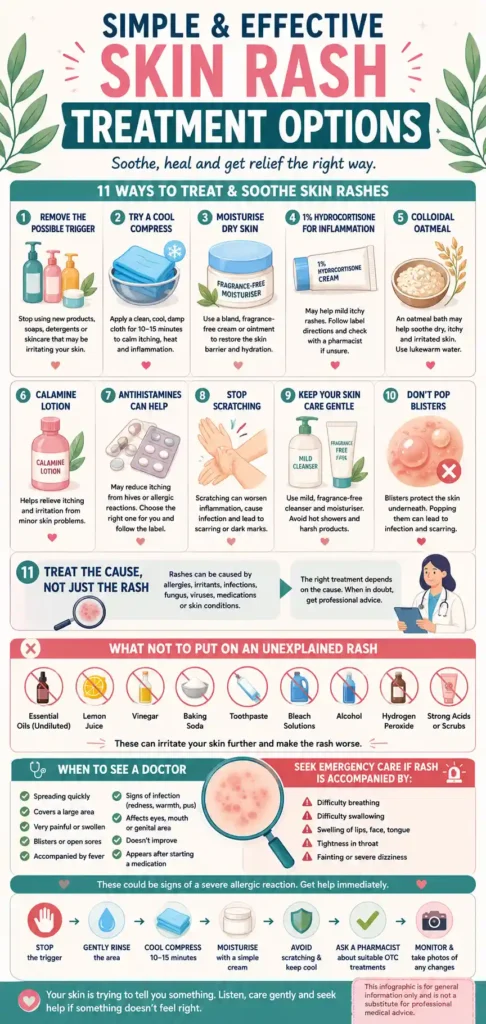
1. Start by Removing the Possible Trigger
Sometimes the most effective rash treatment isn’t something you put on your skin at all.
It’s simply stopping whatever is irritating it.
Contact dermatitis can develop after your skin encounters an irritating substance or something you’re allergic to.
Common triggers include:
Fragranced skincare
Cosmetics
Hair products
Laundry detergents
Household cleaning products
Jewellery containing nickel
Plants
Certain fabrics
Soaps
New creams or lotions
If your rash appeared shortly after using something new, stop using that product for the time being.
Mayo Clinic notes that identifying and avoiding the substance causing contact dermatitis is one of the most important parts of treatment.
It can also help to think back over the previous few days rather than just the last few hours, because some allergic skin reactions don’t appear immediately.
2. Try a Cool Compress
This has to be one of the easiest home treatments for an itchy or inflamed rash.
Take a clean, soft cloth, soak it in cool water and gently hold it against the affected skin.
You don’t need ice.
In fact, putting ice directly against irritated skin can potentially make matters worse.
A cool damp compress can help calm itching, heat and inflammation. The American Academy of Dermatology recommends applying a cool, damp cloth for around 10–15 minutes at a time for contact dermatitis.
Mayo Clinic similarly suggests cool wet compresses as a self-care treatment for irritated skin.
It’s particularly useful when you’re desperately trying not to scratch.
3. Moisturise Dry, Irritated Skin
If your rash is dry, rough or associated with eczema or dermatitis, a simple moisturiser can make an enormous difference.
Personally, I’d keep things boring here.
This isn’t the time for beautifully scented body lotions packed with fragrance and botanical extracts.
Choose a bland, fragrance-free cream or ointment designed for sensitive skin.
Thicker creams and ointments generally provide a stronger protective barrier than very watery lotions.
Mayo Clinic recommends moisturising dermatitis-prone skin and choosing products without fragrances, dyes, alcohol and other potential irritants.
Apply moisturiser gently rather than rubbing vigorously.
A particularly good time to apply it is shortly after bathing, while your skin still retains a little moisture.
4. Consider 1% Hydrocortisone for Minor Inflammatory Rashes
Over-the-counter 1% hydrocortisone cream can sometimes help mild itchy and inflammatory rashes such as certain forms of contact dermatitis.
It works by reducing inflammation.
Mayo Clinic includes non-prescription 1% hydrocortisone among the self-care options that may help relieve itching caused by contact dermatitis and dermatitis.
However, hydrocortisone isn’t the right treatment for every rash.
For example, steroid creams can disguise or potentially worsen some infections.
That’s why I wouldn’t repeatedly treat a mystery rash with hydrocortisone simply because it’s itchy.
Follow the instructions on the product and speak to a pharmacist or healthcare professional if you’re unsure whether it’s appropriate, especially when treating the face, delicate areas, children or a persistent rash.
5. Calm Itching With Colloidal Oatmeal
An oatmeal bath might sound like an old-fashioned remedy, but there’s a reason it continues to be recommended.
We’re talking specifically about colloidal oatmeal, which is very finely ground oatmeal formulated for use on the skin.
Adding it to a lukewarm or cool bath may soothe dry, itchy and irritated skin.
Both Mayo Clinic and Cleveland Clinic list oatmeal baths among possible ways to ease itchy dermatitis and skin rashes.
Just keep the water comfortably warm rather than very hot.
Hot water can strip oils from the skin and leave dryness and itching feeling even worse.
6. Calamine Lotion Can Help Some Itchy Rashes
Calamine is another wonderfully simple product that’s been sitting in medicine cabinets for generations.
It can help temporarily soothe itching and irritation caused by certain minor skin problems.
The American Academy of Dermatology and Mayo Clinic both list calamine lotion as an option for relieving itching associated with contact dermatitis.
It won’t cure every underlying cause of a rash, but it can sometimes make the symptoms much easier to tolerate while your skin recovers.
7. Antihistamines May Help With Hives and Allergic Itching
If your rash is associated with an allergic reaction or hives, an oral antihistamine may help reduce itching.
Cleveland Clinic lists antihistamines among treatments used for itchy skin rashes.
Some antihistamines can cause considerable drowsiness while others are marketed as less sedating.
Because antihistamines can interact with other medicines and aren’t suitable for everyone, follow the label carefully and ask a pharmacist if you’re unsure which option is appropriate.
Also remember that an antihistamine isn’t a substitute for emergency treatment if you’re experiencing a severe allergic reaction.
8. Stop Scratching!
I know.
This is much easier said than done.
But scratching can turn a relatively minor skin problem into something far more uncomfortable.
Repeated scratching can:
Damage the skin barrier
Increase inflammation
Make itching worse
Cause bleeding
Introduce bacteria
Increase the risk of infection
Leave pigmentation or scars
The American Academy of Dermatology advises avoiding scratching because it can worsen a rash and contribute to infection.
Try keeping your fingernails short and using cool compresses whenever the urge to scratch becomes overwhelming.
At night, soft cotton clothing can also create a useful barrier between your fingernails and irritated skin.
9. Keep Your Skincare Routine Extremely Gentle
When your skin is already inflamed, this isn’t the time for an ambitious ten-step skincare routine.
Temporarily simplify everything.
I would avoid:
Scrubs
Exfoliating acids
Retinoids on the affected area
Perfumed soaps
Fragranced body washes
Essential oils
Strong acne products
Very hot showers
Rough washcloths
Instead, use lukewarm water and a mild fragrance-free cleanser if cleansing is necessary.
Cleveland Clinic advises using mild, fragrance-free cleansers and moisturisers to help reduce irritation and prevent some rashes.
Sometimes giving irritated skin fewer products to deal with is exactly what it needs.
10. Don’t Pop Blisters
If your rash has formed blisters, resist the temptation to pop them.
The skin covering a blister acts as a natural protective layer.
Breaking it creates an opening through which bacteria can enter.
Keep the area clean and protected and get medical advice if blistering is extensive, painful, unexplained or accompanied by other symptoms.
A blistering rash can sometimes signal something considerably more important than ordinary skin irritation.
11. Treat the Cause, Not Just the Rash
This is probably the most important point in the whole article.
“Skin rash” isn’t really one condition.
It’s a symptom that can have hundreds of possible causes.
For example:
Contact dermatitis may improve by avoiding the allergen or irritant.
Eczema often requires moisturising and anti-inflammatory treatment.
Hives may respond to antihistamines.
Fungal infections generally require antifungal treatment.
Bacterial infections may require antibiotics.
Shingles can require antiviral medication.
Psoriasis may require prescription topical treatments, phototherapy or systemic medication.
Cleveland Clinic points out that rashes can arise from allergens, irritants, viruses, bacteria and chronic skin conditions, meaning treatment needs to be matched to the cause.
That is why a cream that worked beautifully for your last rash might do absolutely nothing for the next one.
What About Fungal Rashes?
Fungal infections such as ringworm commonly cause itchy, scaly patches that may gradually expand outward.
They’re generally treated with antifungal medicines rather than steroid cream alone.
This distinction is important because some fungal infections can become less obvious while continuing to spread if they’re treated incorrectly with corticosteroids.
If you think you have ringworm or another fungal infection, speak to a pharmacist or healthcare professional about an appropriate antifungal treatment.
Should I Use Antibiotic Cream?
Not routinely.
Most rashes aren’t caused by bacteria, so antibacterial or antibiotic products won’t necessarily help.
In fact, unnecessarily applying products to inflamed skin can introduce another potential irritant.
If your rash looks infected — particularly if it’s becoming increasingly painful, hot, swollen or producing pus — it’s better to seek medical advice.
How Long Should a Rash Take to Clear?
It varies enormously.
A mild irritant rash might begin improving within days once the trigger is removed.
Contact dermatitis can take a couple of weeks or longer to clear completely. Mayo Clinic notes that it often clears within approximately two to four weeks once the offending substance is avoided.
Chronic conditions such as eczema and psoriasis may come and go over many years.
The most useful thing to watch isn’t necessarily whether your rash disappears immediately.
Ask yourself:
Is it getting better?
If it’s gradually becoming less itchy, less inflamed and smaller, that’s reassuring.
If it’s spreading, becoming increasingly painful or developing new symptoms, that’s a different story.
What NOT to Put on an Unexplained Rash
When you’re uncomfortable, it’s tempting to try anything you’ve read about online.
I’d be particularly cautious about home remedies such as:
Undiluted essential oils
Lemon juice
Vinegar
Baking soda
Toothpaste
Bleach solutions
Alcohol
Hydrogen peroxide
Strong exfoliating acids
Inflamed skin already has a compromised protective barrier, so potentially irritating ingredients can make things considerably worse.
Simple is usually safer until you know what you’re dealing with.
When a Skin Rash Needs Medical Attention
Many mild rashes settle with basic care.
Others need professional assessment.
Contact a healthcare professional if your rash:
Appears suddenly without an obvious explanation
Keeps returning
Is spreading rapidly
Covers a large area
Is extremely painful
Has significant swelling
Produces blisters or open sores
Is accompanied by fever
Appears infected
Affects your eyes, mouth or genital area
Doesn’t begin improving
Develops after starting a medication
Cleveland Clinic advises urgent medical attention for rashes that spread rapidly, cover the body, blister, occur with fever or show signs of infection.
When a Rash Is an Emergency
Some skin reactions require immediate medical attention.
Seek emergency help if a rash occurs alongside:
Difficulty breathing
Difficulty swallowing
Tightness in your throat
Significant swelling of your lips, tongue or face
Fainting or severe dizziness
These can be symptoms of a serious allergic reaction.
Don’t attempt to manage a reaction like this with creams or home remedies.
My Simple Rash-Care Routine
If I developed a mild itchy rash and had no concerning symptoms, my basic approach would look something like this:
First: Stop using any new skincare, detergent or product that might be responsible.
Second: Gently rinse the area and avoid harsh soap.
Third: Apply a cool damp compress for 10–15 minutes.
Fourth: Use a simple fragrance-free moisturiser if the skin feels dry.
Fifth: Avoid scratching and keep the skin cool.
Sixth: Ask a pharmacist whether an appropriate OTC treatment such as hydrocortisone, calamine or an antihistamine is suitable.
Finally: Keep an eye on the rash rather than repeatedly changing treatments.
Taking a photograph on the first day can be surprisingly helpful because it’s easy to forget exactly how large or inflamed it originally looked.
See: Unusual Skin Rashes You Should Know About >
Frequently Asked Questions
1. What is the quickest way to soothe an itchy rash?
A cool damp compress is one of the simplest things to try immediately.
A fragrance-free moisturiser, colloidal oatmeal, calamine lotion or an appropriate OTC treatment may also help depending on the cause.
2. Should I keep a rash moisturised or dry?
It depends on the rash.
Dry inflammatory conditions such as eczema often benefit from moisturisation. Other conditions, including certain infections, need different treatment.
If you aren’t sure what the rash is, ask a pharmacist or healthcare professional.
3. Can Vaseline help a rash?
Plain petroleum jelly can provide a protective barrier for some types of dry or irritated skin.
However, it isn’t a treatment for every rash and won’t cure infections.
4. Does hydrocortisone get rid of a rash?
Hydrocortisone can reduce inflammation and itching in some inflammatory skin conditions, but it doesn’t treat every underlying cause.
Don’t assume that every red or itchy rash needs steroid cream.
5. Does an antihistamine help a skin rash?
It may help itching associated with hives or allergic reactions.
It won’t necessarily treat rashes caused by fungal, bacterial or viral infections.
6. Is a hot shower good for a rash?
Usually not.
Very hot water can make inflamed or dry skin feel itchier and strip away protective oils.
Stick with lukewarm water.
7. Can stress cause a rash?
Stress can worsen conditions such as eczema and may contribute to hives in some people.
However, an unexplained rash shouldn’t automatically be blamed on stress.
8. How do I know if my rash is infected?
Warning signs can include increasing redness or discoloration, warmth, swelling, worsening pain, pus, yellow crusting or fever.
A suspected infection should be medically assessed.
The Bottom Line
The best skin rash treatment is often surprisingly simple: cool the skin, moisturise it, stop scratching and remove possible irritants.
Treatments such as colloidal oatmeal, calamine, antihistamines and 1% hydrocortisone can also be useful in the right circumstances.
But the phrase in the right circumstances really matters.
A skin rash can be caused by everything from an irritating shower gel to eczema, fungal infection, medication, shingles or an allergic reaction. Treating symptoms without considering the underlying cause can sometimes delay the correct treatment.
So if a rash is mild and clearly improving, gentle home care may be all you need.
If it’s persistent, painful, spreading, blistering or simply doesn’t look right, get it checked.
Sometimes the simplest and most effective skin rash treatment is knowing when not to treat it yourself.
This article is for general informational purposes and isn’t a substitute for diagnosis or treatment from a qualified healthcare professional.
Resources
American Academy of Dermatology (AAD) – Rash 101: When to Seek Medical Treatment
https://www.aad.org/public/everyday-care/itchy-skin/rash/rash-101
Mayo Clinic – Contact Dermatitis: Diagnosis and Treatment
https://www.mayoclinic.org/diseases-conditions/contact-dermatitis/diagnosis-treatment/drc-20352748
Cleveland Clinic – Skin Rashes: Types, Symptoms, Causes & Treatment
https://my.clevelandclinic.org/health/diseases/17413-rashes-red-skin