
Protein shakes can be incredibly handy when I’m trying to eat a little better, keep hunger under control, or lose a few pounds. They’re quick, portable, easy to customize, and—when they’re made properly—surprisingly filling.
But there’s one thing I want to clear up immediately: drinking a protein shake doesn’t automatically make you lose weight.
Weight loss ultimately depends on your overall eating pattern, activity levels, sleep, stress, and energy intake. The CDC recommends approaching healthy weight loss through a combination of nutritious eating, regular physical activity, adequate sleep, and stress management rather than relying on one particular food or supplement.
Where protein shakes can help is by providing a convenient, protein-rich meal or snack that may help you feel satisfied without packing in a huge number of calories.
Research suggests that protein can increase feelings of fullness, and higher-protein eating patterns may offer modest benefits for weight management and preservation of lean body mass during weight loss.
So, rather than thinking of these as “fat-burning shakes,” I prefer to think of them as easy tools for building a more satisfying weight-loss diet.
View more Weight Loss Ideas >
Here are five of my favorites—including completely DIY versions you can make in your blender.
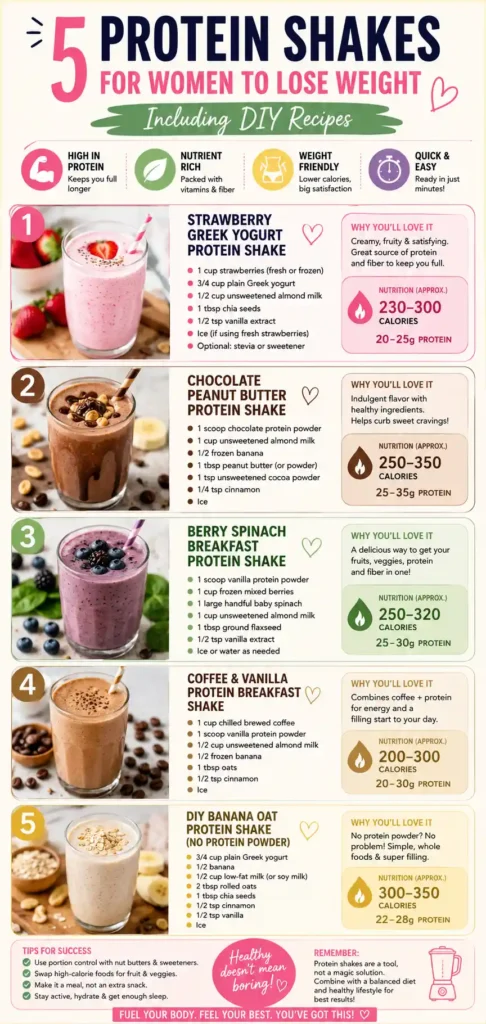
1. Strawberry Greek Yogurt Protein Shake
If I want something that tastes more like a strawberry milkshake than a “diet drink,” this is the recipe I reach for.
Greek yogurt gives it a thick, creamy texture while supplying plenty of protein. Strawberries add natural sweetness, fiber, and plenty of flavor without requiring spoonfuls of added sugar.
Ingredients
1 cup fresh or frozen strawberries
3/4 cup plain nonfat or low-fat Greek yogurt
1/2 cup unsweetened almond milk or low-fat dairy milk
1 tablespoon chia seeds
1/2 teaspoon vanilla extract
Ice, if using fresh strawberries
Optional: a small amount of stevia or another preferred sweetener
How to Make It
Add everything to a blender and blend until completely smooth.
If it seems too thick, add another splash of milk.
Why I Like It for Weight Loss
This shake combines protein with fruit and seeds rather than relying solely on protein powder.
The strawberries add volume, while chia seeds provide fiber and make the shake thicker. The Greek yogurt contributes most of the protein.
Whole foods such as fruit, vegetables, dairy, legumes, nuts, seeds, seafood, eggs, and lean meats can all form part of a healthy eating pattern for weight management.
Approximate nutrition: 230–300 calories and 20–25 grams of protein, depending on your yogurt and milk.
2. Chocolate Peanut Butter Protein Shake
Chocolate and peanut butter may not sound like traditional “weight-loss foods,” but portion size makes all the difference.
This shake gives me that chocolate-peanut-butter dessert flavor without requiring ice cream, chocolate syrup, or several tablespoons of peanut butter.
The secret is using a modest amount of peanut butter—or powdered peanut butter if I want to bring the calories down further.
Ingredients
1 scoop chocolate protein powder
1 cup unsweetened almond milk
1/2 small frozen banana
1 tablespoon natural peanut butter or powdered peanut butter
1 teaspoon unsweetened cocoa powder
1/4 teaspoon cinnamon
Handful of ice
How to Make It
Put everything into a blender and blend until thick and creamy.
For an even thicker shake, use frozen banana slices rather than fresh banana.
Why I Like It for Weight Loss
It tastes indulgent enough to satisfy my sweet tooth while still providing a substantial amount of protein.
Using half a banana rather than a whole one keeps the shake reasonably light, while just one tablespoon of peanut butter provides plenty of peanut flavor.
Be careful with nut butters when you’re trying to lose weight. They’re nutritious, but they’re also calorie-dense. I measure mine instead of adding a giant spoonful straight from the jar.
Approximate nutrition: 250–350 calories and 25–35 grams of protein, depending on your protein powder and peanut butter.
3. Berry Spinach Breakfast Protein Shake
This is my “I should probably eat more vegetables today” shake.
And don’t worry—the berries disguise the spinach remarkably well.
I like this one as a quick breakfast because you’re getting fruit, vegetables, protein, and fiber in one glass.
Ingredients
1 scoop vanilla or unflavored protein powder
1 cup frozen mixed berries
1 large handful baby spinach
1 cup unsweetened almond milk or low-fat milk
1 tablespoon ground flaxseed
1/2 teaspoon vanilla extract
Ice or water as needed
How to Make It
Blend the spinach and milk first if you want an especially smooth texture.
Then add the berries, protein powder, flaxseed, and vanilla and blend again.
Why I Like It for Weight Loss
Fruit and vegetables can help add volume to meals without adding huge amounts of calories.
The CDC specifically recommends replacing some higher-calorie foods with fruits and vegetables rather than simply adding fruits and vegetables on top of everything else you’re already eating.
That’s an important distinction.
If you’re trying to lose weight, your shake should ideally replace something—such as a less nutritious breakfast or snack—rather than becoming an extra 300 calories on top of your normal diet.
Approximate nutrition: 250–320 calories and 25–30 grams of protein.
4. Coffee and Vanilla Protein Breakfast Shake
Coffee lovers, this one’s for us.
Instead of grabbing a sugary coffee shop drink and then buying breakfast as well, I can combine my morning coffee and protein into one creamy shake.
Ingredients
1 cup chilled brewed coffee
1 scoop vanilla protein powder
1/2 cup unsweetened almond milk or low-fat milk
1/2 frozen banana
1 tablespoon oats
1/2 teaspoon cinnamon
Handful of ice
How to Make It
Make the coffee ahead of time and allow it to cool completely.
Add all ingredients to your blender and blend until frothy.
Why I Like It for Weight Loss
Coffee-shop drinks can quietly become incredibly calorie-heavy once syrups, whipped cream, sweetened milk, and toppings enter the equation.
This version keeps things simple while adding protein.
The tablespoon of oats also makes the shake slightly more substantial without turning it into an enormous breakfast.
If you find caffeine affects your anxiety, sleep, heart rate, or digestion, though, choose decaf instead. There’s absolutely no reason a weight-loss shake needs caffeine to “work.”
Approximate nutrition: 200–300 calories and 20–30 grams of protein.
5. DIY Banana Oat Protein Shake Without Protein Powder
You don’t actually need protein powder to make a protein shake.
If you prefer getting your protein from regular foods, Greek yogurt, milk, cottage cheese, soy milk, tofu, nuts, and seeds can all work beautifully in smoothies.
This banana-oat version is one of the simplest.
Ingredients
3/4 cup plain Greek yogurt
1/2 banana
1/2 cup low-fat dairy milk or unsweetened soy milk
2 tablespoons rolled oats
1 tablespoon chia seeds
1/2 teaspoon cinnamon
1/2 teaspoon vanilla
Handful of ice
How to Make It
Blend everything for around 30–60 seconds until the oats are completely incorporated.
Letting the shake sit for five minutes will make it even thicker because the oats and chia seeds absorb some of the liquid.
Why I Like It for Weight Loss
This is a great choice if you don’t want to buy protein supplements.
Milk and Greek yogurt provide substantial amounts of protein while oats, chia seeds, and banana make the shake much more satisfying than simply blending protein powder with water.
Protein is essential for building and maintaining tissues including muscle, bone, and skin, and you can obtain it from a wide variety of everyday foods.
Approximate nutrition: 300–350 calories and approximately 22–28 grams of protein.
How Much Protein Should Women Get?
There’s no single perfect protein target for every woman.
Protein requirements vary according to factors including body size, age, activity level, overall health, pregnancy, and fitness goals.
For healthy adults, the basic Recommended Dietary Allowance is around 0.8 grams of protein per kilogram of body weight per day.
That doesn’t necessarily mean 0.8 g/kg is the ideal target for everyone—particularly people who exercise frequently or are trying to maintain muscle while losing weight.
Research has found that consuming protein above the standard RDA during calorie restriction may help preserve lean body mass.
I wouldn’t get too obsessed with hitting an exact number unless you have a particular medical or athletic reason to do so. For many women, simply making sure that each meal contains a reasonable source of protein is an easier habit to maintain.
Will Protein Shakes Actually Make Me Lose Weight?
Not by themselves.
You could drink protein shakes every day and still gain weight if you’re consistently consuming more calories than your body needs.
Protein shakes become useful for weight loss when they make your overall eating pattern easier to manage.
For example, imagine your usual breakfast is:
Large flavored coffee
Muffin
Mid-morning cookie because you’re hungry again
Replacing that with a filling 300-calorie protein smoothie may make reducing your overall calorie intake much easier.
But if you eat your normal breakfast and then drink a 400-calorie protein shake because it’s supposedly healthy, you’re simply adding more energy to your diet.
That’s why context matters.
What Should I Put in a Weight-Loss Protein Shake?
I like to follow a simple formula.
Start with one protein source, such as:
Greek yogurt
Cottage cheese
Whey protein
Casein protein
Soy protein
Pea protein
Milk
Soy milk
Silken tofu
Then add one serving of fruit:
Berries
Banana
Peach
Mango
Pineapple
Apple
Next, add something for fiber or healthy fat:
Chia seeds
Ground flaxseed
Oats
Nut butter
Then add your liquid:
Water
Unsweetened almond milk
Dairy milk
Unsweetened soy milk
Cold coffee
Finally, use ingredients such as cinnamon, cocoa, vanilla, ginger, or ice to boost the flavor without pouring in lots of sugar.
Protein Shake Ingredients I Wouldn’t Go Overboard With
This is where supposedly “healthy” smoothies can suddenly turn into 700-calorie meals.
I watch the portions of:
Nut butter: A little goes a long way.
Honey and maple syrup: Natural sugar is still sugar. Fruit often provides enough sweetness.
Fruit juice: Whole fruit gives you fiber and tends to make a smoothie more filling.
Coconut milk: Canned coconut milk can be surprisingly calorie-dense.
Granola: Delicious, but very easy to overdo.
Dates: Nutritious but concentrated in natural sugars and calories.
Multiple scoops of protein powder: More isn’t automatically better.
You don’t have to avoid any of these ingredients. I simply wouldn’t throw all of them into the same shake and assume it’s automatically a low-calorie meal because it came out of a blender.
Should I Replace Meals With Protein Shakes?
Occasionally replacing a meal with a nutritionally balanced shake can be convenient, but I wouldn’t want most of my diet to come through a straw.
Whole meals provide variety, chewing satisfaction, fiber, and a broad range of nutrients.
My preferred approach is using shakes strategically—for example:
Breakfast on a rushed morning
A post-workout meal when I’m short on time
A filling afternoon snack
An alternative to a high-calorie dessert
A convenient lunch occasionally
The goal should still be an overall eating pattern based predominantly around nutritious whole foods.
Are Store-Bought Protein Shakes Good for Weight Loss?
They certainly can be.
They’re convenient when you don’t have access to a blender, but I always check the nutrition label.
In particular, I look at:
Total calories
Protein
Added sugar
Serving size
Saturated fat
Fiber
Ingredients
A shake containing around 20–30 grams of protein can be quite filling, but protein content isn’t the only consideration.
Some “protein smoothies” contain enough sugar and calories to rival milkshakes.
The fact that PROTEIN is written across the front of the bottle in giant letters doesn’t automatically make something a weight-loss product.
Whey vs. Plant Protein: Which Is Better?
Both can work.
Whey protein comes from milk and tends to blend very easily. It contains all essential amino acids and is popular with people who want to support muscle maintenance and recovery.
Plant-based powders commonly use:
Pea protein
Soy protein
Brown rice protein
Hemp protein
Protein blends
Soy provides all essential amino acids, while manufacturers often combine different plant proteins to create a more balanced amino-acid profile.
I’d choose based on dietary preference, allergies, tolerance, price, and—very importantly—whether you actually like the taste.
There’s not much point buying the theoretically “perfect” protein powder if it sits untouched in your cupboard because it tastes like sweetened cardboard.
When Is the Best Time to Drink a Protein Shake for Weight Loss?
There isn’t a magical fat-burning hour.
The best time is when the shake solves a problem in your diet.
For me, that might mean breakfast if I’m otherwise tempted to skip it and raid the snack cupboard later.
For somebody else, it might be after exercise.
And another person might prefer a shake around 3 p.m. because that’s when their cravings normally appear.
Consistency and your total eating pattern matter considerably more than whether you drink your shake at 8:03 a.m. or 4:17 p.m.
Frequently Asked Questions
1. Can I drink a protein shake every day and lose weight?
You can include a protein shake every day while losing weight, but the shake itself doesn’t cause weight loss. It needs to fit within an overall nutritious eating pattern and appropriate calorie intake.
2. Can I make protein shakes without protein powder?
Absolutely. Greek yogurt, milk, soy milk, cottage cheese, silken tofu, nuts, and seeds can all contribute protein.
3. Are bananas bad in weight-loss shakes?
No. Bananas are nutritious and perfectly reasonable to include. Portion size simply matters if you’re keeping track of calories. I often use half a banana because it provides plenty of sweetness and creaminess.
4. Is almond milk good for protein shakes?
Yes, although most almond milk isn’t particularly high in protein. If you want your milk to contribute significantly to the protein content, dairy or soy milk generally provides considerably more.
5. Should I drink protein shakes before or after working out?
Either can work. If you exercise regularly, getting enough total protein throughout the day is generally more important than obsessing over a tiny post-workout timing window.
6. Can protein shakes replace breakfast?
They can, provided the shake is substantial enough. I prefer adding fruit, fiber, and a little healthy fat rather than simply mixing protein powder with water.
7. Can I have two protein shakes a day?
You can, but I wouldn’t automatically assume more shakes mean faster weight loss. Whole foods should still make up most of your diet. If two shakes are displacing nutritious meals every day, it may be worth reconsidering your approach.
People with kidney disease or other medical conditions that affect protein requirements should speak with their doctor or registered dietitian before significantly increasing protein intake.
My Final Thoughts
Protein shakes aren’t miracle weight-loss drinks—and I’m always suspicious of products that market them that way.
What they are is incredibly convenient.
A well-made protein shake can give me protein, fruit, vegetables, fiber, and healthy fats in a breakfast that takes about three minutes to prepare.
And because protein may help with satiety and preservation of lean mass during weight loss, including sufficient protein can be a sensible part of a healthy weight-management plan.
The trick is keeping the recipe balanced.
Start with a good protein source, add fruit or vegetables, include a little fiber or healthy fat, keep added sugars under control, and remember that calories from a blender still count.
Most importantly, choose a shake that you genuinely enjoy.
Because the best weight-loss eating plan isn’t the one with the fanciest ingredients or the biggest promises.
It’s the one you can comfortably stick with.
Sources
CDC – Steps for Losing Weight
https://www.cdc.gov/healthy-weight-growth/losing-weight/index.html
Useful for healthy, sustainable weight-loss guidance and the importance of diet, activity, sleep, and stress.
CDC – Tips for Healthy Eating for a Healthy Weight
https://www.cdc.gov/healthy-weight-growth/healthy-eating/index.html
Good supporting source for nutrient-dense foods and healthy eating patterns during weight management.
MedlinePlus – Dietary Proteins
https://medlineplus.gov/dietaryproteins.html
U.S. National Library of Medicine information on protein, amino acids, and dietary protein sources.
PubMed/NIH – The Role of Protein in Weight Loss and Maintenance
https://pubmed.ncbi.nlm.nih.gov/25926512/
Reviews evidence on higher-protein diets, appetite, energy intake, and weight management.
















Comments 1