When I hear the phrase natural antibiotics, I immediately think of garlic, honey and oregano oil. They’ve been used in traditional remedies for generations, and modern laboratory research suggests that quite a few everyday herbs, spices and plant compounds really do have antimicrobial properties.
However, there’s an important distinction to make before we get into my top picks.
View more Health and Wellness Tips and Home Remedies >
Natural remedies are not antibiotics in the medical sense. Prescription antibiotics are medicines that have been tested and approved to treat particular bacterial infections.
The foods, herbs and oils below are better described as natural antimicrobials because laboratory research suggests that they may inhibit or kill certain microorganisms.
That doesn’t mean they’re useless—far from it. I love incorporating many of them into my diet and wellness routine. I just wouldn’t use garlic or oregano oil instead of medical treatment for something like pneumonia, a kidney infection or a serious infected wound.
Another point worth remembering is that antibiotics don’t work against viruses. That means antibiotics aren’t appropriate for illnesses such as colds or flu. The CDC specifically warns that unnecessary antibiotic use can cause side effects and contribute to antimicrobial resistance.
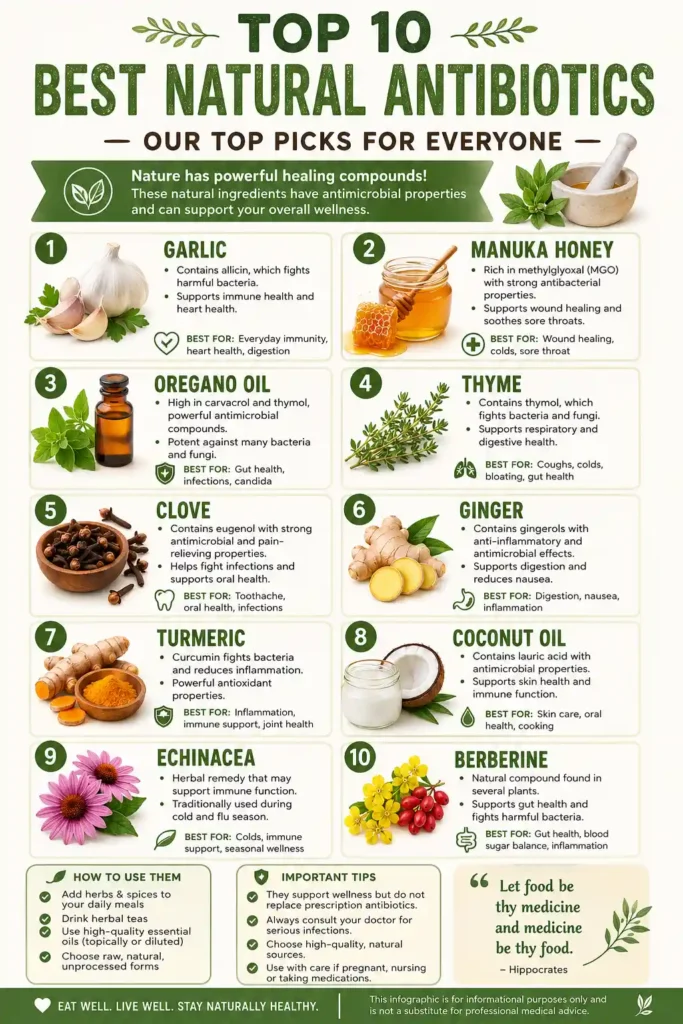
With that in mind, here are 10 of the most interesting natural substances with antimicrobial properties, along with what the research actually tells us.
1. Garlic
My top pick for: An easy everyday antimicrobial food
Garlic has to come first on my list because it’s inexpensive, easy to find and incredibly easy to incorporate into food.
Garlic contains several sulfur-containing compounds, but the one you’ll hear about most frequently is allicin. Allicin forms when fresh garlic is chopped, crushed or chewed.
Laboratory research has found that allicin has antibacterial activity against a broad range of Gram-positive and Gram-negative bacteria.
That sounds impressive, but there’s an important catch. Demonstrating antibacterial activity in a laboratory doesn’t automatically mean eating garlic will cure a bacterial infection in a person.
In fact, the National Center for Complementary and Integrative Health notes that evidence for medicinal uses of garlic remains limited for many conditions.
Easy ways I use garlic
I like adding fresh garlic to:
Soups
Pasta sauces
Stir-fries
Salad dressings
Roasted vegetables
Homemade hummus
Garlic butter
If I want the characteristic garlic compounds to develop, I’ll usually crush or chop the garlic before cooking with it.
A little caution
Large amounts of garlic or garlic supplements can cause digestive upset. Garlic supplements may also increase bleeding risk in some circumstances, so anyone taking medication—particularly blood-thinning medication—should speak to a healthcare professional before using concentrated supplements.
My verdict: One of the easiest natural antimicrobial foods to include regularly.
2. Manuka Honey
My top pick for: The strongest research interest among medicinal honeys
Honey isn’t just something I drizzle over yogurt.
It has attracted serious scientific interest because of its antibacterial properties.
Researchers believe honey’s antimicrobial effects come from several factors, including its high sugar concentration, acidity and hydrogen peroxide production. Certain honeys also contain additional antibacterial compounds.
Manuka honey gets particular attention because it contains relatively high levels of methylglyoxal, another compound associated with antimicrobial activity.
Research reviews have reported activity against numerous microorganisms, including some antibiotic-resistant bacteria.
Where honey becomes particularly interesting medically is wound care.
However, there’s an enormous difference between putting supermarket honey on a wound and using a sterile medical-grade honey dressing. If a wound requires treatment, I’d always use an appropriate medical product under professional guidance.
How I use honey at home
For everyday use, I like honey:
Stirred into warm tea
Drizzled over Greek yogurt
Added to oatmeal
Mixed into homemade salad dressing
Honey can also be soothing when you have a cough or irritated throat.
Important
Never give honey to a child younger than 12 months because of the risk of infant botulism.
My verdict: Probably the most fascinating natural antimicrobial on this list, especially in the context of medical-grade wound products.
3. Oregano Oil
My top pick for: One of the most potent essential oils in laboratory studies
Oregano is another ingredient that’s far more interesting than its pizza-seasoning reputation suggests.
Oregano essential oil contains compounds including carvacrol and thymol.
Both have attracted considerable attention for their antimicrobial properties. Research examining oregano oil, thyme oil, carvacrol and thymol found antibacterial activity against a variety of bacterial and fungal isolates.
Laboratory research has also demonstrated antibacterial activity from carvacrol and thymol against both Gram-positive and Gram-negative bacteria.
But this is where I’m particularly careful about the phrase “natural antibiotic.”
Most of this evidence comes from laboratory research rather than clinical trials showing oregano oil can reliably treat bacterial infections in humans.
Oregano herb vs. oregano essential oil
There’s a huge difference between sprinkling oregano into dinner and swallowing concentrated oregano essential oil.
I happily use oregano as a culinary herb in:
Tomato sauces
Soups
Pizza
Roasted vegetables
Marinades
Concentrated essential oils need much more caution.
I would never assume an essential oil is safe to swallow simply because it’s natural.
My verdict: Very promising antimicrobial activity in laboratory research, but concentrated oregano oil deserves respect.
4. Thyme
My top pick for: A useful culinary herb with impressive antimicrobial compounds
Thyme is another kitchen herb I think deserves more attention.
One of its best-known compounds is thymol.
Thymol has been extensively investigated for its antibacterial and antifungal effects, while thyme essential oil itself has demonstrated antibacterial activity in laboratory testing.
Thyme is particularly appealing to me because it’s so simple to incorporate into normal cooking.
Try thyme in:
Roast chicken
Vegetable soups
Stews
Roasted potatoes
Beans
Tomato dishes
Marinades
You can also make thyme tea from culinary thyme.
Again, I distinguish between the herb and concentrated thyme essential oil. The fact that thyme is safe to sprinkle generously over roasted vegetables doesn’t mean undiluted essential oil should be swallowed or put directly onto skin.
My verdict: One of my favorite ways to add antimicrobial plant compounds to everyday meals.
5. Clove
My top pick for: A spice packed with eugenol
Cloves have an unmistakably warm, spicy smell, and that distinctive aroma comes partly from eugenol.
Eugenol has been extensively researched for its biological activity.
Studies have found activity against a wide range of Gram-positive and Gram-negative bacteria as well as fungi.
Research into clove oil and eugenol has also explored their effects on bacterial biofilms and other factors that help microorganisms survive.
Ways I use cloves
I prefer cloves in ordinary culinary quantities.
They’re lovely in:
Chai
Mulled drinks
Apple desserts
Curries
Rice dishes
Gingerbread
Homemade spice blends
Clove oil is considerably stronger.
You’ve probably heard about using clove oil for toothache. Eugenol does have analgesic and antimicrobial properties, but concentrated clove oil can irritate or damage tissue if used incorrectly. A toothache can also indicate decay or infection, so it’s something I’d get checked by a dentist rather than repeatedly covering up.
My verdict: A surprisingly powerful little spice, but concentrated clove oil requires caution.
6. Ginger
My top pick for: An all-round wellness staple
Ginger is one ingredient that’s almost permanently in my kitchen.
You’ll see it promoted online as a “natural antibiotic,” although I think that’s overstating the evidence.
Ginger contains numerous biologically active plant compounds and has a long history of traditional medicinal use. It has been studied extensively for several health applications, particularly nausea and digestive symptoms.
The NCCIH notes that ginger has been used safely in many research studies, although it can cause heartburn, abdominal discomfort, diarrhea or irritation in some people. It can also interact with medicines.
I wouldn’t rely on ginger to treat a bacterial infection, but I still think it deserves a place in a wellness-focused kitchen.
My favorite ways to use ginger:
Fresh ginger tea
Smoothies
Stir-fries
Soups
Curries
Salad dressings
Ginger and lemon drinks
My verdict: Not something I’d call a genuine antibiotic, but an excellent culinary herb with a long history of medicinal use.
7. Turmeric
My top pick for: A versatile spice with interesting bioactive compounds
Turmeric has become one of the best-known wellness spices around.
Its famous yellow pigment comes partly from curcumin, one of a group of compounds called curcuminoids.
Turmeric and curcumin have been studied for numerous biological effects. You’ll also find laboratory research investigating their interactions with microorganisms.
However, I wouldn’t describe turmeric as a replacement for an antibiotic. Clinical evidence simply doesn’t support using turmeric to treat serious bacterial infections.
The NCCIH also points out something that frequently gets forgotten in wellness articles: natural supplements aren’t automatically harmless. There have been reports linking some highly bioavailable turmeric or curcumin products with liver injury.
That’s another reason I prefer enjoying turmeric primarily as a food.
Ways I use turmeric
I add it to:
Curries
Lentil soups
Rice
Scrambled eggs
Roasted vegetables
Smoothies
Golden milk
Add a little black pepper and you’ve got one of my favorite savory spice combinations.
My verdict: Excellent as part of a healthy diet, but I wouldn’t treat turmeric supplements like medication.
8. Coconut Oil
My top pick for: A naturally antimicrobial fatty acid source
Coconut oil earns a place on this list because it contains a relatively high proportion of lauric acid.
Lauric acid and related medium-chain fatty acids have demonstrated antimicrobial properties in laboratory research.
This is partly why you’ll see coconut oil included in everything from skin products to oral-care products.
Does that make eating spoonfuls of coconut oil equivalent to taking antibiotics?
Absolutely not.
Coconut oil is still predominantly saturated fat, so I don’t see a reason to consume huge quantities simply for supposed antibiotic benefits.
Where I find coconut oil more useful is as an occasional culinary ingredient or ingredient in beauty products.
Ways to use it
Cooking certain dishes
Baking
Hair conditioning treatments
Skin moisturizers if your skin tolerates it
Coconut oil can clog pores in some acne-prone people, so it’s definitely not my first choice as a universal facial moisturizer.
My verdict: Interesting antimicrobial chemistry, but not a reason to start eating coconut oil by the spoonful.
9. Echinacea
My top pick for: Traditional cold-season herbal remedies—with realistic expectations
Echinacea appears on countless lists of natural antibiotics and immune-boosting herbs.
It’s traditionally used when cold symptoms begin, and you’ll find it in teas, tinctures, lozenges and capsules.
However, this is one remedy where the marketing often runs ahead of the evidence.
The NCCIH reports that research investigating echinacea for colds has produced inconsistent results. Overall evidence for clinically meaningful treatment effects remains weak.
So why include it?
Because it’s such a commonly marketed “natural antibiotic” that I think it’s worth discussing—and clarifying what we actually know.
Echinacea may contain potentially interesting bioactive compounds, but there’s currently no good reason to treat it as an alternative to antibiotics.
What I would use it for
If I enjoy an echinacea tea when I’m feeling under the weather, fine.
I just wouldn’t expect that tea to eliminate a bacterial infection.
My verdict: Popular and interesting, but one of the weaker choices if we’re talking specifically about antimicrobial evidence in humans.
10. Berberine
My top pick for: A fascinating plant compound that deserves caution
Berberine is slightly different from the other entries on this list because it isn’t a plant itself.
It’s a naturally occurring compound found in several plants, including barberry and goldenseal.
Berberine has generated enormous interest in recent years, and research has investigated its effects on metabolism, the gut microbiome and microorganisms.
That doesn’t mean it’s something I’d casually recommend to everyone.
Berberine supplements can cause gastrointestinal side effects including nausea, stomach discomfort, constipation and diarrhea. More importantly, berberine can interact with medications. The NCCIH specifically notes an established interaction with cyclosporine and advises people taking medicines to speak with a healthcare provider before using berberine supplements.
I therefore treat berberine very differently from something such as garlic or thyme.
Adding garlic to dinner is one thing. Taking a concentrated pharmacologically active supplement every day is another.
My verdict: Potentially interesting, but this is one I’d discuss with a doctor or pharmacist before supplementing.
My Natural Antibiotics Top 10 at a Glance
Natural ingredient |
Key compound or feature |
My preferred use |
|---|---|---|
Garlic |
Allicin |
Everyday cooking |
Manuka honey |
Methylglyoxal and other antimicrobial factors |
Food; medical-grade products for appropriate wound care |
Oregano |
Carvacrol and thymol |
Culinary herb |
Thyme |
Thymol |
Cooking and herbal tea |
Clove |
Eugenol |
Culinary spice |
Ginger |
Gingerols and other plant compounds |
Cooking and tea |
Turmeric |
Curcuminoids |
Cooking |
Coconut oil |
Lauric acid |
Occasional culinary/topical use |
Echinacea |
Multiple plant compounds |
Traditional herbal preparations |
Berberine |
Berberine |
Supplement only with appropriate caution
|
Which Natural Antibiotic Is the Strongest?
If we’re talking about laboratory antimicrobial activity, I’d put garlic compounds, oregano oil, thyme compounds, clove/eugenol and certain honeys among the most interesting options.
Oregano’s carvacrol and thyme’s thymol have demonstrated substantial antibacterial effects in experimental research.
Garlic’s allicin has similarly demonstrated broad antibacterial activity in laboratory research.
Honey also has a particularly interesting evidence base because antimicrobial honey has been investigated for wound applications—not simply in test tubes.
But there is no universal “strongest natural antibiotic” for treating infections in people.
Different bacteria respond to different substances, concentrations matter enormously, and something killing bacteria in a petri dish doesn’t tell us what dose would safely achieve the same result inside the human body.
That’s exactly why I’m cautious about websites claiming that a spoonful of a particular herb can “replace antibiotics.”
Can Natural Antibiotics Replace Prescription Antibiotics?
This is the most important question in the entire article.
No—not when you genuinely need an antibiotic.
Prescription antibiotics can be lifesaving.
A bacterial infection can occasionally progress incredibly quickly. Conditions including bacterial pneumonia, kidney infections, meningitis, sepsis and certain skin or wound infections require proper diagnosis and medical treatment.
Using an herbal remedy instead of necessary antibiotic treatment can give an infection more time to spread.
At the same time, antibiotics shouldn’t be taken unnecessarily.
Antibiotics treat certain bacterial infections; they don’t treat viruses such as colds or flu. Unnecessary antibiotic exposure also contributes to antimicrobial resistance.
So, for me, the sensible middle ground isn’t “natural versus conventional.”
It’s using each appropriately.
I can enjoy garlic, ginger, turmeric, oregano and honey as part of a healthy diet while still taking an antibiotic if a doctor determines I have an infection that requires one.
Are Natural Antibiotics Safe?
Not automatically.
One of the biggest misconceptions in natural health is that natural = harmless.
Think about it: plenty of extremely powerful substances occur naturally.
Herbal remedies and supplements can:
Cause allergic reactions
Irritate the skin
Upset your stomach
Interact with medication
Affect blood clotting
Affect liver enzymes
Be unsafe during pregnancy
Be inappropriate for children
Become toxic at high concentrations
Essential oils deserve particular caution.
Oregano, thyme and clove may be perfectly normal culinary ingredients while their concentrated essential oils are extremely potent. I wouldn’t swallow essential oils or apply them undiluted simply because a social media post describes them as natural.
Dietary supplements can also vary considerably. In the United States, supplements aren’t approved by the FDA in the same way prescription drugs are before they reach consumers, something the NCCIH repeatedly emphasizes in its consumer guidance.
What About Tea Tree Oil?
Tea tree oil is another well-known natural antimicrobial, and you may be wondering why it didn’t make my main top 10.
It’s because I view it as an external-use ingredient, not a general wellness remedy.
Tea tree oil appears in acne products, shampoos and skin preparations because of its antimicrobial properties.
But it shouldn’t be swallowed.
If I use tea tree oil at all, I stick to properly formulated topical products rather than experimenting with undiluted essential oil.
What About Apple Cider Vinegar?
Apple cider vinegar appears on nearly every natural-remedy list imaginable.
Its acidity can inhibit some microorganisms under certain conditions, but that doesn’t make drinking apple cider vinegar an antibiotic treatment.
Undiluted vinegar can also irritate the throat, digestive tract and skin and can damage tooth enamel.
I enjoy vinegar in food and salad dressing. I don’t consider it medicine for bacterial infections.
How I Prefer to Use Natural Antimicrobials
Rather than waiting until I’m ill and suddenly taking enormous quantities of supplements, I prefer something much simpler:
I incorporate antimicrobial herbs and spices into ordinary food.
A normal week might include:
Garlic in pasta sauce
Ginger in a stir-fry
Turmeric in curry
Oregano in tomato dishes
Thyme with roasted vegetables
Cloves in chai
Honey with yogurt
That approach gives me variety without turning ordinary foods into pseudo-medications.
And there’s another benefit: herbs and spices make healthy food taste much better.
When Should You See a Doctor?
Natural remedies shouldn’t delay medical care.
Seek professional advice if you have symptoms suggesting a significant infection, particularly:
A high or persistent fever
Difficulty breathing
Severe pain
Confusion
Extreme weakness
Rapidly worsening symptoms
A wound that becomes increasingly red, swollen, painful or produces pus
Redness spreading away from a wound
Severe urinary symptoms
Back or kidney-area pain with urinary symptoms
Persistent vomiting
Signs of dehydration
Symptoms that improve and then suddenly become much worse
Young children, older adults, pregnant people and anyone with a weakened immune system may also need medical assessment sooner.
FAQs About Natural Antibiotics
1. What is the best natural antibiotic?
There isn’t a medically established “best natural antibiotic.” Garlic, oregano, thyme, clove and honey contain compounds that have demonstrated notable antimicrobial activity in research, but they shouldn’t automatically be considered substitutes for antibiotic medication.
2. Is garlic a natural antibiotic?
Garlic contains allicin, which has demonstrated antibacterial activity against a variety of microorganisms in laboratory research. However, eating garlic hasn’t been proven to treat serious bacterial infections in the same reliable way as appropriately prescribed antibiotics.
3. Is honey a natural antibiotic?
Honey does have genuine antimicrobial properties. Its antibacterial activity involves several mechanisms, including low pH, high sugar concentration and hydrogen peroxide, with some honeys containing additional active compounds. Medical-grade honey is also used in certain wound-care products.
4. Is oregano oil a natural antibiotic?
Oregano oil contains carvacrol and thymol, both of which have demonstrated antibacterial activity in laboratory studies. Evidence that oregano oil can replace antibiotics for treating human infections is lacking, however.
5. Can natural antibiotics cure a UTI?
I wouldn’t try to treat a suspected urinary tract infection with herbal remedies alone. Some UTIs can travel to the kidneys and become much more serious. If you have persistent burning, frequent urination, blood in your urine, fever or pain around your back or kidneys, get medical advice.
6. Can natural antibiotics treat a tooth infection?
A dental abscess requires dental treatment. Herbs and essential oils may temporarily reduce discomfort or inhibit bacteria in laboratory settings, but they can’t remove infected dental tissue or properly drain an abscess.
7. Can I take natural remedies while taking antibiotics?
Sometimes, but it depends on the remedy and medication. Herbs and concentrated supplements can interact with prescription medicines. Tell your doctor or pharmacist about supplements you’re taking rather than assuming natural products are automatically compatible.
8. Can I use natural antibiotics for a cold?
A cold is normally caused by a virus, not bacteria, so antibiotics aren’t appropriate anyway. The CDC confirms that antibiotics don’t work against cold viruses. Some natural remedies may nevertheless make symptoms more comfortable—for example, warm drinks or honey for a cough.
9. Do natural antibiotics cause resistance?
Antimicrobial resistance is complicated. One reason researchers are interested in compounds such as those found in honey and plants is their variety of antimicrobial mechanisms. That doesn’t mean resistance can never develop or that natural antimicrobial products should be used indiscriminately.
10. Should I take natural antibiotics every day?
I don’t see any good reason to take high-dose antimicrobial supplements continuously without a specific reason. I prefer getting herbs and spices naturally through food unless a qualified professional recommends otherwise.
The Bottom Line
There’s genuinely exciting science behind many so-called natural antibiotics.
Garlic contains antimicrobial allicin. Oregano and thyme provide carvacrol and thymol. Cloves contain eugenol. Certain honeys have complex antibacterial properties, and many other herbs and plant compounds are being investigated for their effects on microorganisms.
But I think we need to resist turning interesting laboratory findings into exaggerated health promises.
For everyday wellness, I’m very happy to keep garlic, ginger, turmeric, oregano, thyme, cloves and honey in my kitchen.
If I have a serious bacterial infection?
I’m going to get proper medical advice.
Natural remedies and modern medicine don’t have to compete with each other. Used sensibly, herbs, spices and traditional remedies can be part of a healthy lifestyle—while antibiotics remain extremely important medicines when they’re genuinely needed.
Resources
Centers for Disease Control and Prevention (CDC) – Antibiotic Use and Prescribing
Useful for explaining when antibiotics are necessary, when they don’t work, and antibiotic resistance.
https://www.cdc.gov/antibiotic-use/about/index.html
National Center for Complementary and Integrative Health (NCCIH) – Herbs and Natural Products
A reliable U.S. government resource for evidence and safety information about natural remedies such as garlic, turmeric, ginger and other supplements.
https://www.nccih.nih.gov/health/herbsataglance
National Institutes of Health / PubMed – Honey: An Advanced Antimicrobial and Wound Healing Biomaterial
A scientific review covering honey’s antimicrobial properties and its potential role in wound healing.
https://pubmed.ncbi.nlm.nih.gov/36015289/