For the best of results, you will obviously need the best ab workouts to get that highly sought-after flat belly that everyone aspires for.
If you’re not sure which routine you can and can’t trust in this amalgam of magical Internet solutions, we’ve helped you filter some of them out.
Coming from some of the renowned accredited trainers around, here are the workouts that can paste that six-pack over your stomach. (Scroll to the bottom to get straight to the tutorials)
View more Fitness Tips >
If there is one area of the body that seems to attract endless workout advice, it is the abs. We are constantly being told to crunch more, plank longer, or try some new “belly-fat-burning” move that promises a flatter stomach in days.
The reality is a little less dramatic, but much more useful.
A good ab workout can absolutely help you build a stronger, firmer-looking midsection. More importantly, strengthening your core can improve your balance, posture, stability, and performance during everything from walking and gardening to lifting weights.
What ab exercises cannot do is magically remove fat from one specific area of your body. If your goal is more visible abdominal definition, your overall diet, activity levels, genetics, hormones, and body-fat levels all play a part.
That does not make ab workouts pointless. Far from it. I think core training is one of the most worthwhile additions to a regular fitness routine — especially when you focus on building strength rather than simply doing hundreds of crunches.
Here are some of my favorite ab exercises, how to put them together into a simple workout, and a few mistakes worth avoiding.
What Exactly Are Your Abs?
When we talk about our “abs,” we are really talking about several muscles that work together.
The rectus abdominis runs down the front of your abdomen. This is the muscle responsible for the classic “six-pack” appearance.
Your obliques sit along the sides of your torso. They help you rotate and bend your body while also keeping your trunk stable.
Deeper inside is the transverse abdominis, which acts a little like a natural corset around your middle. It plays an important role in supporting and stabilizing your spine.
Your core also includes muscles around your pelvis, lower back, hips, and diaphragm.
This is why I prefer a varied ab workout rather than endless sit-ups. Your core is designed to stabilize, bend, rotate, and resist movement, so your training should reflect that.
Benefits of Regular Ab Workouts
A stronger core is useful for far more than appearance.
Better Stability
Your core helps stabilize your torso whenever you walk, run, bend, reach, or lift something.
Improving core strength can make everyday movements feel more controlled.
Improved Posture
Your abdominal and back muscles work together to support your spine.
While ab exercises alone will not automatically “fix” poor posture, strengthening your core can make it easier to maintain a comfortable upright position.
Better Workout Performance
A strong core provides a stable base for exercises such as squats, lunges, push-ups, and overhead presses.
Even exercises that do not look like ab exercises often rely heavily on core stability.
Improved Balance
Core strength can help you control your body more effectively, which is particularly useful as we get older.
A Firmer Midsection
Building your abdominal muscles can give your stomach a firmer, more defined appearance.
Just remember that visible abs depend on more than muscle strength alone.
Can Ab Workouts Burn Belly Fat?
This is probably the biggest misconception surrounding ab exercises.
Unfortunately, doing lots of crunches will not specifically burn the fat sitting over your stomach.
Your body decides where it stores and loses fat based largely on factors such as genetics, hormones, age, and overall energy balance.
This means you can strengthen your abdominal muscles without immediately seeing them.
If fat loss is your goal, I would combine core exercises with regular movement, strength training, cardio if you enjoy it, nutritious meals, sufficient protein, and sensible portion sizes.
You do not need to punish yourself with endless workouts.
Consistency normally beats extremes.
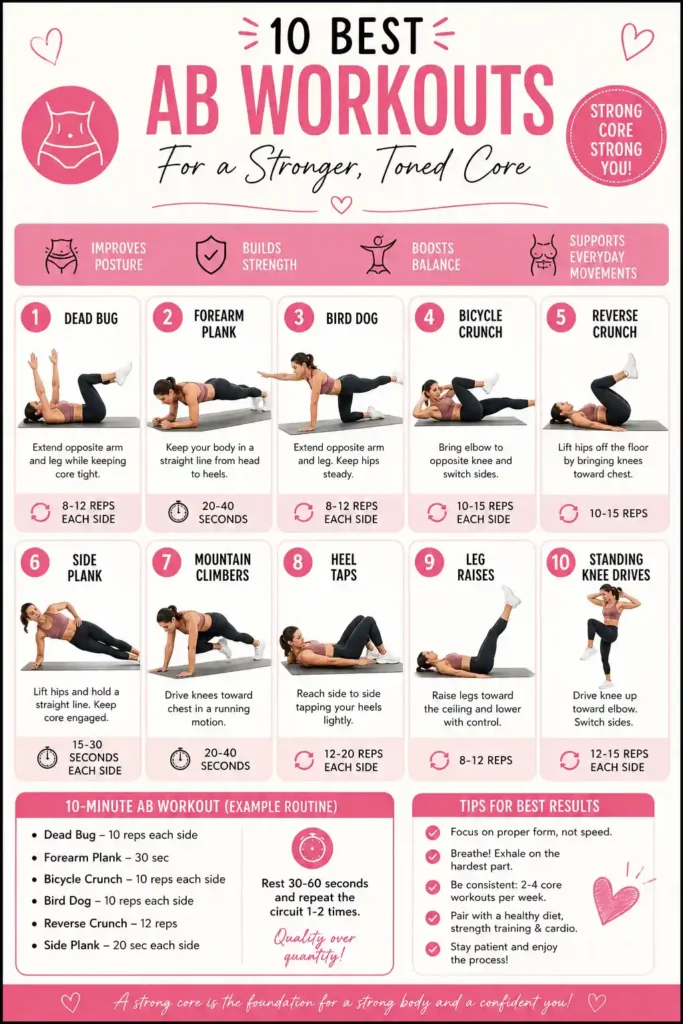
10 of the Best Ab Workouts
You certainly do not need to do all of these exercises in every session. I like choosing four to six and creating a short workout from them.
1. Dead Bug – see further down for a video tutorial
The dead bug may not look impressive, but it is one of my favorite beginner core exercises.
How to Do It
Lie on your back with your knees bent at approximately 90 degrees and your arms pointing toward the ceiling.
Gently brace your stomach.
Slowly lower your right arm behind you while extending your left leg toward the floor.
Return to the starting position and switch sides.
Why I Like It
The dead bug teaches you to keep your torso stable while your arms and legs move.
It is particularly useful if traditional crunches feel uncomfortable.
Try: 8–12 repetitions on each side.
2. Forearm Plank
Planks train your core to resist movement rather than repeatedly bending your spine.
How to Do It
Place your forearms on the floor with your elbows underneath your shoulders.
Extend your legs behind you.
Keep your body in a fairly straight line from your head to your heels.
Brace your stomach and avoid allowing your lower back to sag.
Beginner Modification
Drop your knees to the floor.
You can still get an excellent core workout this way.
Try: 20–40 seconds.
3. Bird Dog
The bird dog works your core, lower back, glutes, and shoulders.
How to Do It
Start on your hands and knees.
Brace your stomach.
Extend your right arm forward while extending your left leg behind you.
Pause briefly.
Return to the starting position and repeat on the opposite side.
Try not to rotate your hips.
Try: 8–12 repetitions per side.
4. Bicycle Crunch
Bicycle crunches involve both abdominal flexion and rotation.
How to Do It
Lie on your back with your hands lightly behind your head.
Lift your shoulders off the floor.
Bring your right elbow toward your left knee while extending your right leg.
Switch sides slowly.
My Tip
Do not rush.
Moving more slowly usually makes the exercise harder and reduces the temptation to pull on your neck.
Try: 10–15 repetitions per side.
5. Reverse Crunch
I often prefer reverse crunches to traditional crunches because they focus more on curling the pelvis toward the ribs.
How to Do It
Lie on your back with your knees bent.
Lift your feet so your knees are positioned over your hips.
Contract your abs and gently curl your hips off the floor.
Lower yourself slowly.
Avoid swinging your legs.
Try: 10–15 repetitions.
6. Side Plank – scroll down for video tutorial
Side planks are excellent for training the muscles along the sides of your torso.
How to Do It
Lie on your side with your elbow underneath your shoulder.
Lift your hips so your body forms a straight line.
Keep your hips stacked rather than rotating forward.
Beginner Modification
Keep your lower knee on the floor.
Try: 15–30 seconds per side.
7. Mountain Climbers
Mountain climbers add a cardiovascular element while challenging your core.
How to Do It
Start in a high plank position.
Bring one knee toward your chest.
Return it and bring the opposite knee forward.
Continue alternating.
You can move slowly for control or increase the pace if your technique remains good.
Try: 20–40 seconds.
8. Heel Taps
Heel taps are simple but surprisingly effective.
How to Do It
Lie on your back with your knees bent and feet on the floor.
Lift your shoulders slightly.
Reach your right hand toward your right heel.
Return to the center and reach toward your left heel.
Continue alternating.
Try: 12–20 repetitions per side.
9. Leg Raises
Leg raises can be challenging, particularly if your core is not yet very strong.
How to Do It
Lie on your back with your legs extended.
Brace your stomach and slowly raise your legs.
Lower them with control.
Stop before your lower back begins lifting excessively away from the floor.
Beginner Modification
Keep your knees bent or lower one leg at a time.
Try: 8–12 repetitions.
10. Slow Standing Knee Drives
Not every ab exercise needs to be performed on the floor.
Standing core exercises are particularly useful if you find floor exercises uncomfortable.
How to Do It
Stand tall with your hands lightly behind your head.
Lift your right knee toward your torso while bringing your left elbow toward it.
Return to standing and switch sides.
Focus on deliberately contracting your abdominal muscles.
Try: 12–15 repetitions per side.
A Simple 10-Minute Ab Workout
If you are short on time, you can create a surprisingly effective core session in around 10 minutes.
Try the following routine:
Dead bug — 10 repetitions per side
Forearm plank — 30 seconds
Bicycle crunch — 10 repetitions per side
Bird dog — 10 repetitions per side
Reverse crunch — 12 repetitions
Side plank — 20 seconds per side
Rest for approximately 30–60 seconds and repeat the circuit if you have time.
Beginners can complete just one round.
There is no need to push yourself until your abdominal muscles are painfully exhausted.
Beginner Ab Workout
If you have not exercised your core regularly before, start gently.
Try:
Dead bug — 8 repetitions per side
Bird dog — 8 repetitions per side
Knee plank — 20 seconds
Heel taps — 10 repetitions per side
Standing knee drives — 10 repetitions per side
Complete one or two rounds.
As the exercises become easier, increase the number of repetitions or gradually move on to more challenging variations.
How Often Should You Train Your Abs?
You do not necessarily need to train your abs every day.
Your abdominal muscles need recovery just like your other muscles.
For most people, adding dedicated core work around two to four times per week is plenty.
You may also already be training your core indirectly through other exercises.
Squats, lunges, push-ups, carrying exercises, rowing movements, and many free-weight exercises require your abdominal muscles to stabilize your torso.
How Long Should an Ab Workout Be?
You do not need a 45-minute abdominal workout.
Around 10 to 20 minutes of focused core work can be enough, particularly if you are already performing other forms of exercise.
Quality matters more than duration.
Ten minutes of slow, controlled exercises is usually more productive than racing through 300 sloppy crunches.
Common Ab Workout Mistakes
Doing Everything Too Quickly
Fast repetitions often rely on momentum rather than your abdominal muscles.
Slow things down.
You should feel as though you are controlling the movement rather than simply completing repetitions.
Pulling on Your Neck
This commonly happens during crunches and bicycle crunches.
Your hands should support your head lightly rather than pulling it forward.
Allowing Your Lower Back to Arch
Exercises such as leg raises and dead bugs can place unnecessary strain on your lower back if you lose control.
Reduce the range of motion if needed.
Holding Your Breath
It is surprisingly easy to forget to breathe during difficult core exercises.
Try exhaling during the hardest part of the movement.
Doing Hundreds of Crunches
More is not automatically better.
Your abs respond to progressive resistance and proper technique just like other muscles.
Ignoring the Rest of Your Body
A strong core is useful, but a balanced workout routine should also train your legs, back, chest, shoulders, and arms.
How to Make Ab Exercises Harder
Once a workout becomes easy, you need some form of progression if you want to continue getting stronger.
You might:
Add a few repetitions.
Increase your plank time.
Perform an additional round.
Slow down each repetition.
Pause briefly at the hardest part of an exercise.
Choose a more difficult variation.
Add appropriate resistance once you have mastered the basic movement.
You do not need to change your routine every week.
Progressing gradually with exercises you already perform well can work perfectly.
Ab Workouts and Diet
If your main goal is visible abdominal definition, your diet matters.
You can have extremely strong abdominal muscles while still having a completely normal layer of body fat covering them.
I would avoid crash diets or dramatically cutting calories simply to reveal your abs.
Instead, concentrate on sustainable habits such as eating plenty of vegetables and fruit, including protein throughout the day, choosing filling whole foods regularly, limiting excessive highly processed snacks, and staying adequately hydrated.
And remember that having visible abs is not a requirement for being fit or healthy.
Do You Need Special Equipment?
No.
One of the best things about ab training is that you can do an effective workout almost anywhere.
A comfortable exercise mat is useful, but even that is optional.
As you become stronger, equipment such as resistance bands, dumbbells, kettlebells, or a cable machine can give you more ways to challenge your core.
Ab Workouts for Women Over 40 and 50
Core training becomes particularly useful as we get older because maintaining strength, stability, and balance becomes increasingly important.
If you are returning to exercise after a long break, however, I would not immediately jump into intense HIIT-style ab workouts.
Start with controlled movements such as dead bugs, bird dogs, standing knee drives, and modified planks.
You can gradually progress as your strength improves.
Women experiencing menopause or perimenopause may also notice that changes in body-fat distribution make the stomach area look different than it once did.
Unfortunately, there is no special exercise that selectively removes this fat.
Building muscle, staying active, sleeping as well as possible, managing stress, and eating a balanced diet are much more realistic strategies.
Can You Get Abs Without Crunches?
Absolutely.
In fact, you could create an excellent core workout without performing a single traditional crunch.
Planks, side planks, dead bugs, bird dogs, carries, and many standing exercises all strengthen the core.
If crunches bother your neck or back, simply choose alternatives.
There is nothing magical about them.
Should Your Abs Hurt After a Workout?
Some mild muscle soreness can happen after an unfamiliar or challenging workout.
However, sharp pain — particularly in your lower back, neck, abdomen, or pelvis — is not something you should simply push through.
Stop the exercise and reassess your technique.
Persistent or significant pain should be discussed with an appropriate healthcare or fitness professional.
Frequently Asked Questions About Ab Workouts
1. How long does it take to see results from ab workouts?
You may notice improvements in strength and stability within several weeks if you exercise consistently.
Visible changes usually take longer and depend on your starting point, overall activity, diet, genetics, and body-fat levels.
2. Can I train my abs every day?
You can perform gentle core activation exercises frequently, but hard abdominal workouts generally do not need to be done every day.
Giving your muscles recovery time can help them adapt and become stronger.
3. Are planks better than crunches?
Neither exercise is universally “better.”
They simply train your core differently.
Crunches involve spinal flexion, while planks mainly train your core to resist movement.
Including several types of core exercises usually gives you a more balanced workout.
4. Do ab workouts make your waist smaller?
They can strengthen and firm your abdominal muscles, but they cannot control where your body loses fat.
Changes in waist measurement are more strongly influenced by overall body composition.
5. What is the best ab exercise for beginners?
I particularly like dead bugs and bird dogs because they are relatively easy to modify and teach good core control.
Modified planks are another excellent option.
6. How many ab exercises should I do?
You certainly do not need 15 different exercises.
Around four to six movements covering different functions of the core can make an excellent workout.
7. Can walking help tone my stomach?
Walking does not directly build your abs in the same way resistance exercises do, but it is excellent general activity.
Combined with strength training and sensible eating habits, regular walking can certainly support overall fitness and weight-management goals.
8. Are standing ab workouts effective?
Yes.
Standing exercises can challenge your abdominal muscles and are particularly useful for people who dislike getting down onto the floor.
They are also easy to incorporate into short home workouts.
9. Why do I feel ab exercises in my lower back?
It can happen when your abdominal muscles become tired, the exercise is currently too difficult, or your technique changes during the movement.
Try reducing your range of motion or switching to an easier variation.
If you experience actual back pain rather than normal muscular effort, stop the exercise.
10. Do I need to lose weight to have a strong core?
Definitely not.
Core strength and abdominal visibility are two completely different things.
You can have a very strong core without having visible abdominal definition.
Top 5 Best Ab Workouts from Renowned Trainers
#1 Dead Bug
Recommended by: Tony Gentilcore
Guidelines: Lie down on your back and lift your arms up in the air in a 90 degrees angle.
Also in a 90 degrees angle, bring up your knees too. As you stretch one knee away from your chest, stretch an arm toward your head.
#2 Barbell Squat
Recommended by: Declan Condron
Guidelines: If you’ve ever done squats, you probably know what you need to do here.
It’s pretty much classical squatting with the added weight (pun intended) of a barbell on your shoulders.
However, in this instance, your position and form are more important than ever.
#3 Side Plank Variation
Recommended by: Mari Winsor
Guidelines: There are lots of variations to the popular side plank around. Mari Winsor’s goes the following way.
Lean on your right hip while supporting yourself with your right arm.
Make sure your legs are slightly bent left foot a little bit in front of the other one.
Lift your body up and extend your arm over your head. Lower your hips while making sure they don’t touch the floor and lower your arm.
Press back up into the side plank and then repeat 6 or 8 times.
#4 Swiss Ball Body Saw
Recommended by: John Romaniello
Guidelines: Assume your push-up position against a Swiss ball, using your elbows rather than your hands.
Clench your abs and hold them in as tightly as possible and then start rolling your elbows against the ball.
#5 Med Ball Side Slams
Recommended by: Rachel Cosgrove
Guidelines: Grab a hold of a medicine ball and lift it above your head, making sure your feet are shoulder-width apart and your arms slightly bent.
Slam the ball toward the outside of your right foot as hard as you can.
Pick it up and then twist your body to the left, repeating the same motion. Cycle through your left and your right.
Final Thoughts
The best ab workout is not necessarily the one that leaves you unable to laugh the next morning.
I would much rather perform a short, controlled core workout several times each week than force myself through hundreds of rushed crunches.
Choose exercises that feel comfortable, pay attention to your technique, and gradually make them more challenging as you get stronger.
And perhaps most importantly, do not judge the success of your ab workouts purely by whether you can see a six-pack.
A stronger core can make everyday movement easier, improve your stability, support better exercise technique, and help you feel physically stronger — and those are pretty good reasons to keep training it.
Resources
Mayo Clinic – Core Exercises: Why You Should Strengthen Your Core Muscles
Covers the benefits of core training, including improved balance and stability, and discusses exercises such as planks and sit-ups.
https://www.mayoclinic.org/healthy-lifestyle/fitness/in-depth/core-exercises/art-20044751
American Council on Exercise (ACE) – Abs Exercises & Workouts for a Stronger Core
Provides a large collection of abdominal and core exercises, including reverse crunches and other beginner-to-advanced movements.
https://www.acefitness.org/resources/everyone/exercise-library/body-part/abs/
U.S. Department of Health and Human Services – Physical Activity Guidelines for Americans
Provides evidence-based U.S. recommendations for physical activity and muscle-strengthening exercise.
https://health.gov/our-work/nutrition-physical-activity/physical-activity-guidelines/current-guidelines