There are so many complementary therapies in the world today. It can be challenging to know what treatments will improve your well-being.
Foot zoning — also called foot zone therapy — is one type of alternative therapy to consider.
So, what is foot zoning?
What Is Foot Zoning?
Foot zoning is a type of complementary medicine that involves the application of pressure to specific areas of the foot.
Massage therapies have existed in cultures throughout the world, but foot zoning is a modern innovation in alternative medicine.
More people are seeking alternative treatments that take into account the emotional, physical, psychological, and spiritual well-being.
Before understanding the role of foot zoning in alternative medicine, we need to know how it came to be.
History of Foot Zoning
There is evidence that foot massage therapies have existed for thousands of years. A possible reference to massage therapy exists within the Egyptian tomb of Ankhmahor, also called the tomb of the physician.
In the tomb is a pictograph showing two men receiving attention to their hands and feet.
Practitioners of reflexology point to this evidence and other examples of massage in ancient history to bolster their claims. What is foot zoning in terms of history?
Who came up with foot zone therapy?
Foot zone therapy, as we know it today, was introduced to the United States by Dr. William H. Fitzgerald.
Fitzgerald was an ear, nose, and throat doctor. He discovered that applying pressure to specific areas of the foot reduced sensation in other parts of the body.
Calling his ideas zone therapy, Dr. Fitzgerald mapped the body into 10 longitudinal zones — 5 on each side of the body. He called his ideas zone therapy.
The zones terminated in the foot and hands. He suggested a direct route between the zones of the foot and corresponding internal organs. Other doctors expanded upon zone theory.
A student of Dr. Fitzgerald, named Dr. Joe Shelby Riley, added eight horizontal divisions on the feet to complement the other vertical divisions described in zone theory.
Dr. Eunince D. Ingham expanded upon the work of both scientists.
She was a student of Dr. Riley, and she worked with him in St. Petersburg, Florida. She was the first to call zone theory by the name reflexology. Dr. Ingham popularized reflexology with a book entitled “Stories the Feet Can Tell Thru Reflexology.”
Her nephew later founded the International Institute of Reflexology. Dr. Ingham is credited with modifying the ideas of Dr. Fitzgerald and bringing them into the public. Modern reflexologists primarily rely on the work of Dr. Eunince D Ingham.
At this point, you may be wondering how are foot zoning and reflexology related?
Foot Zoning vs. Reflexology

image source: Pixabay
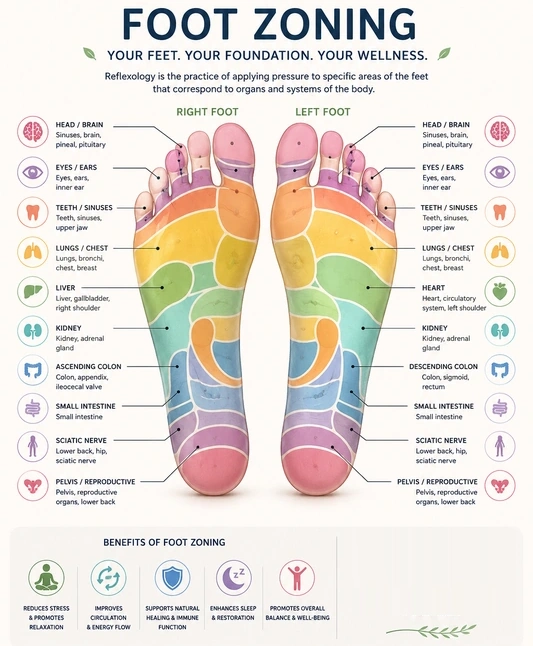
Reflexology includes maps for the feet, hands, and ears. These maps indicate what areas correspond to internal organs. By applying pressure to these areas, it’s thought to stimulate the corresponding internal organ.
Reflexologists use these maps to guide their work. Both foot zoning and reflexology differ from other types of pressure therapy, such as traditional Chinese acupressure.
What is foot zoning in comparison to reflexology? Foot zoning is simply reflexology specifically for the foot. Reflexology evolved out of the idea of zone therapy put forth by Dr. William Fitgerald.
And reflexology goes beyond the foot and involves applying pressure on other areas of the body, including the hands and ears.
When you’re receiving foot zone treatment, you are working with a reflexologist.
What Is Foot Zoning Like?

image source: Pixabay
Foot zoning involves applying pressure with the fingers to specific areas of the foot. When you apply pressure to the foot, you are stimulating nerve pathways. The pressure itself feels relieving, especially when you have been on your feet all day.
As a sensory experience, it can feel quite nice. There are no negative side-effects or dangers in trying foot zoning. And now you may be wondering, what is foot zoning meant to do for you?
What is foot zoning used for?

image source: Pixabay
Foot zoning is a type of complementary medicine. Over the years, medical practices have become more accepting of alternative medicine. Nurses, midwives, and doctors are integrating alternative treatments into their practices.
The goal of adopting reflexology is to improve the well-being of patients. Foot zone therapy is thought to bring about stress relief. It may also help nurses to form a more personal, healing relationship with their patients.
Does foot zoning work?
There are very few scientific studies exploring the effects of these therapies. Scientific studies generally support the belief that reflexology can improve health, but there is no consensus whether areas of the foot are “connected” to various internal organs.
There are currently no descriptions of anatomical structures that correspond to the pathways.
Indeed, medical professionals and scientists have belittled reflexology as quackery.
That attitude is quickly changing as more studies come out of the scientific community. Though, many scientists are still reluctant to embrace complementary medicine for fear of sounding unscientific.
Despite a lack of acceptance of reflexology, some studies indicate that foot reflexology can improve well-being. Scientific studies have found improvements in fatigue, nausea, and anxiety.
Though it is crucial to recognize that scientific studies have found that a regular foot massage can also improve these issues. So, the positive results may have less to do with zone theory and more to do with the healing benefits of touch.
Pampering that begins at your feet and ends at your soul.
The improvement in health ratings may be due to the connection between the patient and the massager. Indeed, many criticize the medical system for not being personal enough. Adding a massage may help patients feel cared for.
Many midwives and nurses are adding foot zone therapies to their practices. It may prove useful. Overall, one cannot conclusively say that foot zone therapy will work to provide whatever relief you’re seeking.
Complementary therapies are meant to enhance the treatment you are receiving from a medical professional.
How does foot zone therapy work?
There are several competing theories on how foot zone therapy and reflexology work. One theory posits that by applying pressure to the foot, you are sending signals to the central nervous system.
When the nervous system receives those signals, it adjusts bodily tension to relieve stress. Reflexology may reduce pain by reducing emotional and cognitive stress that amplifies pain signals.
Other theories rely on the belief that the internal organs can be accessed by applying pressure to certain areas.
You could, for example, stimulate your liver or stomach. These theories have yet to be scientifically verified. They mostly rely on anecdotal evidence by practitioners and patients.
Is Foot Zone Therapy Worth a Try?
It could be worth trying, but you cannot rely on foot zone therapy as your only treatment option. Complementary therapies give you opportunities to explore beyond the conventional medical system.
What is foot zoning for? It’s for expanding your treatment options. It may be worth a try if you want something new to improve your health. Similarly, it may be worth a try if you feel your traditional treatment could use a boost from alternative therapies.
It’s crucial to recognize that foot zoning treatment is yet to be fully explored by scientists. For these reasons, health insurance plans do not cover foot zoning.
If you’re not willing to take the risk of being disappointed, it might not be for you. It’s simply not meant to treat severe mental or physical conditions.
When our feet hurt, we hurt all over. – Socrates
Regardless of the effectiveness, it may be stress-relieving to try applying pressure to your foot yourself. If you’re interested in learning more about foot zone therapy and reflexology, you can find books to understand the topic in more depth. Furthermore, you can use a map of the ear, hands, or feet to apply pressure yourself.
If you enjoy foot massages and want to learn a little more about the theories of reflexology, foot zone therapy may be worth a try.
Do you or someone you know have any experience with foot zone therapy or reflexology in general? Let us know in the comments below how this therapy worked for you.
See also: Get Baby Soft Feet In No Time With These Easy Methods >
Foot Zoning FAQs
If you’ve ever wondered about Foot Zoning, you are definitely not alone! I remember hearing about it for the first time and wondering what it actually involved, whether it would hurt, and if it could really help me feel better. The more I learned, the more I became enthralled.
Whether you are considering your first appointment or simply want to know what the fuss is all about with Foot Zoning, I have answered some of the most frequently asked questions to help you feel informed and confident.
1. What is Foot Zoning?
Foot zoning is a term that is used to describe the way we use our feet. It refers to the different areas of the foot and the way they are used to control movement.
For example, the front of the foot is used to push off the ground, while the back of the foot is used to control balance.
Foot Zoning is a holistic wellness system where specific gentle pressure is applied to specific areas of the feet. The idea is that these areas relate to different parts and systems of the body.
This is to promote relaxation, encourage balance throughout the body and support overall wellbeing. For many people, it’s a relaxing and healing experience.
2. Is Reflexology the Same as Foot Zoning?
This is probably one of the questions I get asked most often!
Although Foot Zoning and reflexology are working on the feet, they are two different practices. Foot Zoning has its own techniques, patterns and philosophy.
When working with Foot Zoning, the practitioner works through specific pathways across the feet, rather than focusing on individual reflex points.
Both are different therapies but both are focused on relaxation and wellbeing.
3. What is a Foot Zoning Session?
Sessions are peaceful and relaxing on average. I usually take off my shoes and socks before getting comfortable on a treatment couch or chair.
The practitioner uses a series of precise finger and thumb movements, gently working up and down each foot.
In the session I can just relax, close my eyes if I want to and have some quiet time.
Many of the sessions are somewhere between 45 and 90 minutes, depending on the practitioner and treatment plan.
4. Is foot zoning painful?
Foot Zoning is comfortable and most people find it deeply relaxing.
There can be times when certain areas of the feet may feel a little tender or sensitive, but this is usually only temporary. Everyone responds differently to treatment and practitioners generally adjust the pressure to make sure you are as comfortable as possible.
5. What Does Foot Zoning Feel Like?
For me, it feels calming and soothing.
Some people experience warm feet, tingling sensations or a feeling of deep relaxation. Others just enjoy the peaceful experience of taking time out of a busy day.
Every session is a little different.
6. What could be the advantages of foot zoning?
Many people choose Foot Zoning just because they love how relaxed and refreshed they feel afterwards.
People often find benefits such as:
Feeling very relaxed
Less stress, less tension
Enhanced feeling of wellbeing
Better sleep quality
More feelings of balance and calm
Self-care scheduled time
Everyone’s experience is different. Foot Zoning should be considered a complementary wellness therapy, not a medical cure.
7. Can Foot Zoning Cure Medical Conditions?
No. Foot Zoning is not intended to diagnose, treat, cure or prevent any medical condition.
Many people find that it supports their overall wellbeing and relaxation, but it’s important to continue following advice from your GP or healthcare professional for any medical concerns.
8. Number of Required Sessions
There is no single answer that will fit everyone.
Some people come once just to de-stress, others make it a regular appointment on their self-care routine. Your practitioner may recommend a course of treatment based on your individual wellness goals.
9. Who can have foot zoning?
Most healthy adults can benefit from Foot Zoning.
But it’s important to let your practitioner know if you’re pregnant, have diabetes, circulatory problems, recent injuries, infections affecting the feet or any other health conditions.
This way they know if treatment is appropriate or if changes need to be made.
10. Do I need to prepare for my appointment?
Preparation is easy.
I like to wear comfortable clothes and make sure my feet are clean before I get there. It’s also nice to arrive a few minutes early so you have time to settle in and take a few deep breaths before the session begins.
11. What to do after the session?
After treatment I generally have a quiet rest of the day, if possible.
A lot of practitioners suggest:
Drink plenty of water
Listening to your body
If you feel tired, have a rest.
Don’t drink too much alcohol at once.
Continue with your healthy habits as normal
12. Is Foot Zoning Scientifically Sound?
Research on Foot Zoning in particular is scarce at this time.
While many people report positive personal experiences, more high quality scientific research is needed to confirm its effectiveness.
Foot Zoning is a complementary wellness practice that may support relaxation and overall wellbeing and is not an evidence-based medical treatment.
13. Can I Combine Foot Zoning with Other Wellness Treatments?
Certainly. Many people like to combine Foot Zoning with massage, facials, yoga, meditation or other complementary therapies as part of a balanced self-care regime.
Always tell your practitioners about any treatments you are receiving so they can give you the most appropriate care.
14. Is Foot Zoning For Me?
If you are looking for a gentle relaxing therapy that encourages you to slow down and prioritise your wellbeing then Foot Zoning could be worth exploring.
Each person’s experience is unique, but in today’s fast-paced world many people enjoy the opportunity to unwind, de-stress and reconnect with themselves.
Final Thoughts
I think one of the best things about Foot Zoning is that it gives you dedicated time to stop, relax and focus on self-care.
It is not a replacement for medical treatment, but many people find it a valuable addition to their overall wellness routine.
And if you’re curious, don’t be afraid to ask questions before you book your first appointment.
A qualified practitioner will be happy to explain the process and help you decide if Foot Zoning is a good fit for your individual needs.
Sometimes, we just need to take that first step towards relaxation.