When I first heard about snake venom skincare, I’ll admit that my mind went straight to a jar of face cream containing actual venom. It sounds slightly terrifying — and exactly like the sort of beauty trend designed to grab attention.
Thankfully, that isn’t really what we’re talking about.
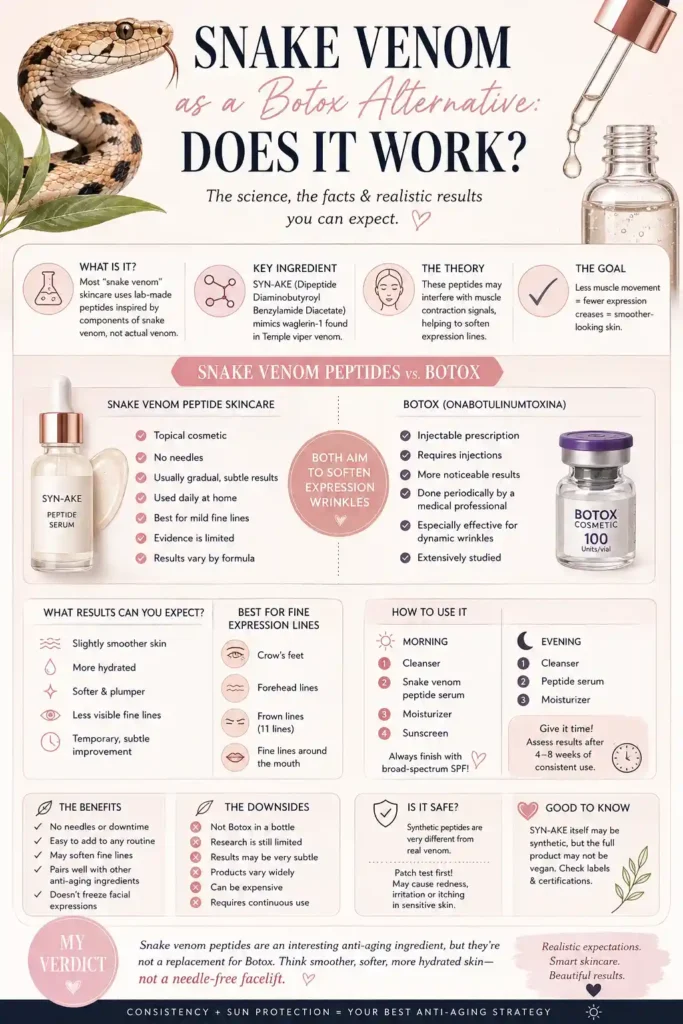
Most so-called snake venom creams don’t contain venom squeezed from a snake. Instead, they use lab-made peptides inspired by certain components of snake venom, particularly peptides that can interfere with signals involved in muscle contraction. One of the best-known ingredients is SYN-AKE, also known as dipeptide diaminobutyroyl benzylamide diacetate.
And this is where the Botox comparisons begin.
Botox temporarily reduces wrinkles by preventing specific facial muscles from contracting as strongly. Snake venom-inspired peptides are marketed as producing a somewhat similar relaxing effect — except they’re simply applied to the skin.
It sounds brilliant. No needles, no appointment and no frozen forehead.
But can a face cream really compete with Botox?
The short answer is: probably not — although these peptides may still have some interesting cosmetic benefits.
See also: Cosmetic Procedures: Our Complete Guide
View more Skin Care Tips >
What Is Snake Venom Skincare?
The name is definitely more dramatic than the reality.
Most anti-aging products marketed as containing “snake venom” actually contain a synthetic peptide designed to mimic part of a naturally occurring snake venom molecule.
One of the most common is SYN-AKE.
Researchers developed SYN-AKE to imitate the activity of waglerin-1, a peptide found in the venom of the Temple viper (Tropidolaemus wagleri). Research literature describes SYN-AKE as a peptide mimic rather than actual snake venom.
Waglerin peptides affect receptors involved in communication between nerves and muscles. This biological effect is what inspired their use in cosmetic formulations.
So when a beauty product says “snake venom cream,” you’re normally getting something considerably less exotic than the packaging suggests.
In simple terms:
Real snake venom: a complicated mixture of biologically active substances produced by snakes.
Snake venom skincare: usually a laboratory-created peptide inspired by one tiny component of venom.
That’s quite an important distinction.
How Is It Supposed to Work?
Every time I smile, squint, frown or raise my eyebrows, the muscles underneath my skin contract.
Do this thousands of times over many years and certain creases eventually become more noticeable. These are what dermatologists often call dynamic or expression wrinkles.
Think:
Crow’s feet
Forehead lines
Frown lines between the eyebrows
Fine lines around the mouth
SYN-AKE is designed to interact with pathways involved in muscle contraction. Scientific reviews describe it as an acetylcholine receptor antagonist inspired by waglerin-1.
The theory is straightforward.
Less muscle movement = fewer expression creases = smoother-looking skin.
That immediately sounds similar to Botox.
But there’s a major difference.
Snake Venom Peptides vs. Botox
Botox isn’t a cream.
Botox Cosmetic contains onabotulinumtoxinA, a botulinum toxin preparation that is injected directly into selected muscles. It blocks acetylcholine release at the neuromuscular junction, temporarily reducing muscle contraction.
That’s why its effect can be quite dramatic.
The FDA has approved botulinum toxin products for certain facial wrinkles, and the American Academy of Dermatology lists botulinum toxin among established treatments for wrinkles.
A snake venom-inspired peptide cream has a much tougher job.
It has to:
Survive inside a cosmetic formulation.
Penetrate the skin sufficiently.
Reach the area where it can have a biological effect.
Remain active at a high enough concentration to make a visible difference.
That’s very different from placing medication directly into a muscle with a needle.
So despite the nickname “Botox in a bottle,” I wouldn’t consider the two treatments equivalent.
Does SYN-AKE Actually Work?
This is where things become interesting.
There is scientific support for the biological concept behind SYN-AKE. Research confirms that it was developed as a synthetic peptide mimicking waglerin, and scientific reviews continue to discuss its potential use in anti-wrinkle cosmetics.
Some studies and cosmetic research have also reported improvements in wrinkle appearance following topical use.
A 2025 scientific review of peptides used in skincare describes SYN-AKE as capable of reducing facial muscle movement and potentially improving expression wrinkles.
However, there’s an important catch.
The evidence behind topical snake venom peptides is nowhere near as extensive or convincing as the clinical evidence supporting injectable botulinum toxin.
Some of the research is laboratory based, some evaluates mechanisms rather than real-world wrinkle reduction, and much of the cosmetic evidence involves relatively small studies or ingredient formulations rather than huge independent clinical trials.
A 2024 study examining SYN-AKE, for example, reported promising anti-aging properties, but much of the work involved computational and laboratory approaches rather than demonstrating that a drugstore serum produces Botox-like results in large numbers of people.
That’s why I think the best way to look at snake venom skincare is:
Interesting anti-aging peptide? Yes.
Proven topical replacement for Botox? No.
What Results Can I Realistically Expect?
If a good snake venom peptide serum agrees with your skin, the improvements you’re more likely to notice are subtle.
Your skin may appear:
Slightly smoother
More hydrated
Softer
A little plumper
Less creased around fine expression lines
Temporarily more refined
And remember that the peptide often isn’t working alone.
Many anti-aging serums also contain ingredients such as:
Hyaluronic acid
Glycerin
Niacinamide
Other peptides
Ceramides
Antioxidants
These ingredients can improve hydration and temporarily plump the skin, which itself makes wrinkles look softer.
So when someone sees impressive results from a “snake venom serum,” it can be difficult to say how much came from SYN-AKE specifically and how much came from the rest of the formula.
Will It Freeze My Face?
No.
This is another misconception I see surrounding these products.
You’re not going to apply a snake venom peptide serum before bed and wake up unable to move your eyebrows.
Cosmetic peptides applied topically simply don’t work in the same way, at the same strength or at the same depth as injected botulinum toxin.
If they did genuinely paralyze facial muscles to anything approaching Botox levels, they wouldn’t be ordinary anti-aging cosmetics sitting on beauty shelves.
So if you’re worried about developing a motionless forehead from your moisturizer, that’s not what you should expect.
How Quickly Does It Work?
Don’t expect overnight transformation.
Some cosmetic formulations may provide an immediate smoothing effect simply because they moisturize and plump dehydrated skin.
Any benefits attributable specifically to peptides are more realistically something I would assess after several weeks of regular use.
Many skincare studies involving peptides evaluate results after approximately four weeks or longer rather than after a couple of applications.
I’d photograph my skin before starting and compare it again after roughly four to eight weeks.
Use the same:
Lighting
Camera
Distance
Facial expression
Otherwise, it’s incredibly easy to convince yourself that something has worked when you’ve simply taken a more flattering photograph.
What Types of Wrinkles Might Benefit Most?
Snake venom-inspired peptide products make the most sense for fine expression lines rather than deep structural wrinkles.
I’d expect any potential benefit to be most noticeable around areas such as:
Crow’s Feet
These develop largely because of repeated movement around the eyes.
Forehead Lines
Repeatedly raising the eyebrows gradually contributes to horizontal forehead lines.
Frown Lines
The vertical lines between the eyebrows are strongly influenced by muscle activity.
Fine Lines Around the Mouth
Movement contributes here too, although aging, collagen loss and sun exposure also play significant roles.
Deep wrinkles caused by substantial collagen loss, skin laxity or photoaging are much less likely to respond dramatically to a topical peptide.
Snake Venom Serum vs. Botox: Which Works Better?
For wrinkle reduction, Botox is far more predictable and powerful.
That’s not particularly surprising.
Botulinum toxin is injected directly into carefully selected muscles specifically to reduce their activity. The American Academy of Dermatology describes botulinum toxin therapy as a treatment dermatologists use to soften signs of aging including frown lines and crow’s feet.
Snake venom serum sits on top of your skin.
They’re simply not comparable delivery systems.
Here’s how I would think about the two:
Snake Venom Peptide Skincare |
Botox |
|---|---|
Topical cosmetic |
Injectable prescription treatment |
No needles |
Requires injections |
Usually gradual, subtle results |
More noticeable wrinkle reduction |
Used regularly at home |
Performed periodically by a qualified medical professional |
Mainly suitable for mild fine lines |
Particularly effective for dynamic wrinkles |
Evidence is relatively limited |
Extensively studied |
Results depend heavily on formulation |
More predictable results |
If you absolutely don’t want injections, a peptide product may be worth experimenting with.
But I wouldn’t buy one expecting Botox results.
What Are the Benefits of Snake Venom?
There are several reasons I can understand the appeal.
1. No Needles
This is easily the biggest attraction.
Some people simply don’t want injectable cosmetic procedures, whether that’s because of cost, discomfort or personal preference.
2. Easy to Add to a Routine
A serum takes seconds to apply.
There’s no appointment and no recovery period.
3. It May Improve Fine Lines
Although I wouldn’t expect miracles, peptide-based skincare may make fine wrinkles look somewhat softer.
4. Peptides Can Complement Other Anti-Aging Ingredients
The American Academy of Dermatology notes that peptides can be useful skincare ingredients and discusses them alongside ingredients such as retinoids in anti-aging care.
5. It Doesn’t Dramatically Alter Facial Movement
Some people like the results of Botox but don’t particularly like the idea of deliberately reducing muscle movement.
A topical peptide provides a much gentler option.
What Are the Downsides?
This is where I’d temper expectations.
1. It’s Not Really Botox in a Bottle
This phrase is excellent marketing.
It’s not particularly useful scientifically.
The mechanism, delivery method and strength are completely different.
2. Research Is Still Limited
There are studies supporting the idea behind SYN-AKE and other cosmetic peptides, but the evidence isn’t remotely comparable with decades of clinical research into botulinum toxin.
3. Products Vary Enormously
Two products containing SYN-AKE won’t necessarily perform identically.
Concentration, formulation, stability, packaging and accompanying ingredients all matter.
4. Some Products Are Expensive
Once a cream is marketed with words such as venom, neuropeptide and Botox alternative, the price can climb very quickly.
Don’t assume the £150 version is automatically better than a £25 peptide serum.
5. Results May Be Very Subtle
If you’ve got deep forehead creases and you’re expecting them to disappear, you’ll probably be disappointed.
Is Snake Venom Skincare Safe?
For most people, properly formulated cosmetic products containing synthetic snake venom-inspired peptides are very different from exposure to actual snake venom.
Still, any skincare ingredient can potentially cause:
Redness
Irritation
Itching
Burning
Contact dermatitis
I’d always patch-test a new product before putting it all over my face, particularly if my skin were sensitive or reactive.
I would also avoid applying a new peptide serum immediately after aggressive treatments that compromise the skin barrier, such as strong chemical peels or certain laser procedures, unless a skincare professional advised otherwise.
And if you have a known allergy, significant skin disease or you’re receiving dermatological treatment, discussing new active skincare with your dermatologist makes sense.
Is Snake Venom Cream Vegan?
This is a surprisingly complicated question.
If the product contains synthetically manufactured SYN-AKE, the peptide itself may not be directly harvested from snakes.
However, that doesn’t automatically make the finished product vegan.
Other ingredients could be animal-derived, and the company’s manufacturing or testing policies may not meet every definition of vegan or cruelty-free.
If that’s important to you, check the manufacturer’s certification rather than assuming that “synthetic snake venom” equals vegan.
How Should I Use a Snake Venom Serum?
I’d generally use it like any other peptide serum.
A simple routine could look like this:
Morning
Gentle cleanser
Snake venom peptide serum
Moisturizer
Broad-spectrum sunscreen
Evening
Cleanser
Peptide serum
Moisturizer
Follow the instructions for your particular product because formulas vary.
And don’t forget sunscreen.
It isn’t nearly as exciting as snake venom, but preventing UV damage is one of the most useful things you can do for aging skin.
The American Academy of Dermatology specifically emphasizes sun protection as part of preventing premature skin aging and treating sun-damaged skin.
What Ingredients Work Better for Wrinkles?
If wrinkle reduction is my main aim, I wouldn’t build my entire skincare routine around snake venom peptides.
I’d see them as an optional extra.
The foundations I’d prioritize are:
Sunscreen
Daily sun protection helps prevent UV-related collagen breakdown and premature aging.
Retinoids or Retinol
Retinoids have considerably stronger evidence behind them for improving photoaging and fine wrinkles.
Moisturizer
Simple hydration can make fine wrinkles significantly less noticeable.
Peptides
These can be an interesting supporting ingredient, particularly if you enjoy peptide-based skincare.
Then, if I wanted a larger improvement in expression wrinkles, I’d speak to a board-certified dermatologist about professional treatment options.
The AAD lists treatments including prescription retinoids, botulinum toxin, fillers, chemical peels, microdermabrasion and laser resurfacing for various signs of aging and sun damage.
Pros and Cons of Snake Venom Skincare
Pros
No injections
Easy to use at home
Little or no downtime
May soften the appearance of fine expression lines
Can be combined with a wider anti-aging routine
Synthetic versions don’t normally contain actual snake venom
May suit people who don’t want Botox
Cons
Doesn’t replicate Botox results
Clinical evidence remains limited
Results may be subtle
Premium formulations can be expensive
Effectiveness varies between products
Marketing claims can greatly exceed the science
Requires continuous use
Who Might Like It?
I think snake venom peptide skincare makes the most sense for someone who:
Has early fine lines
Likes peptide serums
Doesn’t want injections
Has realistic expectations
Wants another anti-aging ingredient to add to an established routine
It makes considerably less sense if you have deep expression lines and expect a serum to produce the dramatic before-and-after results you may have seen from injectable treatments.
Frequently Asked Questions
1. Is there actual snake venom in snake venom cream?
Usually, no.
Most products marketed this way use synthetic peptides inspired by molecules found in snake venom, particularly waglerin-derived peptide mimics such as SYN-AKE.
Always check the ingredient list for the particular product you’re considering.
2. What should I look for on the ingredient list?
SYN-AKE may appear under the cosmetic ingredient name dipeptide diaminobutyroyl benzylamide diacetate.
You may also see manufacturers advertising “snake venom peptide,” “viper peptide” or similar terminology.
3. Is SYN-AKE the same thing as Botox?
No.
SYN-AKE is a synthetic cosmetic peptide. Botox Cosmetic contains onabotulinumtoxinA and is an injectable medication.
They’re completely different substances.
4. Can snake venom cream remove deep wrinkles?
Probably not.
It may make mild lines look softer, particularly if the product also hydrates the skin, but deep wrinkles generally require more powerful treatments for a dramatic improvement.
5. Can I use SYN-AKE with retinol?
Many peptide serums can fit into a routine containing retinol, although compatibility depends on the complete formulation.
If your skin becomes irritated, I’d simplify the routine and introduce active ingredients separately.
6. Can I use it around my eyes?
Only if the manufacturer states that the product is suitable for the eye area.
Don’t put a facial serum directly into the eyes or too close to the lash line unless it’s specifically formulated for that purpose.
7. How long do results last?
A topical cosmetic won’t give you a permanent change.
Any benefit will generally depend on continued use.
8. Is it better than Argireline?
Both SYN-AKE and acetyl hexapeptide-8, better known as Argireline, are marketed as topical peptides targeting expression wrinkles.
Neither should be viewed as an equivalent replacement for Botox.
Which works better will also depend heavily on the formulation rather than simply which peptide appears on the label.
My Verdict: Does Snake Venom Work as a Botox Alternative?
I find the science behind snake venom-inspired skincare genuinely fascinating.
The concept isn’t complete nonsense. SYN-AKE and similar ingredients were developed from legitimate research into venom-derived peptides, and there’s enough scientific interest in these compounds to make them considerably more than a beauty-industry fairy tale.
But calling snake venom cream a Botox alternative stretches things too far.
Botox is injected directly into muscle and has a well-established ability to temporarily reduce selected facial muscle activity. Snake venom-inspired peptides are topical cosmetic ingredients whose effects are considerably more modest.
So would I try one?
Yes, if I found a reasonably priced, well-formulated serum and wanted another peptide in my anti-aging routine.
Would I pay a fortune because the bottle promises “Botox-like” results?
Probably not.
Think smoother-looking skin and potentially softer fine lines, rather than a needle-free facelift.
And that’s still a perfectly respectable result from a bottle of face serum.
Resources
National Institutes of Health / PubMed – SYN-AKE Research
A 2024 study examining the anti-aging potential and safety profile of the synthetic SYN-AKE peptide. It supports explaining that SYN-AKE is a lab-made cosmetic peptide rather than actual snake venom.
https://pubmed.ncbi.nlm.nih.gov/37349941/
American Academy of Dermatology – Botulinum Toxin Therapy
Excellent for comparing snake venom peptide creams with real Botox. The AAD explains how botulinum toxin injections temporarily relax targeted facial muscles and reduce wrinkles such as crow’s feet and frown lines.
https://www.aad.org/public/cosmetic/wrinkles/botulinum-toxin-overview
National Institutes of Health / PubMed Central – Cosmetic Anti-Aging Peptides
A useful scientific review covering SYN-AKE specifically. It describes SYN-AKE as a peptide related to waglerin-1 and discusses its proposed effect on facial muscle movement, while also noting that more research is needed to establish its effectiveness and safety.
https://pmc.ncbi.nlm.nih.gov/articles/PMC11762834/